Malavika Velayanikal · · 5 min read
Why Xiaomi faces a catch-22 situation in India, and what it is doing about it

Tomorrow, Xiaomi’s Redmi 1S will go on sale for the first time in India. The plan is to sell 40,000 units in the flash sale on Flipkart, but well over 200,000 people have already registered for it, Manu Jain, Xiaomi’s India head, told Tech in Asia.
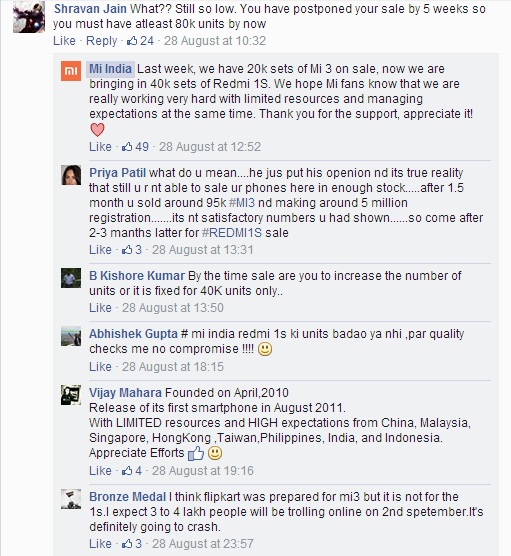
40,000 is not a small number to sell on the first day of sales but eager Mi fans on Xiaomi India’s Facebook page have already started posting their disappointment over the huge gap between the demand and supply.
Mi 3 on hold
India is a very price-conscious market, and understandably, people have been waiting for the disruptive Chinese phone-maker to feed their appetite for value-for-money gadgets. That has put Xiaomi in an unusual predicament.
Last week, Xiaomi sold 20,000 Mi 3 phones in two seconds. It was the sixth such flash sale and about 200,000 people had queued up online for the phone. The disappointed fans who didn’t get the phone were soon complaining on Mi 3 forums online. Soon after, Xiaomi put Mi 3 sales on hold, and Flipkart closed pre-registrations for it.
According to Manu Jain, this suspension was to concentrate on Redmi 1S sales. “Over the next few weeks, we will focus on Redmi 1S, and Mi 3 won’t be available. We will take the final call after a few weeks, once we have more visibility and data points,” Jain told us.
Xiaomi vice president Hugo Barra is in India currently with Jain. At the Redmi 1S launch event in Bangalore, they admitted that the overwhelming reception in India took the hot Chinese phone-maker by surprise. “Over 90,000 Mi 3 were sold in five flash sales since the launch on July 23, well over what the company expected to sell in three months,” Barra said.
Xiaomi forecasts the demand three months in advance, and its suppliers in China work along that cycle. So it’s no surprise that the company is struggling to meet the unexpected demand in India. Suspending Mi 3 sales for the time being is the only way out to tide over the device scarcity.
The catch-22 Xiaomi faces in India
Xiaomi runs on an unusual business model. Its phones are sold almost at cost price. In India, Mi 3 is priced at INR 13,999 (US$231), and Redmi 1s at INR 5,999 (US$99). The company spends nothing on ads. An ad-driven market traditionally, smartphone makers in India – from home-grown Micromax to Samsung, Motorola, and the latest Alcatel – have been spending heavily on marketing and advertising to launch new devices. In sharp contrast, Xiaomi counts on word of mouth, social media, and tech bloggers to create buzz and sell its phones.
Almost as soon as Xiaomi India opened its Facebook page, however, its posts went viral. People who had never heard of the company a few months ago rushed to register for the Mi 3 as soon as its top-of-the-line features and price-point were announced. That’s India for you.
But when Xiaomi enters a news market, instead of a blitzkerg, it tests the waters in small increments. That’s part of its long-term strategy. “We are not looking to make profits out of selling our phones. Our phones are just the starting point. We will make our money in the long run from an ecosystem around our devices. Like Amazon who built Kindle, Fire Phone, and invested in technology to boost its core ecommerce. Similarly, our phones are just a means to an end, and not the end,” Barra explained. In fact, Xiaomi thinks of itself as an ecommerce company.
Madder rush for Redmi 1S?





Stay updated on the go with our mobile app.
Get latest insights with smoother, more personalized experience through TIA mobile app.