- Insights This article was written by a TIA community member. Insights pieces undergo the same rigorous editorial process that newsroom-produced articles have.
 Stephen Turban · · 7 min read
Opinion: Asia is becoming the leader in blockchain, but there’s still room to grow
Stephen is a TIA Star Contributor and publishes high-value content that serves the Asian tech community. Read more from TIA Star Contributors here.
After I spoke at a blockchain meetup in New York a few days ago, a friend hurriedly approached me. “Stephen, can we talk?” he whispered. His eyes were bloodshot, and his expression was peculiar. Was that fear? Excitement? Awe at my remarkable speaking abilities?
We moved quickly to a private corner of the room where he beckoned for me to bend down. He typed something into his phone and then flipped it so I could see what it was. “Stephen. What. Is. This?”
I squinted to make out the text. It read, “Meet Virtual Currency Girls, The Cryptocurrency themed J-Pop group.”

Admittedly, masks, maid outfits, and cryptocurrencies make a rather scary combination. / Photo credit: Getty Images
He looked at me searchingly and asked, “Dude, what is happening in Asia?” And then, interestingly, he asked, “If I want to work in blockchain, do I need to move out there?”
Is Asia the center of the blockchain world?
With all the buzz around Asia and blockchain, it’s easy to see why my friend would ask that question. South Korea was the first place to popularize in-person exchanges, China still controls the majority of mining power, and Singapore seems to spit out ICOs more than its citizens spit on the ground. As Patrick Dai (founder of the Asian unicorn Qtum) put it, “Asia is already setting itself up to be a blockchain leader.”
But, is that true? Is Asia the center of the blockchain world (i.e. is it recognized as the driving force for innovation, adoption, and funding)? How do the East and West actually compare in the cryptocurrency and blockchain space?
As I’ve found in my research and experience hosting blockchain events in the US and Asia, Asia leads the West in terms of community, infrastructure, and adoption, but lags behind in technical talent and entrepreneurship.
To be fair, trying to compare Asia and the West is an oversimplification. China’s blockchain ecosystem is remarkably different from Singapore’s, just as Switzerland’s is distinct from the US’s. Trying to lump countries into regions could be naive and, at worst, misleading.
However, I think there is use in contrasting the two regions. As Tech In Asia proves, there is a pan-Asia tech community. And, as research has shown, network effects mean that regional success does matter. In other words, what happens in Singapore does affect China and vice versa.
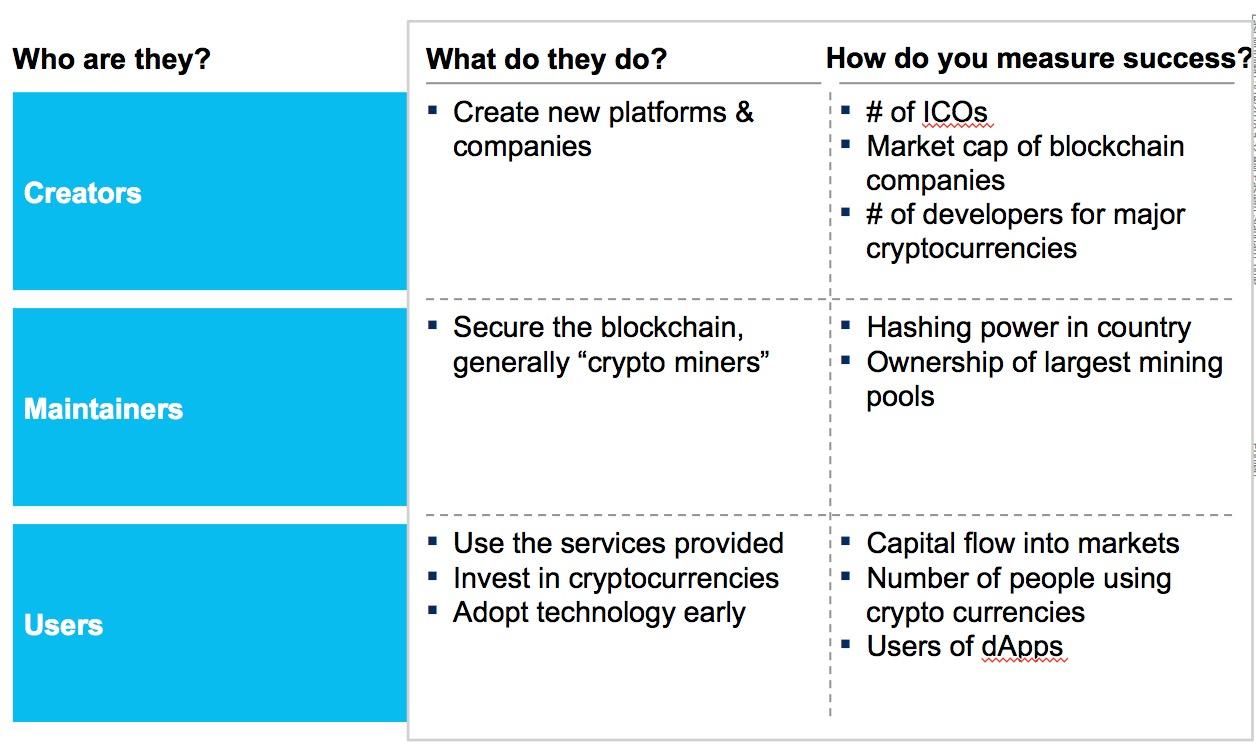
But to compare these two regions, we need a way to measure and quantify success. Below, I’ve proposed a framework to measure success across regions. It’s broken into the three most significant stakeholders in the blockchain community—groups I call “the creators,” “the maintainers,” and “the users.”
How to measure regional dominance in blockchain
The blockchain world is distributed





Stay updated on the go with our mobile app.
Get latest insights with smoother, more personalized experience through TIA mobile app.