- Insights This article was written by a TIA community member. Insights pieces undergo the same rigorous editorial process that newsroom-produced articles have.
 Nicole Cheung · · 5 min read
The viral playbook behind my 1m-user AI apps
You don’t need a pile of VC money to build a successful AI consumer app. I learned that firsthand, twice over.
I co-founded two apps that scaled from zero to more than US$150,000 in monthly recurring revenue (MRR) in less than a year, without spending on ads or raising funds from VCs.
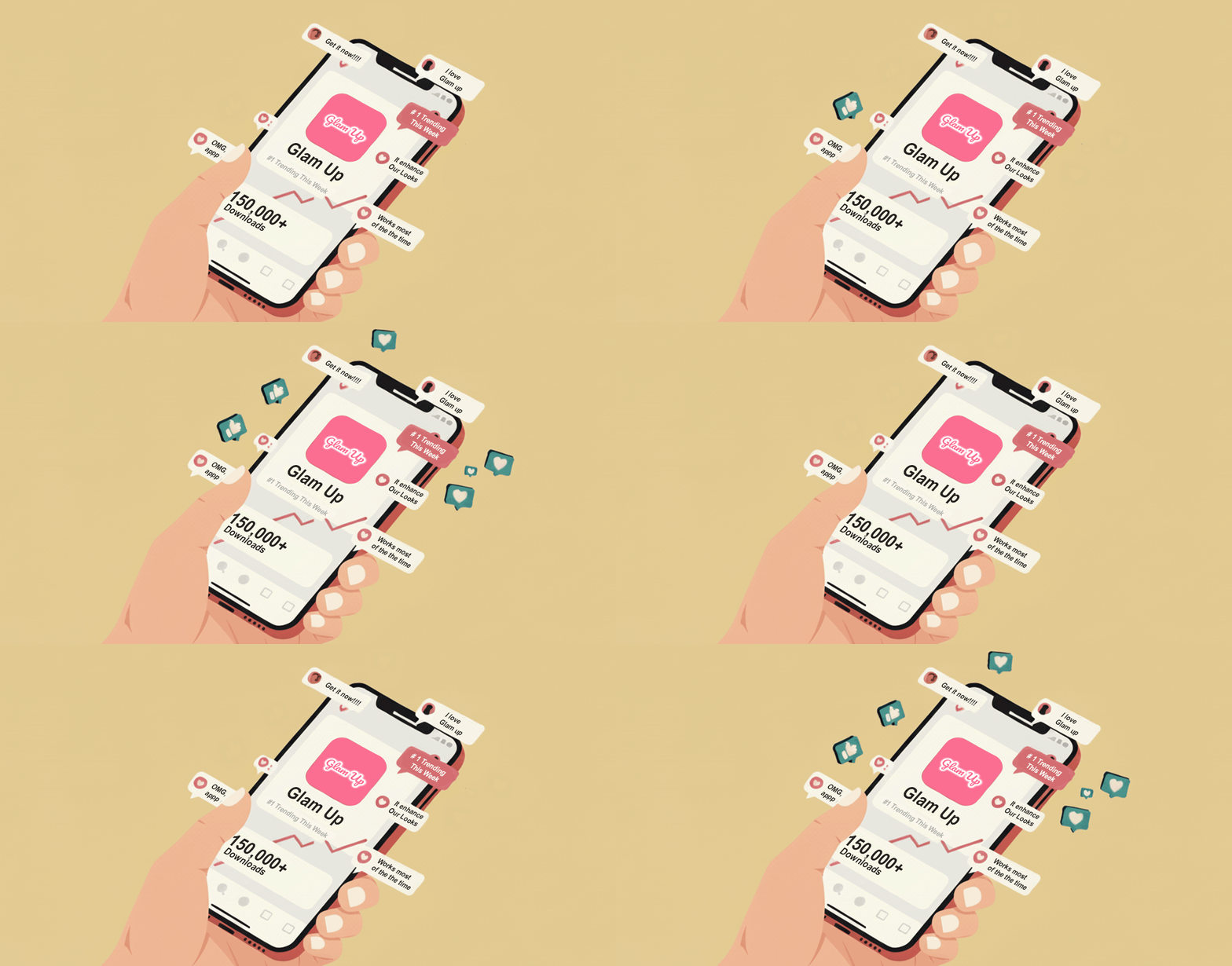
Image credit: Arsal Ysfin
The first was Glam Up, an AI beauty app that hit 1 million users and US$150,000 MRR within six months of launch, eventually ranking third in the US App Store lifestyle category. The second was Sprout (formerly Prep AI), an AI job-application tool that grew to US$250,000 MRR within eight months of launch, powered by over 100 million monthly views across TikTok and Instagram.
These weren’t flukes. Both apps were built on the same playbook: engineer virality into the product, monetize in ways that amplify growth instead of killing it, and distribute through creators rather than ads.
Here’s what worked, what didn’t, and the lessons I learned along the way.
Virality built in
A lot of app developers treat virality as a bonus, something that might happen if people like the product enough. But it can be designed into the app as a requirement.
For both Glam Up and Sprout, the virality breakthrough came via a pay-or-refer system. New users could either pay for a subscription to use the apps’ full features (for Glam Up, a personal AI beauty consultant; for Sprout, automatic job applications) or refer friends to get free access.
Such a setup turns curiosity into distribution. Every viral TikTok post about the apps featured comments with referral codes.
The more people commented, the more TikTok’s algorithm boosted the videos, creating a self-reinforcing loop of views, installs, and more referrals.
See also: Hard truths from building a startup in the AI boom
This turned virality into paying subscribers, as referrals only unlocked limited use of the apps. If users liked their first taste of the services, they would pay for more.
The choice between subscription and referral was blunt, but we were surprised to find that it didn’t scare people off. The lesson for me was simple: people value what they commit to.
It wasn’t the “friendly” approach that most apps took, but it worked twice, in two very different categories. Sometimes the most effective growth strategy is the one that feels the riskiest.
When to paywall
Distribution on a budget
Always be shipping
Stay ahead in Asia’s tech landscape
This is premium content. Subscribe to read the full story.
This founder built two AI apps to US$150,000 MRR in less than a year without ads or VC money. Here’s the playbook she used to make it happen.
We know this is not ideal. ⌛ Sign up in 20 seconds. Cancel anytime.
Our subscriber community includes professionals from these companies:





Stay updated on the go with our mobile app.
Get latest insights with smoother, more personalized experience through TIA mobile app.