
Photo credit: Michał Huniewicz
Of the 18.2 million developers that exist across the globe, 2.75 million are in India alone. By 2017, this number will nearly double to 5.2 million, pushing the United States’ 4.2 million developers into second place.
With so many options to choose from, how do companies decide who to hire?
This is a tough question to answer, even when applicants are from India’s elite universities. Sachin Gupta, an alumni of IIT-Roorkee, explains that he’s faced the inefficiencies of hiring firsthand.
“Right after graduation, there was this crazy event where companies entered the school to recruit employees,” he reminisces. “They have this model where you set up different days for hiring. Day zero is the first day and it’s the day that companies pick up the best people and offer the best jobs. We had this one friend who was the top of our class and had really great programming talent, and when he went in, we were all like: ‘you’ll definitely get placed on day zero’. We’d say that each day, and he didn’t even get placed until day 7 or 8. It’s not like he was inarticulate or something. It just didn’t make sense.”
As Sachin found, it can be difficult to prove that you’re the best person for a job with just your credentials. This is where HackerEarth comes into play. “Only three out of every twenty guys on our website have a computer science degree,” Sachin explains. “There are people that haven’t even graduated, but if you saw their skills… Microsoft would kill for that sort of talent. People need to broaden their horizons and look at tech talent from a skill perspective and not from a pedigree one.”
Sachin launched the startup with his classmate, Vivek Prakash, in 2011. While it began as just a place for programmers to congregate and discuss ideas, HackerEarth has expanded in several directions. Put simply, it’s an end-to-end solution for developers to create unique and employable identities. They’re provided access to everything from coding tutorials to a job portal. For companies, HackerEarth represents a resource to test potential candidates, host hackathons, and crowdsource ideas.
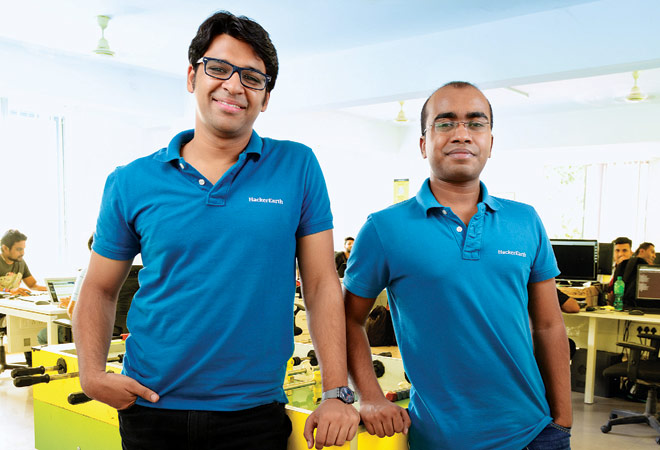
The HackerEarth founders, Sachin Gupta and Vivek Prakash.
From its initial team of two, HackerEarth is now made up of 80 people across three cities, and it claims that over 800,000 developers use its site. “We haven’t spent a single marketing dollar outside of India and have users from Eastern Europe, Russia, Kazakhstan, Southeast Asia, and the United States,” says Sachin. HackerEarth has raised two rounds of funding totaling US$500,000 from Prime Venture Partners and TA Ventures.
“Our first and number one focus is to get people better at coding,” he adds. “If you look at computer science as a skill, the ability to learn it is so easy. All you have to do is go online and study.”
Coders of every color

Photo credit: corinnepw.
Once a developer signs up with the site, they’re introduced to the latest challenges that have been posted. These are usually hosted by large companies or organizations and developers can win money and other prizes. For the companies, it’s a great way to source innovative ideas from the developer community. For developers, it’s a great way to build out their portfolios.
If you’re good at something, never do it for free
Building out a community





Stay updated on the go with our mobile app.
Get latest insights with smoother, more personalized experience through TIA mobile app.