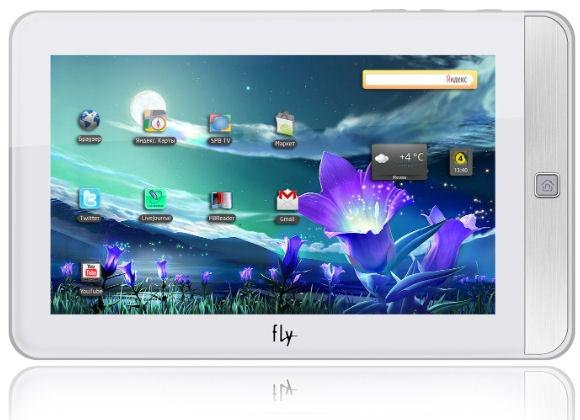
The Indian-made Fly Vision budget tablet - available in white ot black.
While the international market is getting flooded with high-end, high-price tablets, the Indian tech arena is seeing a surge in low-end devices. And of course, the smaller price tag comes at the cost of features. The latest offering in the market is from Fly Mobile, which has launched its Android tablet at US$145, a lot cheaper than even the upcoming Amazon Fire.
The tablet, christened Fly Vision, runs Android; but at a sub-$150 price point, you will have to make do with the outdated Froyo (2.2) version. With its 256MB of RAM, you can’t really expect it to rock Honeycomb (3.x). The tablet comes with a seven-inch LCD touchscreen, which is able to give you a 800 x 480 pixel resolution. Fly Vision packs the low-power 600 MHz Rockchip 2818 processor, which powers many low-end Chinese- and Indian-made slates.
While it has 2GB of SSD storage on board, you can expand that up to 16GB using its micro-SD card slot. The tablet also has a 1.3-megapixel camera and the usual bells and whistles such as a built-in speaker, a 3.5 mm audio jack, and the full range of Google apps. The tablet supports wifi, Bluetooth, and even 3G.
Local tablet makers have been aiming for low prices and a bare minimum feature-set in the Indian market. Barring the ultra low-budget Aakash, which is priced at a subsidized $35 point, this Fly Vision sports the lowest price tag. The other contenders are the Beetel Magiq, which is priced at $199, HCL’s ME X1 tablet at $210, and Reliance’s 3G Tab at $260. Though all these tablets also offer considerably better specs than the Fly Vision.
The speed at which the Indian tech industry is churning out low-price tablets may give the illusion that the segment is thriving in the country. However, most of these companies have refused to provide official sales figures for their products. The freshest figures in this regard come from market research companies. According to CMRI, 85,000 tablets were sold in India in the period between November 2010 and March 2011. While Samsung commanded the sector with 84.7 percent market share and Apple followed with a miniscule 5.9 percent, the remaining 9.4 percent of slate sales was shared among the other tablets. But note that all of the afore-mentioned home-grown tablets were not available at that time.
In the absence of sales figure and other data, it is difficult to gauge the real market performance of these budget tablets. Though, keeping in view their low price tag, we assume that consumers have pretty subdued expectations of them.
[Source: ThinkDigit]





Stay updated on the go with our mobile app.
Get latest insights with smoother, more personalized experience through TIA mobile app.










📅 Upcoming Events
22 October 2026
Payoneer x CSPN Summit 2026