
I once participated in a panel discussion hosted by a distinguished media to discuss innovation in Asia startups. Sitting in the audience were mostly white-collar folks from the corporate world.
My fellow panelist, who dressed in his company T-shirt, jeans and sneakers explained how his company grew. Along with his infectious enthusiasm, he exuberantly answered it in bullet-train speed, effortlessly weaving his sentences with startup jargon. It went something like that, “Our MVP was merely a wireframe we built in a few weeks. We pivoted a couple of times till we finally figured out what our product market fit was. Then our MAU took off. We did a few growth hacks like embedding the share buttons, adding social features, tweaking our onboarding experience…”
While I tried to digest what he was saying, I turned to the audience— looking even more perplexed than me yet still politely nodding their heads, seemingly impressed by his fluency and confidence. I almost chuckled.
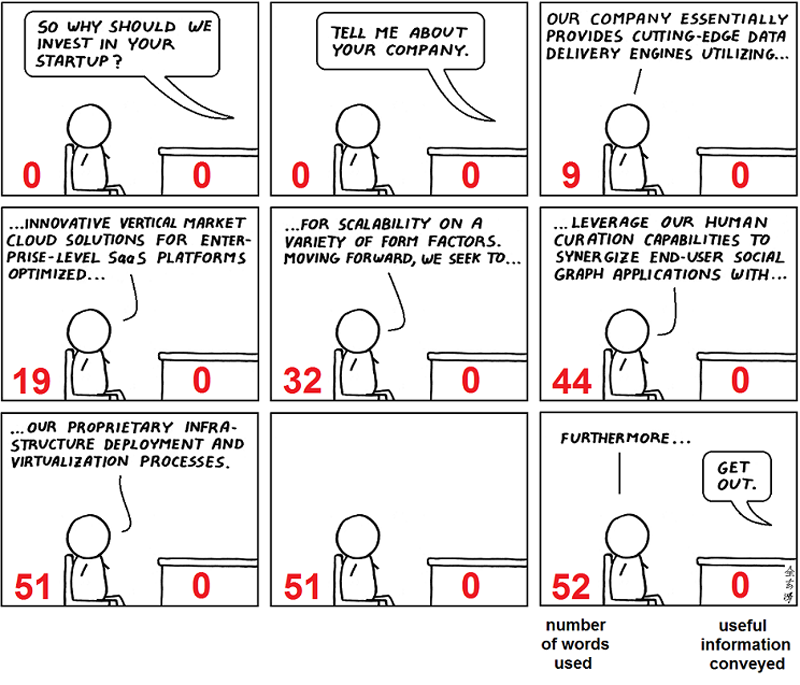
Photo credit: http://comics.ganneff.de/
I almost chuckled not because I was making fun of my fellow founder, but only because I was both an offender and a receiver of such language as well. Having worked in a big conglomerate for years, I know well how corporations and their employees notoriously throw buzzwords and acronyms around. If you want to see where corporate lingo flourish, just read their mission statements or public announcements.
Lucy Kellaway’s podcasts from the Financial Times has been one of the most vocal persons to criticize the use of cryptic jargon in business. She has a whole collection called “Guffipedia”. Just recently, Twitter ex-CEO Dick Costello made the honorable Kellaway’s Guffipedia list by saying,
“As we iterate on the logged-out experience and curate topics, events, moments that unfold on the platform, you should absolutely expect us to deliver those experiences across the total audience and that includes logged in users and users in syndication” — Dick Costello, ex-CEO, Twitter.
Some of you might ask, “What’s wrong with what Costello was saying?” I would suggest you repeat that to your mother and pay attention to her reaction.
Is it ever ok to use jargon?
It is ok that you speak your own language within your group.
Using your own jargon within your group indicates a certain common understanding among the members. It could strengthen bonds and promote camaraderie within the group. It makes communication fast and efficient. I get it — we do that in university clubs, sports teams, military, political parties.
It is somewhat ok to use the jargon of another group within that group. That could show you have taken the effort to do research about the other party — provided that you really did understand the terms, and can use them appropriately.
The original “pivot”





Stay updated on the go with our mobile app.
Get latest insights with smoother, more personalized experience through TIA mobile app.









📅 Upcoming Events
22 October 2026
Payoneer x CSPN Summit 2026