Josh Horwitz · · 4 min read
Fireside chat: How Indonesia’s Picmix grew from zero to 15M users (LIVE BLOG)
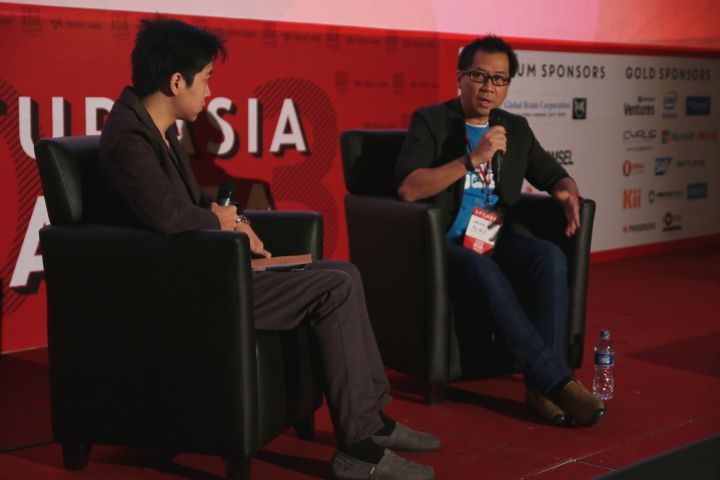
Indonesia is no stranger to PicMix. As one of the country’s bigger social networks, it has garnered 15 million users worldwide and seen over 225 million photos posted, despite being no more than two years old.
On stage, Tech in Asia writer Enricko Lukman is interviewing founder Calvin Kizana on stage, where he will ask Calvin about the history of PicMix, how the app got to where it is, and how PicMix’s monetization strategy has been coming along.
#09:40: Kizana and Luckman take the stage. It’s time for intros. Kizan reached a 15 million user base, and is a social sharing app.
#09:42: Kizana was a heavy Instagram user, but noticed that users liked certain photo features that it didn’t have. He saw opportunity to integrate stickers, frames, and other decorative additions with social sharing.
#09:43: “We keep it simple and listen to our users,” Kizana says.
#09:45: Keeping it simple isn’t just for the Indonesian market. When launching an app, he suggests that developers don’t confuse users. He recalls his first startup, which was a restaurant finding app loaded with social features as well as virtual reality. It won awards, but had no users.
#09:48: Daily active users about 900,000. Monthly active users about 48 percent. “We’re quite happy with that,” says Kizana.
#09:49: Kizana notes that most startups don’t really care about data. He thinks this is a mistake. “Stickiness comes from the data,” he says.
#09:50: Picmix is available on BlackBerry, Android as of six months ago, and Windows Phone as of two months ago. Nokia Asha in the works for next month, and then iOS should be coming out next year.
#09:51: Why did Kizana launch on BlackBerry first? Well, on iOS and Android, they would be competing with hundreds of Instagram-esque photo sharing apps. Meanwhile, on Blackberry, there were very few. “Honestly, we didn’t think too much about it,” says Kizana. “We just launched. We developed for three months, and then two months after we went live we hit one million users, which was faster than Instagram’s growth.”
#09:53: Indonesia makes up 35 percent of the userbase, followed by South Africa and Venezuela. The majority of users are BlackBerry for now, but Kizana expects that Android will be the next platform where the app will see major growth. “We believe that the community we developed on BlackBerry will still be with us when they switch over. Social networks aren’t about platforms. Would you drop Twitter if you switch from Windows Phone to Android?”
#09:55: As for revenue generation, Picmix employs a B2C model selling frames, stickers, and other additions. There’s also a B2B side that works with brands. There are 18 team members.
#09:57: “We just started to monetize this year, so when operational costs are factored in, we’re not entirely covered just yet. But we’re seeing growth in paid members every day.” At the moment, however, Picmix isn’t really looking for revenue, it’s just looking to develop a user base and put its basic business model into practice, Kizana says.
#09:59: Kizana confirms that they’ve received funding of $7 million from a local Indonesian angel investor, which also happened to be one of the largest multi-brand distributors in the country. The angel’s connections provided perks, like pre-installs on Sony Xperia devices.
#10:03: Kizana notes that the company hasn’t spent a single cent on marketing – its virality and growth has been driven purely by word of mouth.
#10:05: Picmix doesn’t have ads yet, but it will soon. However, Kizana wants to incorporate native ads by integrating them into the actual frames. He’ll also implement a “featured feed. We don’t want to annoy users with pop ups,” he says.
#10:07: On internationalization and branding – “The tendency of users in Indonesia is that they’re reluctant to use Indonesian products. I hate that mindset. So we tried to make a market that really looked like it was overseas. We put it all in English, even the advertising. We only revealed publicly that we were an Indonesian product once we hit 10 million users. Before that, we tried to keep quiet. But now that we have 10 million users, we can say to other people, ‘You know, Indonesian products aren’t bad.’”
#10:11: Any tips for the mobile developers here? Kizana encourages developers to focus on building their product by doing research first. “Start small and deliver your message clearly,” he says.
#10:13: And we’ve wrapped up!
Note for live blog readers: Click refresh to keep the updates coming!
This is a part of our coverage of Startup Asia Jakarta 2013, our event running on November 21 and 22. For the rest of our Startup Arena pitches, see here. You can follow along on Twitter at @TechinAsia, and on our Facebook page.
(Editing by Terence Lee)
Stay updated on the go with our mobile app.
Get latest insights with smoother, more personalized experience through TIA mobile app.
Recommended reads
 Indonesian AI startup goes global
 Forrest Li on scaling Sea, building smarter bots, and founder grit
 An AI assistant that joins sales calls and scores team skills
 Beyond the check: Why VCs need more than capital
 SGX’s CEO says it doesn’t need a unicorn to win
 SMEs want AI too, but not the kind Big Tech is selling
 Oatside’s alt-milk rise hits a profitable gear
 Alibaba’s financial health in 12 charts
 Asia’s telcos bundle AI into mobile plans. Will it pay off?
 M-Daq chases bigger clients as revenue falls, losses grow