Goh Ruoxue · · 2 min read
SG minister highlights AI adoption pitfalls in SEA
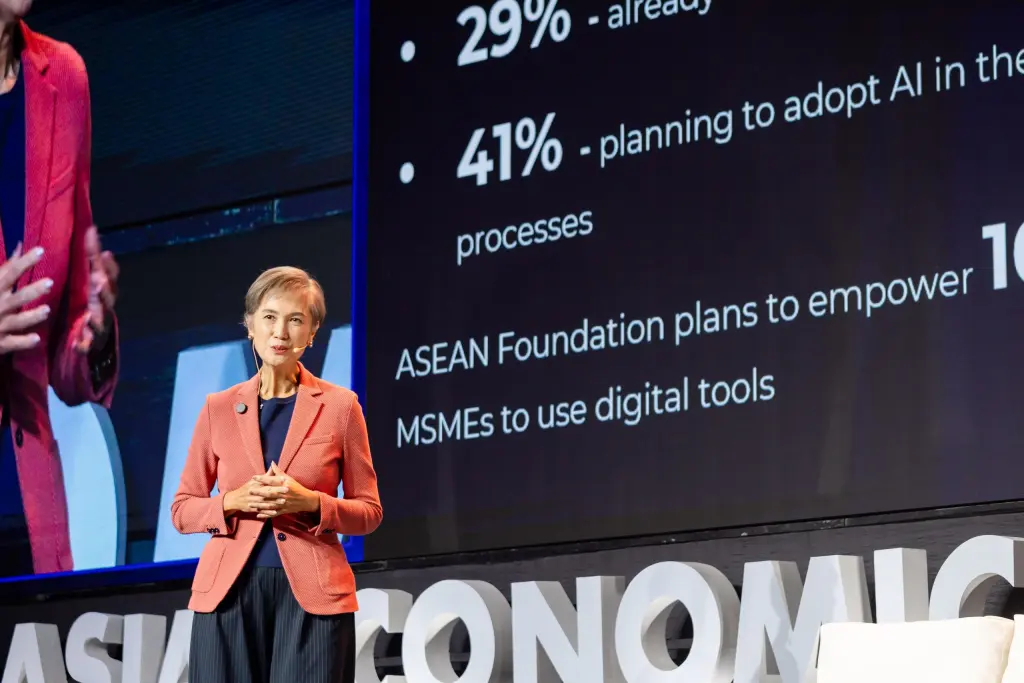
Josephine Teo spoke at the Asia Economic Summit held on June 17 in Jakarta / Photo credit: Tech in Asia
Singapore’s Minister for Digital Development and Information, Josephine Teo, said on June 17 that the city-state would advance several shared AI priorities centered around encouraging better adoption across sectors and investing more in shared digital public goods.
The nation also intends to deepen cross-border data-flow mechanisms and align regional approaches to AI governance, said Teo.
She was speaking at the second edition of the Asia Economic Summit organized by Tech in Asia under the theme “Where Southeast Asia’s economic decisions take shape.”
The day-long meeting for some 250 regional policymakers, business leaders, investors, and tech stakeholders set out to align policy intent with investment priorities and execution pathways in Southeast Asia.
This comes as Singapore assumes the chairmanship of the Association of Southeast Asian Nations in 2027. Teo closed her keynote address on why Southeast Asia is well-positioned to expand AI adoption and the pitfalls the region must avoid.
What could go wrong?
The minister identified two potential pitfalls of AI adoption: data policy and sovereignty.
On data policy, she said that while restrictions are necessary to protect personal and sensitive data or national security, onerous regulations may hamper innovation and businesses.
In particular, small companies without the resources to overcome compliance hurdles would feel the impact.
Teo added that when businesses expand their operations to scale beyond a single territory, the interoperability of data policies becomes possible.
Efforts to help small enterprises thrive include regional initiatives such as the landmark Digital Economy Framework Agreement, which will enact common rules to enable digital trade and support trusted cross-border data flows.
The second pitfall concerns how countries respond to the need for AI sovereignty.
The often narrow framing of this question as one of ownership or a race to claim full possession of the entire AI stack is neither realistic nor helpful for most nations because of cost and supply chain intricacies, said Teo.
The way she sees it, national goals can be framed with three points in mind: the need to use and govern AI for the public good; autonomy to make smart choices on sources, partnerships, and terms; and the anchors that can broaden and deepen AI ecosystems.





Stay updated on the go with our mobile app.
Get latest insights with smoother, more personalized experience through TIA mobile app.