
For the first time ever in 2013, the number of 2G subscribers in the world began its descent, falling three percent to 4.8 billion, according to TeleGeography. Despite this, 2G users continue to account for roughly 70 percent of the world’s 6.8 billion mobile subscribers, many of whom live in rural areas and developing markets and can hardly afford the 2G connections that they have, much less 3G or 4G. And as we all know, the rates charged for phone calls can be extortionately high.
The solution would naturally be to turn to online telephony (VoIP) apps, such as Skype or Viber, to make free online calls. Martin Nygate, the founder and CEO of Singapore-based mobile technology company Gentay Communications, says that there are two huge problems with this.
“First, they aren’t very reliable, especially in a poor cellular network environment. They struggle in congested 3G networks and just don’t work in 2G,” he explains. “Second, you can only call app-to-app for free. App-to-non app calls such as calls to landlines cost money. Telcos have been exploiting this for years by charging high roaming charges.”
The solution? Create an app that allows quality calls to be made even on 2G networks – which is exactly what Nygate set out to do with the creation of mobile VoIP app Nanu:
Whereas apps such as Skype and Viber operate in a high bandwidth environment such as 3G/4G/Wifi, naNanunu uses low bandwidth VoIP technology that allows it to provide quality calls where other apps can’t, including on 2G networks. This means it is truly mobile, and you can use it pretty much anywhere.
Quality is also assured because of the low bandwidth that Nanu requires put together with the team’s network infrastructure. The team has tested Nanu in rural regions with limited connectivity and according to Nygate the “results have been very positive”.
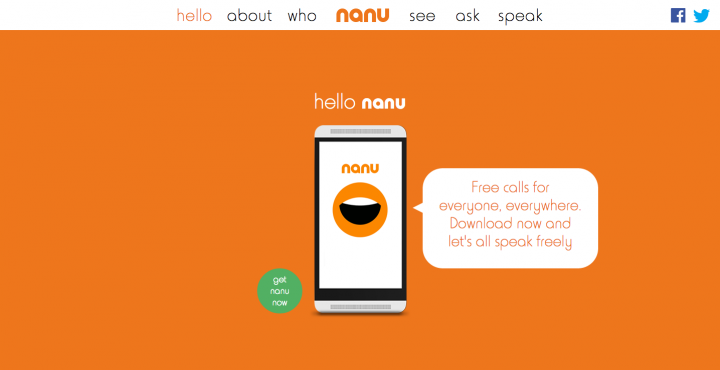
Voice calls made on Nanu are absolutely free, too – even for app-to-non app calls. To make this happen, Nanu inserts an advertisement that plays over the ringtone while you are waiting for a call to be picked up. “The revenue from the ad subsidizes the cost of the call so you can make it completely for free,” says Nygate. He says the ad is designed to be as inconspicuous as possible.
See: Wassup WhatsApp? Viber claims an early lead in Myanmar with 5 million registered users
It began at sea
The founding team comprises of a father-son duo. Nygate and his son, Daniel, were attempting to solve the problem of mariners on vessels at sea not being able to call their families on shore using products like Skype and Viber. VoIP applications such as Skype and Viber were unable to operate via satellite communications systems due to the low bandwidth available.
“Daniel innovated a new approach to reducing the bandwidth required to deliver VoIP calls, resulting in a reduction of bandwidth requirements in comparison to conventional VoIP applications by 80 percent – and the solution was found,” Nygate recalls. The duo quickly realised that there were far wider applications for such technology, and so Nanu was born.
Scaling quickly
Free, but limited





Stay updated on the go with our mobile app.
Get latest insights with smoother, more personalized experience through TIA mobile app.