- Premium Content It takes our newsroom weeks - if not months - to investigate and produce stories for our premium content. You can’t find them anywhere else.
 Vincent Fernando, CFA · · 5 min read
Commentary: Should Sea sell Shopee and focus on Garena?
The full year 2019 financial results recently released by New York-listed Sea Ltd highlights the extreme performance disparity between its online gaming unit Garena and ecommerce business Shopee.
While Garena has become highly profitable, Shopee has been burning a lot of cash. It might be in the Singapore-based Sea’s best interest to divide itself into two companies so that Garena can reach its full potential.
To be clear, Shopee has established a leading position in Southeast Asia’s ecommerce space, and it’s among the top five most downloaded apps in the region according to App Annie. It has also been busy creating revenue: Shopee’s gross merchandise volume (GMV) soared 71% to US$17.6 billion in 2019. Adjusted revenue leapt 224% to US$942 million as the company increasingly monetized its GMV.
 Photo credit: Sea Group
Taken together, this data presents a picture of a thriving business. However, Shopee has also lost US$1 billion in EBITDA on an adjusted basis during the year. The company also earned a negative gross margin, which indicates that it could be subsidizing product sales to obtain market share and boost its revenue.
Going gangbusters
In contrast, the latest financial results highlighted how Garena, Sea’s original video game business that existed before Shopee, is going gangbusters.
Garena’s 2019 revenue jumped 172% to US$1.8 billion, and it generated US$1 billion of EBITDA on an adjusted basis.
This is not only a huge number in absolute terms but also represents a 40% EBITDA profit margin. Should Shopee eventually become profitable, its margins probably won’t come close to Garena’s. Garena is killing it, but it’s essentially fully bankrolling Shopee right now, as implied during the company’s recent earnings call.
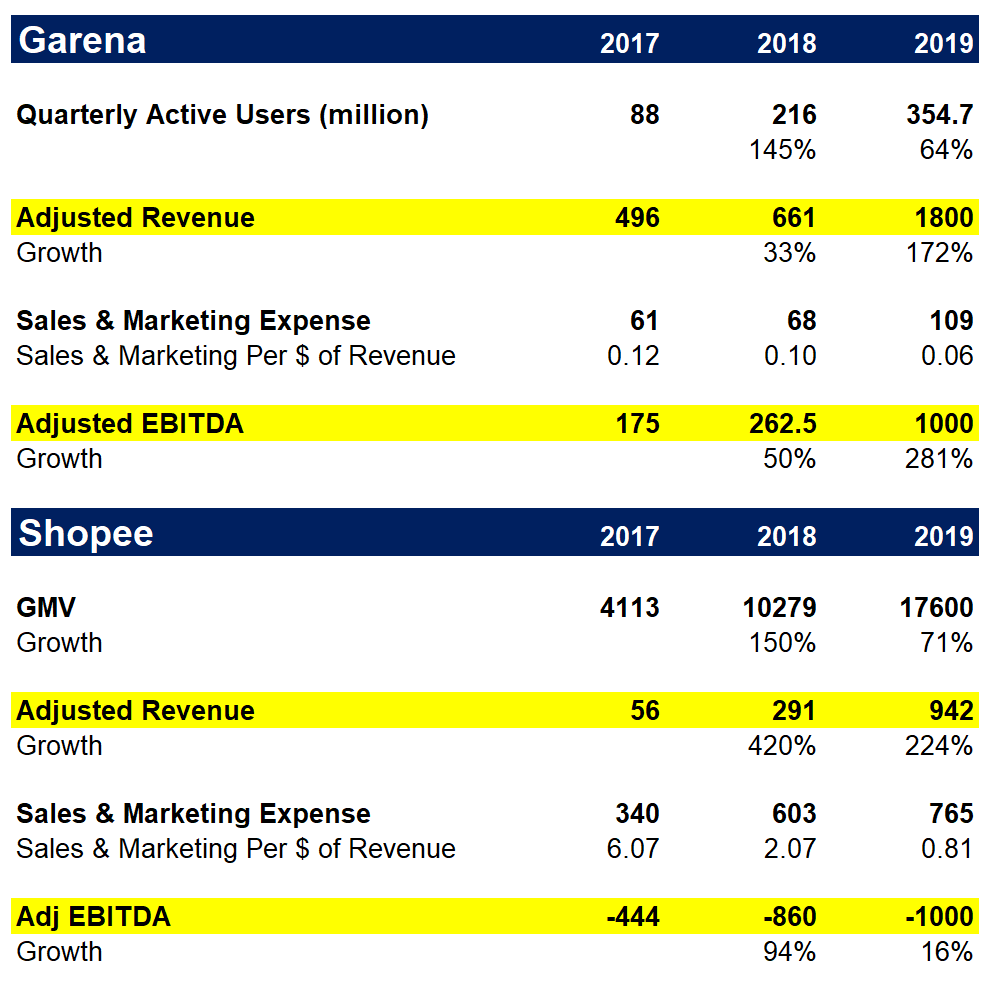
Figures in US million dollars
Sources: Sea, Zero One
Garena’s cash flow should not be financing Shopee. That’s not an optimal allocation of shareholder capital based on the performance of the two businesses.
For example, Shopee reported US$765 million in sales and marketing expenses during 2019 – all to generate US$942 million of revenue and lose US$1 billion of EBITDA. Meanwhile, Garena spent just US$109 million of sales and marketing expenses, and yet it achieved US$1.8 billion of sales and yielded a positive US$1 billion of EBITDA.
Back-of-the-envelope math shows substantially higher returns on capital invested into growing Garena versus Shopee. Tech in Asia reached out to Sea, but it declined to comment on this analysis.
The accepted premise in the ecommerce game is that players usually have to lose a lot of money over many years to eventually gain dominance and win. As such, Shopee’s continuing losses is understandable. Part of Sea’s long-term growth strategy is to leverage its ecommerce business to offer not just payments services but an entire suite of financial services should – assuming it secures a much-coveted digital bank license in Singapore. This would naturally entail more capital investment.
Major moneymaker
Garena surprise
Stay ahead in Asia’s tech landscape
This is premium content. Subscribe to read the full story.
While Garena has become highly profitable, Shopee has been burning a lot of cash. Splitting Sea into two companies is perhaps the best option.
We know this is not ideal. ⌛ Sign up in 20 seconds. Cancel anytime.
Our subscriber community includes professionals from these companies:





Stay updated on the go with our mobile app.
Get latest insights with smoother, more personalized experience through TIA mobile app.








📅 Upcoming Events
22 October 2026
Payoneer x CSPN Summit 2026