- Premium Content It takes our newsroom weeks - if not months - to investigate and produce stories for our premium content. You can’t find them anywhere else.
 Pranav Balakrishnan · · 7 min read
Last to board: why travel may be AI’s final frontier
Ixigo, one of India’s largest online travel agents (OTAs), says its new AI-powered assistant “understands you, assists you, and gets things done for you.” I put her to the test on a recent work trip.
“The Global Fintech Fest is happening in Mumbai,” I told the assistant, Tara, who speaks in an Indian-accented, faintly robotic voice. “I need to attend the first two days, stay close to the venue, and keep the entire trip within 50,000 rupees (US$523).”
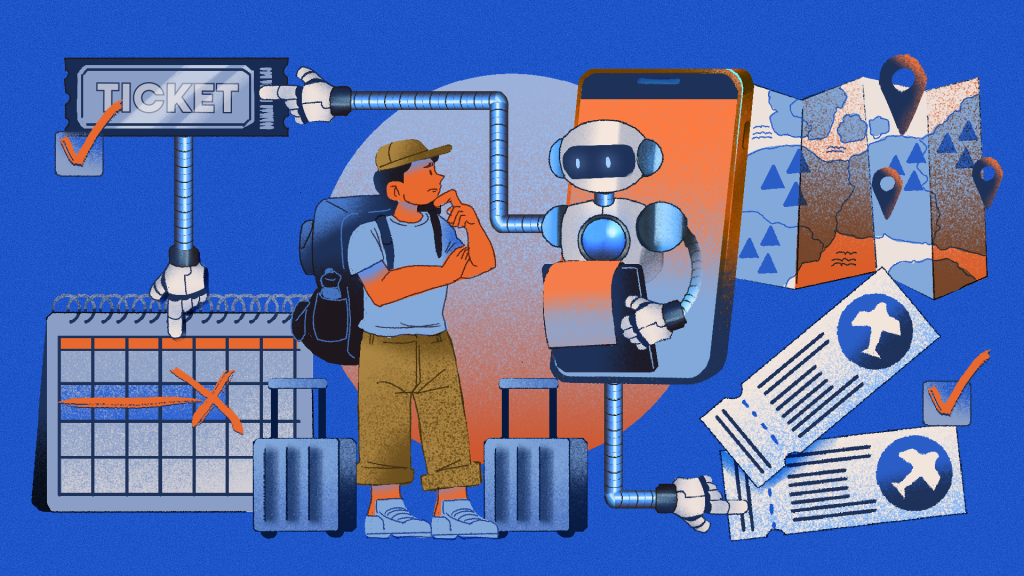
Image credit: Ulla
Spoiler: If I had left the trip entirely to Tara, I wouldn’t have made it out of Bengaluru.
She began by showing me flights a week ahead of the event, which, as much as I like Mumbai, would have given me far more time there than I needed. She then told me to manually select the flight, enter my personal details, choose seats, and pay. Hotels appeared only after I booked the flight, and I had to pay for them separately.
Travel looks particularly well suited to agentic AI: Planning a trip involves comparing options, coordinating bookings, and making decisions that AI agents can handle.
But as my Mumbai trip planning experience showed, a true end-to-end agentic AI booking experience remains a promise. Travel might be an industry where incumbents set the pace of AI adoption instead of being disrupted by it.
See also: Add to bot: how AI agents could reshape online retail
To be fair to Ixigo, I had unrealistic expectations from Tara.
The company isn’t planning wholly agentic discovery and booking for the time being, says co-founder and group co-CEO Rajnish Kumar. He adds that travelers still want to review and approve key decisions, something they have been used to for two decades. This also limits mistakes that could lead to booking the wrong flight or incurring cancellation charges.
Kumar acknowledges that Tara should have found out the dates for the fintech fest and suggested flights. The query failed because Ixigo instead restricted the assistant to specific sources such as Google Places, Google’s database of locations and businesses, and certain travel-related searches on the web.
He says these guardrails keep AI from doing things it isn’t meant to.
“The more tools you give AI, the more non-deterministic it becomes,” Kumar explains. “It might do something you don’t want.”
The many hurdles
International travelers spent a record US$2.02 trillion in 2025, according to the World Travel & Tourism Council. Yet while 90% of travel executives say their organizations use generative AI in some form, only 2% say agentic AI is widely deployed across their businesses, a McKinsey survey found.
The changing market
Reinventing legacy systems
Hybrid model
Disruption, postponed
Stay ahead in Asia’s tech landscape
This is premium content. Subscribe to read the full story.
Travel looks perfect for AI agents. But with legacy systems, volatile fares, fragmented supply, and unfinished payments, it could be AI’s last box to tick.
We know this is not ideal. ⌛ Sign up in 20 seconds. Cancel anytime.
Our subscriber community includes professionals from these companies:





Stay updated on the go with our mobile app.
Get latest insights with smoother, more personalized experience through TIA mobile app.











📅 Upcoming Events
22 October 2026
Payoneer x CSPN Summit 2026