- Premium Content It takes our newsroom weeks - if not months - to investigate and produce stories for our premium content. You can’t find them anywhere else.
 Owen Guo · · 5 min read
Behind the rise of Meituan-Dianping, China’s food-delivery giant
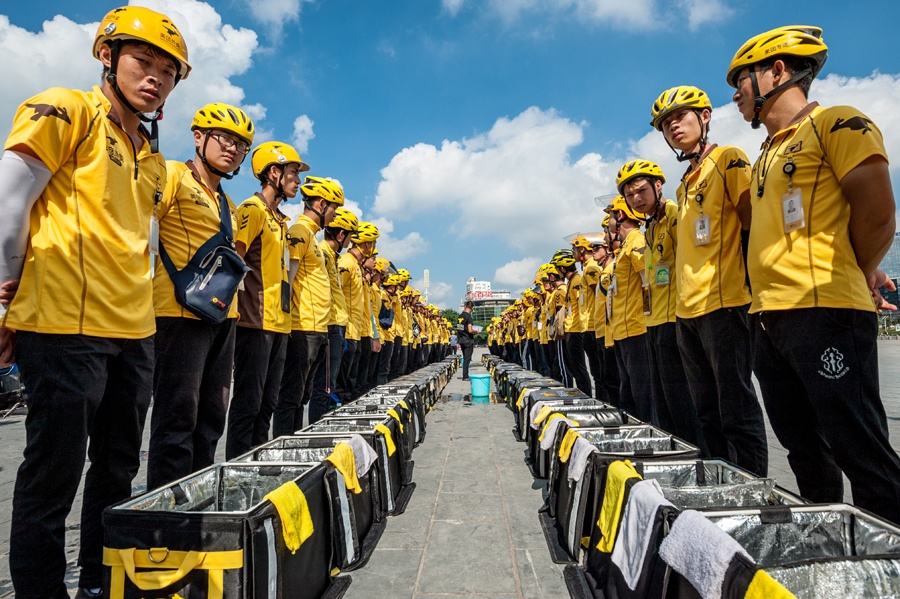
Meituan-Dianping’s delivery staff / Photo credit: Meituan Dianping
This article is an adapted translation of the original story by tech writer Yin Sheng.
Just as what Didi Chuxing did for transportation and Ctrip for travel, Meituan-Dianping has built an ecommerce empire in China centered around dining that could be worth US$60 billion after its initial public offering.
Meituan-Dianping has already eclipsed its American counterparts Groupon and Yelp in market value. But how did it achieve this?
Here’s the problem with Groupon and Yelp: they have failed to build business models that create added value. Varying consumer needs, high costs, and low population density have made it hard for American food-delivery firms to generate consistent revenue.
Meituan-Dianping’s success is partly buoyed by China’s unique characteristics. The country’s population is almost five times that of the US, and its average urban population density is seven times higher. In addition, the relatively low labor cost and the underdeveloped offline services sector have allowed companies like Meituan-Dianping to expand.
How different is it from JD and Alibaba?
Just like JD, Meituan-Dianping relies heavily on a large logistics network, which raises its operational cost. Both firms face stiff competition from their peers. In the long run, Alibaba is likely to emerge as the single biggest challenger to both JD and Meituan-Dianping, potentially driving up the marketing cost for the two Chinese ecommerce giants.
But there’s one thing that sets Meituan-Dianping apart from JD. Because the food-delivery company essentially connects dining businesses with customers, it does not need a physical space to store the goods. As a result, Meituan-Dianping is able to charge a fee to both sides because it gives consumers convenience while allowing businesses to take online orders without added logistical costs.
For JD, it’s a different story. Since it sells mostly standardized products like home appliances, this creates a relatively transparent pricing mechanism that will limit its ability to secure higher commissions and profits.
Meanwhile, products from the services and dining sectors – many of which are owned by small businesses – are far from being standardized. The flexibility allows Meituan-Dianping to charge higher transaction fees. Last year, its revenue booked per yuan of transaction (or monetization rate) stood at 9.5 percent compared to Alibaba’s 3 percent.
Meituan-Dianping’s business model resembles Alibaba’s, but the difference lies in how Alibaba’s profits come from its own manufacturing of products as well as third-party sellers. It doesn’t have to worry too much about when these products are created and if there’s a supply crunch. However, Meituan-Dianping cannot ignore these issues as it must match the capacity of the dining businesses to the preferred time slots of the customers. It needs to be in sync with when customers want to eat.
Huge client base and transactions
Judging from Meituan-Dianping’s prospectus, the company has the potential to become an ecommerce platform that boasts a massive customer base and sellers with high transaction frequencies.
Large number of users
In 2017, Meituan-Dianping had 310 million transacting users, marking a 20 percent increase year-on-year. In December last year, it had 289 million active users.
Can it stay profitable?
Stay ahead in Asia’s tech landscape
This is premium content. Subscribe to read the full story.
Meituan-Dianping has built an ecommerce empire in China around dining.
We know this is not ideal. ⌛ Sign up in 20 seconds. Cancel anytime.
Our subscriber community includes professionals from these companies:





Stay updated on the go with our mobile app.
Get latest insights with smoother, more personalized experience through TIA mobile app.










📅 Upcoming Events
22 October 2026
Payoneer x CSPN Summit 2026