- Premium Content It takes our newsroom weeks - if not months - to investigate and produce stories for our premium content. You can’t find them anywhere else.
 Deepti Sri · · 6 min read
Terra, Celsius raise prospects for crypto insurance
Earlier this month, the world witnessed one of the largest crashes in the history of crypto markets. Bitcoin prices have dropped to their lowest levels since 2020, more than one lending platform banned customers’ withdrawals, and several crypto firms including Coinbase and BlockFi have called for layoffs.

Image credit: Timmy Loen
As the market falters, crypto holders are on the lookout for insurers who can provide timely assurance.
Over the last few years, the decentralized finance (DeFi) insurance industry has been at the forefront of protecting diverse blockchain protocols and their users against various risks, to varying levels of success. Traditional insurers, meanwhile, are slowly warming up to the sector.
The importance of viable crypto insurance cannot be understated: It could help stabilize and reduce risk and volatility in the markets, making the asset class more attractive for investors.
Upcoming crypto insurers looking to dominate this space include InsurAce, which covers damages resulting from crypto hacks, and OneDegree, which offers insurance for non-fungible tokens, among other services.
The Wild West of crypto insurance
Crypto differs from fiat currency in a lot of ways, but one major distinction is that fiat assets kept in banks enjoy more protection. In the US, the Federal Deposit Insurance Corporation is one of two agencies that supply deposit insurance. In the event that banking institutions fail, savers can claim up to US$250,000 per depositor, per insured bank, and for each account ownership category.
DeFi insurance, like regular insurance, protects crypto holders from hazards in exchange for premiums. Investors contribute funds to a risk pool and receive insurance fees by taking on the risk. The difference is that premiums and payouts are decided on a decentralized basis rather than calculated by an insurer.
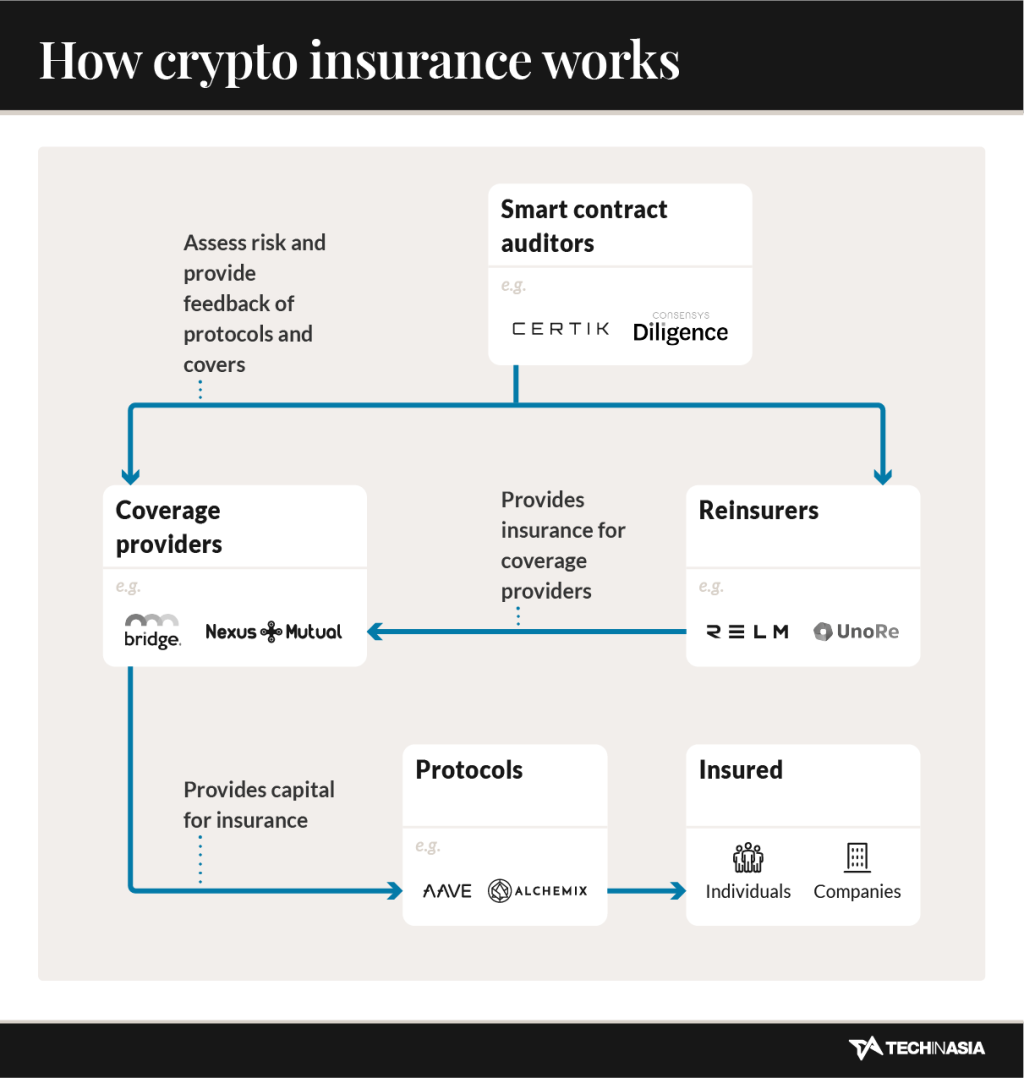
Image credit: Timmy Loen
And like their traditional counterparts, crypto insurance policies have terms and conditions. Coinbase carries crime insurance that protects a portion of digital assets held across their storage systems against losses from theft, including cybersecurity breaches. The firm, however, cautions that its plan may not cover all losses.
The “capacity to provide crypto insurance is very limited across the world. It is not sufficient to cover even the tiniest fraction of the total exposure out there,” Helen Ye, chief commercial officer at OneDegree, tells Tech in Asia.
The founder of a crypto insurance firm, who did not want to be identified, pegged the crypto market’s capacity to provide insurance at US$6 billion to US$8 billion.
This highlights a major problem in evaluating the risk of a crypto investment: Nobody can accurately quantify the risks associated with DeFi since it is a new industry with protocols that might fail in unforeseen ways, Kiril Ivanov, co-founder at risk aggregator Bright Union, tells Tech in Asia.
Sweet spot for an ideal crypto insurance product
The biggest obstacle
Stay ahead in Asia’s tech landscape
This is premium content. Subscribe to read the full story.
Investors are looking to put their money behind crypto insurers who can cut through the red tape of the traditional insurance sector.
We know this is not ideal. ⌛ Sign up in 20 seconds. Cancel anytime.
Our subscriber community includes professionals from these companies:





Stay updated on the go with our mobile app.
Get latest insights with smoother, more personalized experience through TIA mobile app.