Kyle Johnson · · 7 min read
Hatch’s new playbook for rapid innovation with cutting-edge tech

Summary:
- It’s a challenge for public safety decision-makers to identify, verify, and apply emerging technologies amid a vast and complex marketplace.
- Hatch’s In-Beta program addresses this by actively scouting frontier technologies for an eight-week experimental sprint, allowing agencies to explore potential use cases.
- Selected startups receive S$30,000 in prize money and direct access to potential key stakeholders, allowing them to bypass cold calls and validate their tech with government end users.
- Startups interested in working with Hatch to enhance public safety and security can connect with the center through its website.
Imagine you’re a key decision-maker at one of Singapore’s Home Team agencies, which are in charge of the city-state’s public safety and security.
You’re tasked with upgrading your organization’s capabilities to keep Singapore safe, so you start looking at the market for technologies and solutions that could help. The endeavor ends up being extremely difficult and time-consuming.

Photo credit: GONGYU / Shutterstock
You still need to carry out your regular responsibilities at your job, and you may not have time to scour all of the emerging technologies in your purview, let alone check whether they’re actually safe, validated, or useful in high-stakes public safety contexts.
Plus, tech is such a vast vertical. Where would you start? How would you know if a specific solution is worth the time, risk, and investment? And finally, how would you even know where to apply a new piece of technology if there isn’t a clear problem statement to address?
That’s where Hatch’s latest program comes in.
Cutting through the noise
Called In-Beta, the program is the latest addition to the suite of programs at Hatch, an innovation center dedicated to curating and validating dual-use deeptech solutions from startups around the world to enhance Singapore’s public safety.
While Hatch already runs established programs like the open innovation challenge Dimension X and the tech scouting program Hatch & Match, the team realized there was a gap for something faster and more exploratory.
Explore the public safety sector with Hatch
“If you look at the ecosystem, there are a lot of options,” says Mok Shao Hong, center director at Hatch. “The number of tech startups and technology being developed is at an unprecedented scale.”

Mok Shao Hong, center director at Hatch / Photo credit: Hatch
“In-Beta came about as a useful tool in our repertoire, as there is a need to remove the noise and develop a clear value proposition.”
In-Beta acts as a “tech evaluation program,” according to Judah Tan, senior innovation manager at Hatch.
Unlike the innovation center’s traditional programs that demand co-developed or fully realized solutions for identified problems, In-Beta is designed to be experimental. It allows Hatch to scout cutting-edge technology from around the world and test it against potential use cases in public safety – sometimes before the agencies even realize they need it.

Judah Tan, senior innovation manager, and Lydia He, open innovation manager / Photo credit: Hatch
“In-Beta is very much Hatch’s initiative, on behalf of Home Team departments, to really explore frontier tech developments,” explains Lydia He, open innovation manager at Hatch. “Instead of drilling down on one problem, we can expand and see different solutions, then we narrow down to specific use cases that the tech could address.”
The inner workings of In-Beta
Unlike Hatch’s open innovation challenge Dimension X, In-Beta is not open for public application. Instead, Hatch’s analysts actively scout and invite startups that fit a specific profile.
The program looks for companies where technology is the absolute core of the business.
“If it’s just licensing, it’s a bit weaker,” says Mok. “We need companies where the founding team has a mastery over the tech.”
Crucially, while the program is experimental, Hatch also looks for viability. The goal is not to fund mere ideas but to verify technologies that could eventually survive in the real world.
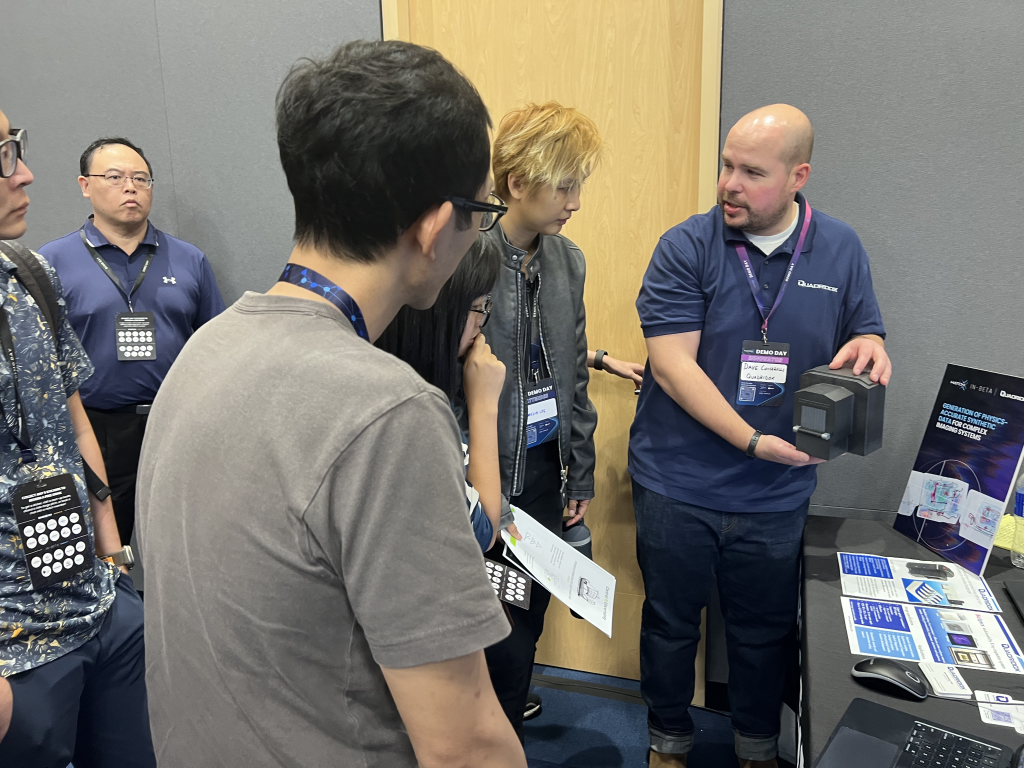
Dave Coccarelli, COO of Quadridox, which experimented with their synthetic data generation capabilities for screening system validation through In-Beta, shares more about his company’s products with Amelia Lee, a forensic scientist at HTX / Photo credit: Hatch
Selected startups undergo an eight-week sprint to do research on their proof of technology (POT). Tan says eight weeks is the “sweet spot” to go deep enough to validate a hypothesis without dragging on too long for fast-moving startups.
The first seven weeks involve testing and development at the startups’ own facilities in their home countries, guided by biweekly online check-ins with Hatch to ensure they are meeting set parameters.
This culminates in a final week in Singapore, where startups present their experiment outcomes through on-site demos.
Tangible benefits for founders
For invited startups, In-Beta’s benefits are designed to be catalytic.
Participants receive S$30,000 (US$22,300) in non-dilutive prize money to cover the costs of experimentation, and Hatch doesn’t take any equity, according to Tan.
Further, Hatch does the heavy lifting of verifying these nascent technologies. By validating the tech during the program, Hatch minimizes the risk for end users, making it easier for them to say “yes” to further operational deployment.
Beyond the findings from experimentation, the real value lies in access. The final on-site demo isn’t just a presentation – it also acts as a networking opportunity with interested key stakeholders from the Home Team agencies and the wider Hatch ecosystem in attendance.
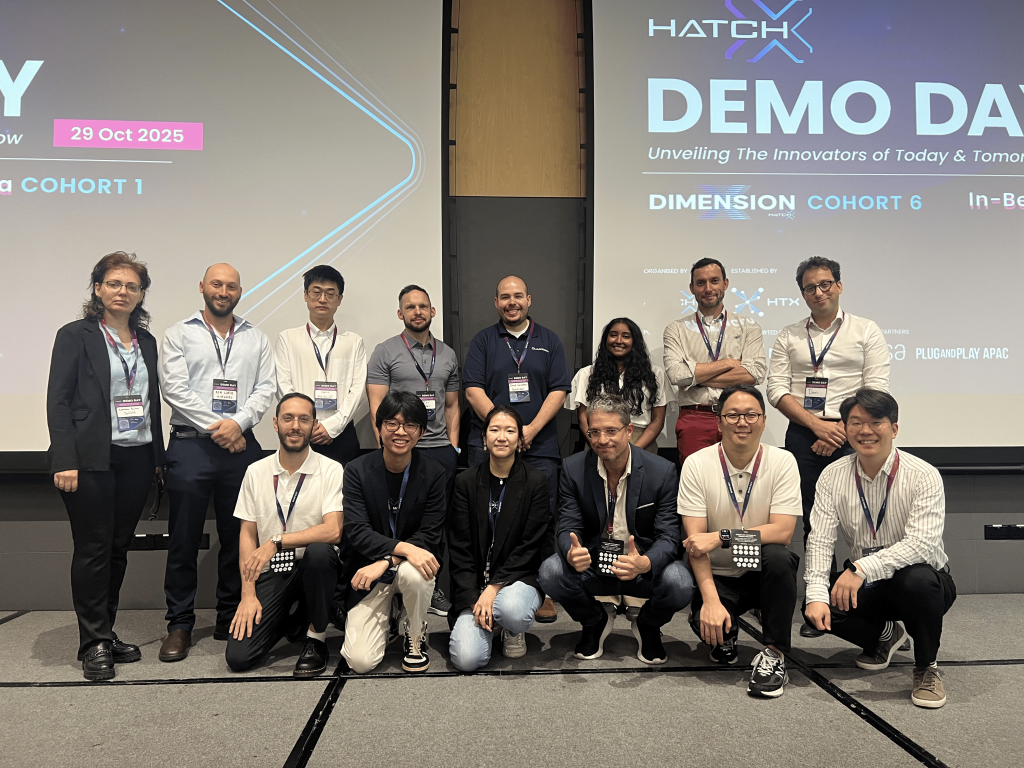
In-Beta’s inaugural cohort of startups at Hatch’s latest Demo Day. / Photo credit: Hatch
This allows startups to bypass the “cold call” phase, as their tech has already been verified through POT experimentation.
“For the startup, it’s catalytic because they have targeted introductions, without which they’re just banging on doors,” explains Mok. “Even if Hatch were to create meetings, the conversation may not move because of elephants in the room or complications to navigate. In-Beta removes the uncertainties.”
The explorer vs. the builder
In-Beta’s He notes that it is important to distinguish the program from Hatch’s other offerings.
Dimension X, for instance, is a “concept builder.” It typically focuses on mature startups that can adapt existing solutions to specific Home Team problem statements over a longer period. Hatch & Match, on the other hand, is a direct conduit for agencies that know exactly what they want and need a ready-made solution.
In-Beta is the “explorer,” He says. It deals with nascent, emerging technologies that may not have a defined problem statement yet. This positioning allows Hatch to be agile.
“The edge of In-Beta is the speed to decision that we bring to the table,” adds Tan.
Into the future with In-Beta
For startups that receive the tap on the shoulder to join In-Beta, the Hatch team emphasizes the importance of curiosity.
“Be curious, interested in the work our Home Team colleagues do, and ask questions,” advises Tan. “Those who stand out are the ones that ask the right questions to open new frontiers for the work being done here.”
Mok echoes this sentiment, encouraging founders to view Hatch not just as an evaluator but as a long-term collaborator.

Photo credit: wee dezign / Shutterstock
He adds that In-Beta is meant to act as the start of a journey for Hatch – and by proxy, the Home Team – to know a startup’s tech and their founders better. In other words, it acts like a “paid trial” for startups, which, if successful, will give them the opportunity to explore programs with more prize money, verifying their tech more rigorously as well.
“Look at us as a development partner,” Mok continues. “It’s easy to think you’re delivering an experiment report, but it’s better to see that the experimentation is to create evidence for future decisions.”
“This program is a clear next step in Hatch’s mission to bring in new technologies to innovate within the public safety sector.”
Hatch is an innovation center driven by the mission to curate and accelerate dual-use technologies that enhance public safety and security. To find out more about its In-Beta program, click here.
This content was produced by Tech in Asia Studios, which connects brands with Asia’s tech community. Learn more about partnering with Tech in Asia Studios.
Stay updated on the go with our mobile app.
Get latest insights with smoother, more personalized experience through TIA mobile app.
Recommended reads
 Indonesian AI startup goes global
 Forrest Li on scaling Sea, building smarter bots, and founder grit
 An AI assistant that joins sales calls and scores team skills
 SGX’s CEO says it doesn’t need a unicorn to win
 SMEs want AI too, but not the kind Big Tech is selling
 Oatside’s alt-milk rise hits a profitable gear
 Alibaba’s financial health in 12 charts
 Asia’s telcos bundle AI into mobile plans. Will it pay off?
 M-Daq chases bigger clients as revenue falls, losses grow
 VC tracker: Accel raises US$3.5b, including US$550m for India





Editing by Jonathan Chew, Winston Zhang, and Jaclyn Tiu
(And yes, we’re serious about ethics and transparency. More information here.)