 Day 2 of iStrategy 2010 started with a inspiring talk by Haresh Khoobchandani, Chief Marketing Officer, Microsoft, Asia Pacific. A revolution, he says, is underway. And technology is the catalyst. Technology and its tools, such as Twitter, Facebook and Youtube has had profound impact on the way we are expressing ourselves. If marketers don’t take note, we will get more obsolete than we realize.
Haresh says the pressure is on marketers to see how we reach out to consumers across different platforms and mediums.
It is part of a technological paradox: while life gets easier and easier for consumers, it gets increasingly more complex for businesses. It also gets tricky as people trust friends and family more than advertising: 78% of consumers trust peer recommendations more than advertisers. In fact, there is the danger of disconnect between the consumer and advertiser today.
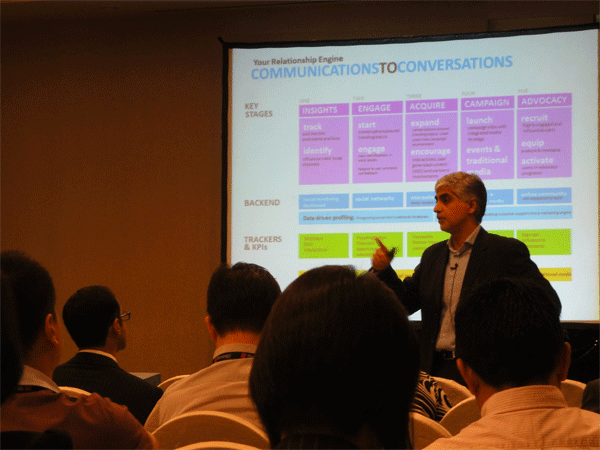
Some trends he highlighted was the fact that consumers spend more time on social networks rather than on a company’s webpage. While it is tempting to use social media as the be all and end all, Haresh continually emphasized that social media is just a feature and should not be used solely as the destination. Just because you have a Facebook page, doesn’t mean you are in digital. A strategy has to be used to back it up.
Haresh then described to us the Relationship Engine that Microsoft uses. It has five steps: Insights, Engage, Acquire, Campaign, Advocacy.
Using Windows 7 as an example, they listened to consumers to gather insights. Microsoft initiated the single largest beta product test in the world, where they gathered insights to build the product, through listening to the consumers. Identifying the concerns being raised, Microsoft engaged the neutrals, which formed a big bulk of the target audience. They isolated the appropriate target audience, brought them in and talked to them to understand more about their concerns. Microsoft then acquired more information expanding and drawing the neutrals to their product. With the concerns solved, Microsoft then proceeded to campaign and advocate the product.
From the insights garnered from the target audience, Microsoft decided not to go with print, but just online and radio. In fact, the budget was just 1/3 of Vista’s launch. Even though it was backed with research, it is not that hard to imagine that within the team itself, some people had no faith that the launch would work. As it turned out, Windows 7 was the fastest selling OS in Microsoft history. At some point, Haresh says, you just have to trust your gut and go with it. This is especially so for new technologies: you are not going to get it right the first time around, so might as well jump in with two feet.
In the end, Haresh describes that it is not only a very different tomorrow, but a very different today. It will be all about connections, insights and expressions. The consumer will no longer look for the products; rather products will look for the consumer via behavioral targeting. Additionally, one cannot just rely on rational thinking. It is about combining the rational and emotional minds to find the best way to reach out to the consumer.
However, as we move forward, we must never forget the power of tradition. Using the Dabbawalas example, Haresh highlighted the power of people. Without people, marketers are nothing. There is a need for the new and old to co-exist.
Key takeaways:
Evolution from Marketing to Conversations
- You cannot drive a conversation if you don’t own the data
- Evolution of Conversations in a digital age
- Social Media is a means not the destination





Stay updated on the go with our mobile app.
Get latest insights with smoother, more personalized experience through TIA mobile app.









📅 Upcoming Events
22 October 2026
Payoneer x CSPN Summit 2026