Jum Balea · · 6 min read
While rivals struggle, RedDoorz sees ‘exponential’ growth with $11m new funding

RedDoorz’s first fully leased property located in Singapore / Photo credit: RedDoorz
The last couple of years have seen a slew of bad news from Southeast Asia’s online budget-hotel booking industry. In Indonesia, Nida Rooms faced financial trouble, while rival Tinggal has hung up its gloves and pivoted to another business model. Recently, a rumor broke out about Zen Rooms’ alleged impending shutdown. Launched by Rocket Internet, the company operates in several markets across the region.
Yet one player seems to be bucking the trend. Singapore-based RedDoorz today announced it has bagged US$11 million in its pre-series B round to “grow exponentially” in its current markets. This follows a US$5 million series A round closed toward the end of 2016 but was only disclosed today.
RedDoorz and its rivals take after SoftBank-backed Oyo Rooms from India: They buy an inventory of rooms from budget hotels and spruce them up to provide a standardized service in terms of cleanliness, bed quality, and things like wifi. Users can then book these rooms online.
Since its launch three years ago, RedDoorz has accumulated rooms in 500 properties and serviced over 700,000 stayed nights in Indonesia, Singapore, and the Philippines. In Indonesia, the region’s biggest market, it operates in 16 cities and expects to be profitable soon.
Overall, the startup seems to have overtaken most of its competitors in several metrics.
A larger war chest
The company’s founder and CEO Amit Saberwal estimates the region’s travel market to be worth about US$52 billion. Of the amount, the whole accommodation industry accounts for about US$20 billion, and budget hotels around US$12 billion.
While the market potential may be large, it is difficult to tap into. Players need to spend millions of dollars to brand small and unorganized hotels – apart from buying their inventory for months. Occupancy rates tend to be low at the beginning, so they have to invest in marketing and building customer loyalty.
They must train the hotel staff to provide the level of service they aim for. Even then, because they don’t directly employ the staff, there’s a risk that the personnel won’t be able to give the same customer experience on a consistent basis. This and funding might be the areas where many players fall short.
Data shows RedDoorz has the most firepower to continue spending on growth.
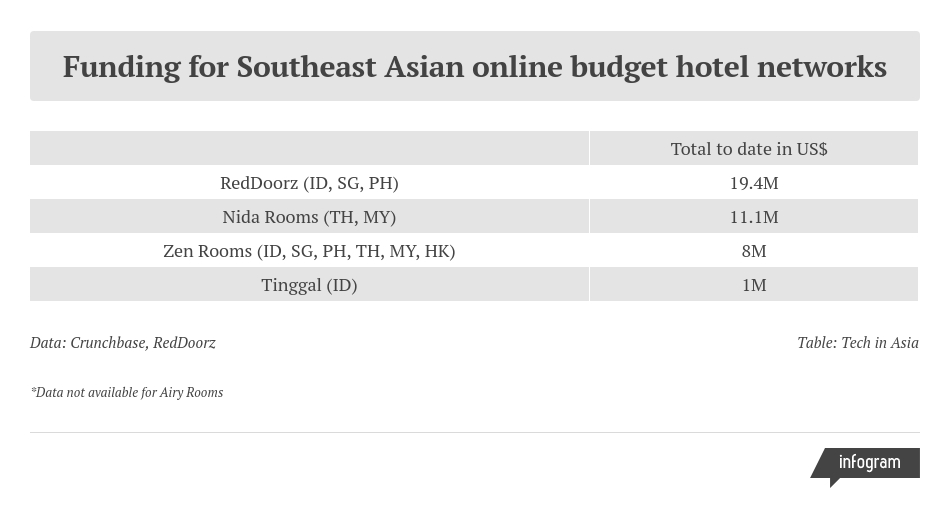
In 2016, Nida Rooms experienced a cash crunch and reportedly couldn’t pay employees and vendors. A US$5.6 million round led by investment firm Shanda Group in February 2017 allowed the startup to stay afloat. (Its website has also been renamed as Hotel Nida, but its app is still called Nida Rooms.)
Tinggal, on the other hand, decided to pivot to a software business for small hotels, saying that the unit economics of the hotel-room aggregation model didn’t make sense. The firm said most of the revenue from its hotel bookings was paid to the property owners and platforms like Traveloka and Booking.com, which marketed its branded rooms.
From aggregating to fully leasing





Stay updated on the go with our mobile app.
Get latest insights with smoother, more personalized experience through TIA mobile app.