Guest Contributor · · 4 min read
Enterprise startup issues: What’s different about B2B startups?
By Mike Holt, CEO of Singapore enterprise incubator Get2Volume
 While all the startup buzz we hear about seems to focus on social networking, mobile, and casual gaming, there’s real opportunity for startups to make big money in enterprise technology. Consider this: Enterprise startups are twice as likely to become billion-dollar companies compared to consumer startups, according to venture capitalist Jim Goetz.
Enterprise or B2B companies have been the recent rage of the investment community. In 2012, the enterprise IPO market was red-hot. Companies such as Splunk, Palo Alto Networks, and Workday having very successful initial public offerings. Singapore has several exciting enterprise startup companies including ConnectedHealth, gridComm and Sprooki (Editor’s note: these are Get2Volume’s portfolio companies).
Building an enterprise startup is hugely different than a consumer focused company. In this series, I will go through these differences and how B2B startups can best succeed.
So what exactly is a B2B or enterprise business? B2B is short for Business-to-Business (B2B) and B2C is short for Business-to-Consumer (B2C). While B2B products and services are sold from one company to another, B2C products are sold from a company to the end user. Most B2C products or services can also be a B2B product or services. B2B products or services will typically not be used by consumers.
B2B markets tend to be more focused. For B2B, the sales process is much longer compared to B2C (9-18 months as an example for health care IT systems from ConnectedHealth) and involves multiple decision makers (executive management, engineering, quality, manufacturing).
Products and services may go through qualification processes and trials prior to a decision. The sales process is driven by relationship, experience and detailed information. In contrast, a B2C sales process is shorter, sometime impulsive, and is driven by a single decision maker (the consumer). Critical sales drivers are brand recognition and repetition. B2C marketing is a “one to many” process whereas B2B marketing is typically a “one-to-one process”.
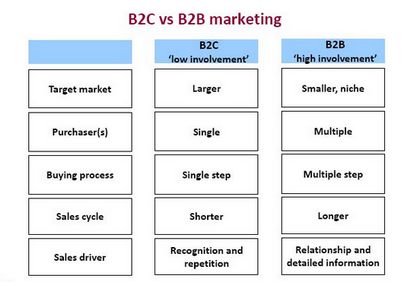
These differences result in different growth plans and execution for the two categories of startups. Identifying opportunities and defining product requirements requires deep, direct B2B customer understanding and alignment of B2B customer product roadmaps with the startup company product plans.
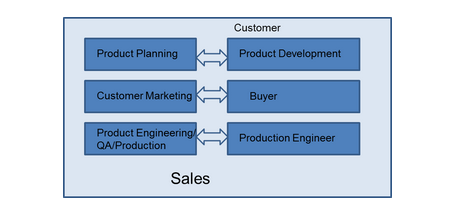
This requires significant multi-functional relationship between the companies. More sophisticated buyers requires better promotional, marketing and relationship skills from the startup. We refer to this selling process as a “Teacher Customer” process where the B2B company must work closely with its customers to understand needs and product requirements.
The customer engagement process is involves a multi-level relationship as shown below. The B2B startup company must discuss needs, products and engagement with several experts that understand the customer in multiple areas.





Stay updated on the go with our mobile app.
Get latest insights with smoother, more personalized experience through TIA mobile app.