Bree Chan · · 5 min read
OCBC takes a first-mover role in bringing quantum tech to banking

Quantum technology is emerging as one of the most closely watched innovations in the global technology landscape, promising to transform industries from finance to logistics and cybersecurity.
Singapore’s national push to develop quantum expertise – including multimillion-dollar investments in research, infrastructure, and talent development – reflects the country’s belief in the tech.
Financial institutions, in particular, are starting to explore how quantum computing and quantum-safe solutions could offer faster problem-solving, enhanced security, and new capabilities that were previously unattainable.
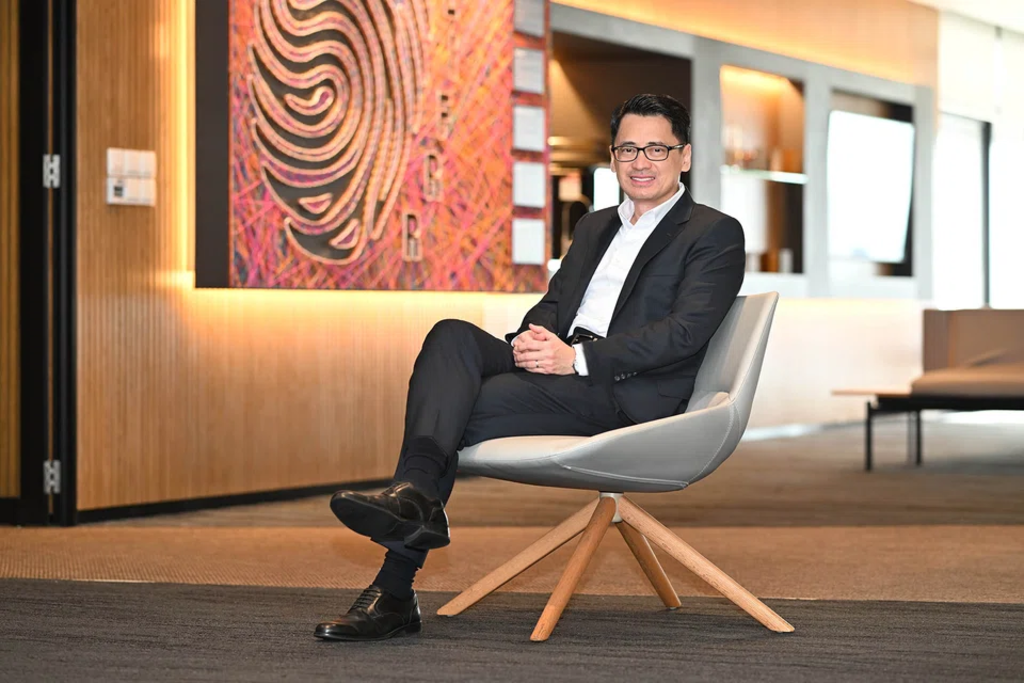
“We are hoping that through the use of quantum computers, we could better optimize some pricing for our customers,” says Peter Koh, head of group technology architecture at OCBC. / Photo credit: OCBC
Against this backdrop, OCBC is positioning itself as the “first mover” in quantum technology adoption among Singapore banks. It is exploring applications and research that could transform its operations in cybersecurity, financial modelling, and fraud detection, says Peter Koh, the head of group technology architecture at OCBC.
The bank began developing these capabilities in 2021 as part of a broader road map for emerging technologies. It has held pilot projects, staff training, and academic collaborations to lay the groundwork for wider adoption, says Koh, who is responsible for identifying and driving the adoption of emerging technologies at OCBC.
He says quantum technology has the potential to solve complex problems more quickly than traditional computing. This is possible thanks to quantum bits, which can exist in multiple states simultaneously, unlike conventional computers that rely on binary digits in switches that are either zero or one.
Quantum technology has two primary uses: quantum computing and quantum-safe solutions.
The former, which can optimize logistical processes or solve cryptographic problems faster than traditional computers, is still about five to 10 years away from becoming mainstream, says Koh.
However, the latter can already be used to enhance security today. It includes both quantum key distribution, which detects unauthorized access between communication networks, and post-quantum cryptography, which protects classical computing systems from quantum attacks.
Laying the groundwork
OCBC has identified several key areas that can help with quantum technology adoption, beginning with cybersecurity and expanding to financial modelling.
It is pursuing these through partnerships with private entities for commercial pilots as well as research collaborations with institutes of higher learning (IHLs).
OCBC has also begun deploying the tech within its operations For instance, it’s the first financial institution in Singapore to trial Singtel’s Quantum-Safe Network, which secures communication channels using quantum key distribution. This enables immediate alerts if unauthorized users try to tap into the network link between OCBC’s headquarters and the bank’s data center.
OCBC is also one of the banks that completed a proof-of-concept sandbox with the Monetary Authority of Singapore to evaluate the use of quantum key distribution to securely transfer financial data.
Another area the bank is exploring is enhancing financial modelling, particularly in pricing derivative products.
Koh notes that calculating these prices often involves numerous complex formulas that fluctuate with changing market conditions. “We are hoping that through the use of quantum computers, we could better optimize some pricing for our customers,” says Koh, who adds that efforts in this area might take up to five years to bear fruit.
In terms of research partnerships, OCBC is collaborating with Singapore’s three major universities – the National University of Singapore (NUS), Nanyang Technological University (NTU), and Singapore Management University (SMU) – for a year to advance quantum research. These partnerships, formalized in July 2025, focus on three key areas: derivative pricing, data security, and fraud detection.
Koh says IHLs make “ideal partners” for OCBC, as they are often at the forefront of research in emerging technologies. With NUS’ Centre for Quantum Technologies, for instance, OCBC is exploring the application of quantum computing for complex risk management models, such as Monte Carlo simulations, which are widely used in the financial sector to model a range of potential outcomes and their probabilities.
At SMU, the bank is working on improving fraud detection by analyzing millions of patterns and using quantum technology to compress these patterns into formulas that make it easier to identify suspicious activity.
Meanwhile, NTU is helping OCBC with research on post-quantum cryptography, which involves designing encryption methods based on complex mathematical problems that stay secure against quantum attacks.
The findings from these collaborations will be published in technology-focused research papers and journals, allowing the financial industry to assess the potential of quantum technology and accelerate broader adoption.
“This is part of our contribution back to the community,” Koh says. “We hope to bring some of these capabilities to commercial use.” He also notes that the bank plans to expand partnerships with private-sector companies and regional universities in the future.
Building internal capabilities is also central to OCBC’s strategy. The bank follows a two-pronged approach: cultivating a core group of quantum experts and fostering broader awareness across the workforce.
For the first, selected staff work directly with partners such as Singtel and SPTel to get hands-on experience as well as attend courses on quantum technology to improve their know-how. These employees could be in roles related to quantum computing, such as technology, business, and cybersecurity.
“By getting our people hands-on experience, they can adopt any development in quantum a lot quicker in the future,” says Koh.
Training of its workers began in May 2024, and courses include a combination of online classes and in-person workshops by OCBC’s in-house experts and NUS instructors.
Staff complete around 16 hours of self-directed classes to build foundational knowledge in quantum computing, as an introduction.
About 50 employees have reached an intermediate proficiency level as of the end of 2024. Koh says that OCBC aims to train more than 100 employees by 2026.
For the second prong, meanwhile, OCBC has held appreciation courses via virtual talks for around 700 staff to help them understand the basics of quantum technology and its potential applications. These talks help employees prepare for a future where quantum technology is more widely adopted within the bank.
“We just want to make sure as many employees know about quantum technology, and other new technology, as much as possible,” Koh says. The bank plans for 1,500 employees to participate in these sessions by 2030.
Gearing up for the next phase
Overall, Koh describes OCBC’s approach to adopting emerging technologies as “structured.
The bank’s road map outlines a gradual approach to adopting quantum technology, and it has focused on commercial pilot projects with partners over the past year.
In the next two years, it plans to expand the use of quantum key distribution to secure its communication networks and implement post-quantum cryptography to safeguard its data against future quantum attacks.
Two to three years down the road, the bank intends to explore quantum-assisted AI and machine learning, leveraging the technology’s ability to tackle complex problems more efficiently.
“If we could harness the power of quantum to solve some AI models, we can develop those models a lot quicker and a lot more powerful as well,” says Koh.
In the long term, quantum technology is expected to strengthen customer information security and risk management in OCBC. This could result in better protection against fraud and more accurate pricing of financial products, says Koh.
“If we can find a way to optimize the pricing models for investors, I think that could radically transform the way we serve our customers,” Koh says. He estimates that the full impact for customers may take at least five years to materialize.
The bank’s plans, combined with national support and structured training programs, positions OCBC to navigate the emerging quantum landscape confidently.
This story was republished with permission from The Business Times. It was moderately edited to reflect Tech in Asia’s editorial guidelines.
Stay updated on the go with our mobile app.
Get latest insights with smoother, more personalized experience through TIA mobile app.
Recommended reads
 Inside OpenAI’s public-first bet on medical AI
 Southeast Asia pulls ahead of global average on AI adoption
 Killing ‘zombie’ projects: PH bets big on offshore wind
 A middleman model makes free patient tracking possible
 Why AI is hiring problem, not just a technology one
 The hardware secret that gave OpenAI the edge on Anthropic
 How AI agents will be the new software buyers
 How AI is breaking SaaS where trust matters most
 This startup helps chipmakers stop repeating the same mistakes
 Why Google moved fast on AI in Search but held back on chat





Editing by Jonathan Chew and Jaclyn Tiu
(And yes, we’re serious about ethics and transparency. More information here.)