
When most banks talk about digital transformation, they point to new apps or online services. UOB’s Lawrence Goh is thinking bigger.
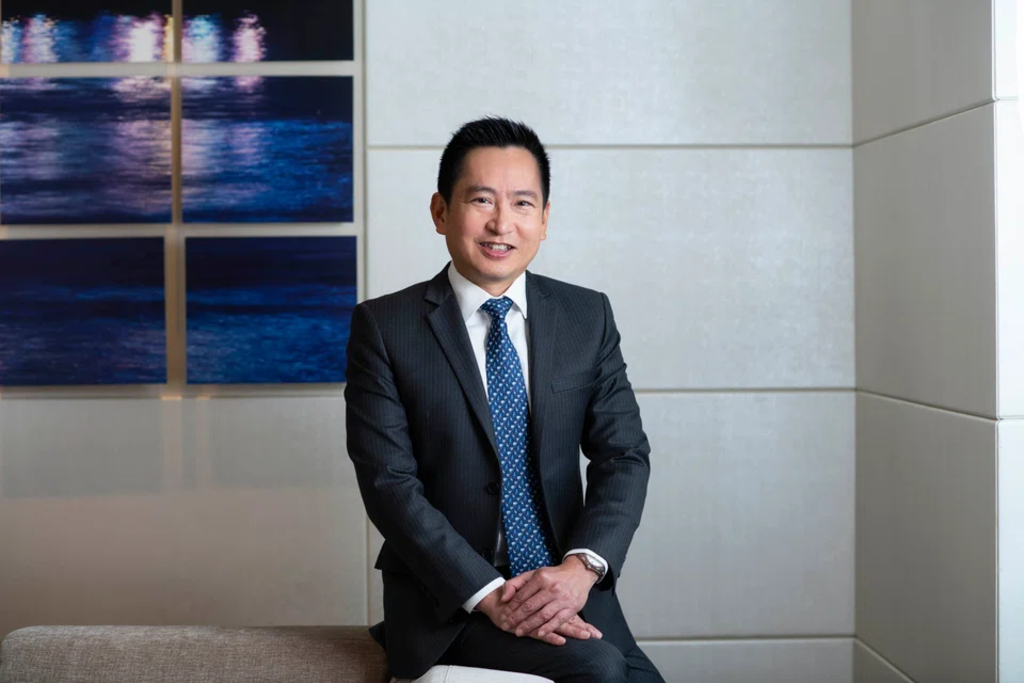
“In today’s digital age, customers expect more than just transactional services from their banks. They seek intuitive, impactful experiences that support their broader financial journeys,” says Lawrence Goh, head of group technology and operations at UOB. / Photo credit: UOB
The bank’s head of group technology and operations has been rearchitecting how a regional bank can run – fusing data, AI, and human insight into every part of the organization.
“Our technology strategy is about enabling UOB to deliver innovation responsibly, creating long-term value for customers and stakeholders across ASEAN,” he says.
UOB embarked to build a regional tech platform more than a decade ago, becoming the only Singapore bank to have a set of standardized systems across ASEAN. This platform supports its operations in Singapore, Malaysia, Thailand, Indonesia, and Vietnam.
The platform’s design allows new technologies to be “plugged in” without disrupting existing systems. For customers, this means a consistent and seamless experience across markets; for the bank, it enables faster product rollouts and greater scalability.
UOB’s platform was also built for resilience and reliability. As Goh explains, innovation must always be balanced with a “strong risk culture.”
The infrastructure operates on a common architecture supported by risk management and cybersecurity frameworks that meet regulatory standards across markets.
These guardrails ensure that new technologies can be introduced without compromising compliance or stability.
One such example is UOB TMRW, the bank’s all-in-one digital banking app. It was launched in Thailand in 2019, adapted for Indonesia within nine months, and enhanced for Singapore only four months later – an acceleration made possible by the unified technology foundation.
“This enabled our core banking systems and operating processes to be harmonized across our five key ASEAN markets, supported by a regional technology hub in Singapore,” says Goh.
UOB TMRW reflects the bank’s vision of using AI and machine learning to deliver hyper-personalized banking experiences to more than 8.4 million customers across ASEAN.
Designed to understand individual behavior and preferences, the app analyzes transaction data to provide tailored insights, curated lifestyle rewards, and integrated digital-wealth solutions.
It nudges customers to invest surplus savings when they have maximized interest on their UOB One Account, flags duplicate charges or unusual spending patterns to prevent fraud, and offers financial content and expert analyses to help users stay informed.
UOB is also applying generative AI tools to elevate service quality at contact centers. Front-line staff handle thousands of inquiries daily, from routine transactions to urgent scam-related calls.
By analyzing conversations in real time, generative AI tools can suggest accurate responses, summarize calls, and recommend follow-up actions. The result: faster and more consistent service as well as improved customer satisfaction.
The bank’s use of AI extends beyond retail banking and customer engagement.
“UOB has leveraged AI across many parts of the bank to further strengthen risks and controls, improve productivity, and enable data-driven decision-making,” Goh explains.
It created the Enterprise GenAI Platform (EGP), which lets the bank develop generative AI applications and run them across its operations.
For example, the bank made an ESG solution that uses pre-engineered prompts designed by subject-matter experts to process companies’ sustainability reports. The solution can also extract key information from these reports to perform risk assessments.
By automating manual and time-intensive tasks, relationship managers are able to focus on higher-value advisory work, such as helping clients craft decarbonization strategies. This leads to an uplift of the quality of ESG assessment by not solely relying on the understanding of the individual relationship managers.
The bank also uses generative AI tools to monitor adverse ESG news about corporate clients. “This ensures timely interventions and strengthens our ability to manage reputational and sustainability risks,” explains Goh.
At the same time, UOB deploys advanced AI and machine learning models within its fraud-surveillance and anti-money-laundering systems, enabling 24/7 detection of anomalies and potential mule accounts.
Combined with proactive alerts, these safeguards strengthen the bank’s security posture and reinforce customer trust.
“Through these innovations, UOB continues to harness AI responsibly to deliver smarter solutions, strengthen resilience, and create long-term value for our customers and stakeholders,” says Goh.
Responsible innovation
For Goh, technological progress and governance must go hand in hand. “At UOB, our approach to generative AI adoption is anchored on a clear principle: balancing strong governance with speed to value,” he says.
UOB’s framework for responsible innovation has two complementary tracks.
The first is user-driven innovation, which lets employees create generative AI-enabled tools that enhance daily workflows. Through Microsoft 365 Copilot and the bank’s in-house Build-Your-Own-Bots platform, staff use proprietary data to design chatbots that address specific operational needs.
For instance, the Branch Bot helps branch teams respond to customer queries. The solution is being rolled out across all of UOB’s outlets.
Other bots handle HR-related questions, provide product guidance to relationship managers, and help overseas offices navigate internal policies.
The second track focuses on enterprise-grade deployments integrated with core systems.
UOB leverages its EGP to enforce security and compliance guardrails, while its AI Ethics and Model Governance Taskforce embeds the Monetary Authority of Singapore’s FEAT (fairness, ethics, accountability, and transparency) principles into every model.
Collaboration also plays a key role. Through public-private partnerships such as Project MindForge, UOB works with regulators, industry peers, and technology partners to develop frameworks that ensure AI adoption remains transparent, fair, and aligned with ethical standards.
Yet, as Goh points out, technology alone cannot drive transformation. “Human interaction remains key for banks to build trust with our customers, with technologies serving as tools to enhance experience, engagement and productivity,” he notes.
Through the UOB Innovation Academy, employees receive training in AI, data analytics, and blockchain. The program aims to deepen expertise across the organization and foster a culture of experimentation and continual learning.
Building on this commitment to upskilling, UOB recently signed a memorandum of understanding with Accenture to accelerate the bank’s adoption of advanced technologies such as generative AI and agentic AI. This marks Accenture’s first collaboration with a Singapore bank.
Over the next three years, UOB staff will undergo training under Accenture’s LearnVantage program, gaining practical skills to deploy new tools effectively.
Future talent development is another focus area. The AI & Data Analytics Centre of Excellence, co-developed with the National University of Singapore and supported by the Infocomm Media Development Authority, welcomed its first cohort of graduates in July 2025.
Over the next three years, the initiative aims to train 100 graduates, building a pipeline of talent aligned with Singapore’s National AI Strategy 2.0.
The next decade
Banking, Goh believes, is evolving beyond transactions. “In today’s digital age, customers expect more than just transactional services from their banks,” he says. “They seek intuitive, impactful experiences that support their broader financial journeys.”
To meet these expectations, UOB is reimagining customer engagement as a two-way dialogue powered by data.
In the coming decade, the bank plans to move from an app-centric to a data-centric architecture – one that is simpler, more modular, and faster to adapt.
Generative AI tools will be woven throughout UOB’s development, security, and operations pipelines, shaping how every solution is designed and deployed.
UOB’s long-term technology vision rests on three pillars.
The first is adaptive experiences, where customer journeys evolve dynamically rather than follow a fixed path, anticipating what users need and guiding them across touchpoints.
The second is embedded intelligence, which ensures every interaction is informed by real-time context and data, transforming routine transactions into relevant, personalized moments.
The third is autonomous orchestration, where AI systems manage workflows efficiently with minimal human input. This enhances productivity and enables employees to have more time for higher-value tasks, contributing to better customer experience and journeys.
These pillars mark a decisive shift in how UOB approaches innovation.
“This is not simply a technological shift, but a strategic imperative to meet the evolving expectations of our customers and to shape the future of banking,” says Goh.
This story was republished with permission from The Business Times. It was moderately edited to reflect Tech in Asia’s editorial guidelines.
Stay updated on the go with our mobile app.
Get latest insights with smoother, more personalized experience through TIA mobile app.
Recommended reads
 Forrest Li on scaling Sea, building smarter bots, and founder grit
 SGX’s CEO says it doesn’t need a unicorn to win
 SMEs want AI too, but not the kind Big Tech is selling
 Oatside’s alt-milk rise hits a profitable gear
 Alibaba’s financial health in 12 charts
 Asia’s telcos bundle AI into mobile plans. Will it pay off?
 M-Daq chases bigger clients as revenue falls, losses grow
 VC tracker: Accel raises US$3.5b, including US$550m for India
 Graas buys Temasek-backed Trustana in agentic commerce push
 Doctor Anywhere posts healthier operations in 2025





Editing by Jonathan Chew and Lorenzo Kyle Subido
(And yes, we’re serious about ethics and transparency. More information here.)





