- Premium Content It takes our newsroom weeks - if not months - to investigate and produce stories for our premium content. You can’t find them anywhere else.
 Putra Muskita · · 9 min read
Indonesia’s logistics scene is growing fast. Here are the main players
Logistics is the backbone of any successful ecommerce operation – how else will goods reach consumers? But in Indonesia, where the ecommerce scene is thriving, logistics is a more complicated matter than it is in countries like the US or China.
That’s largely because Indonesia is an archipelago with more than 17,000 islands. Some areas have more developed infrastructure than others, for example. Also, the country’s eastern part is more sparsely populated compared to the western side, where Jakarta is. As such, it doesn’t hurt to be nearer to the capital city.
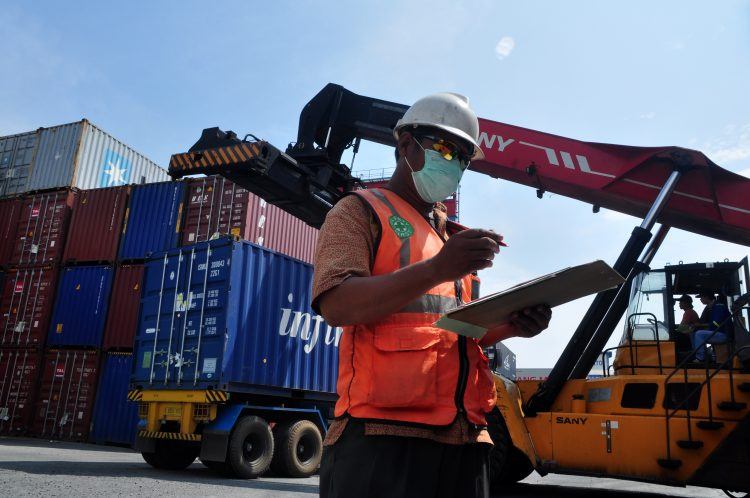
A logistics yard at Jakarta’s Tanjung Priok port / Photo credit: 123rf
But even Greater Jakarta itself presents a host of logistical challenges. There’s the ubiquitous traffic, of course, but it’s a victim of poor city planning and the urban sprawl as well. Street numbers and housing blocks like in the South Jakarta neighborhood of Tebet, for instance, are not always in order, while postal codes in general are best treated as suggestions. It often gets even more difficult the farther you are from urban areas.
These issues are part of the reason why last-mile deliveries are dominated by local companies, especially those that have been in the business for decades. But there’s also a rising number of startups that are solving logistical problems with a strong tech angle.
Indonesia’s logistics players can be divided into two categories: third-party logistics (3PL) and fourth-party logistics (4PL). Freight forwarders or courier companies are considered as 3PL – customers commonly outsource their entire logistics operations to them.
Meanwhile, 4PL companies take it a step further. In addition to typical 3PL services, their offerings often include technology, resource management, and more. A model that’s becoming common involves a logistics provider that owns zero assets – like vans or a fleet of full-time delivery staff – but acts as a middleman between users and 3PL partners through an online platform instead.
Third-party logistics (3PL)
JNE
Established back in 1990, JNE is perhaps the most widely known of Indonesia’s logistics providers. (Public data isn’t easy to obtain, but the company claims to be the industry leader.) The company’s ecommerce partners include giants Tokopedia, Bukalapak, and Shopee, and in 2018, it claims to have processed an average of 24 million parcels per month.
Aside from being a first mover, a key advantage for JNE is accessibility: by mid-2018, the company had 6,800 agents all over Indonesia. These agents typically run a physical outlet that functions as a drop-off point and sales counter.
J&T Express
Founded in 2015, J&T Express is a relatively young company that has scaled rapidly. By April 2018, it was operating 2,000 branches across Indonesia, along with 500 franchise outlets. Similar to JNE, these outlets function as a drop-off point and sales counter, among other services.
Available on the major ecommerce platforms, J&T Express has also partnered medium-sized ecommerce companies like Blibli and fashion marketplace Berrybenka.
Interestingly, J&T Express has strong connections with smartphone maker Oppo. Tony Chen, the Chinese brand’s founder, established J&T Express, along with Oppo Indonesia CEO Jet Lee. The company’s current CEO is Robin Lo, who was previously Oppo’s general manager in Indonesia.
Fourth-party logistics (4PL)
Stay ahead in Asia’s tech landscape
This is premium content. Subscribe to read the full story.
Logistics is a more complicated matter in the Southeast Asian archipelago than it is in countries like the US or China.
We know this is not ideal. ⌛ Sign up in 20 seconds. Cancel anytime.
Our subscriber community includes professionals from these companies:





Stay updated on the go with our mobile app.
Get latest insights with smoother, more personalized experience through TIA mobile app.