Terence Lee · · 7 min read
Entrepreneurs and investors pour grievances during Dr Tony Tan Q&A
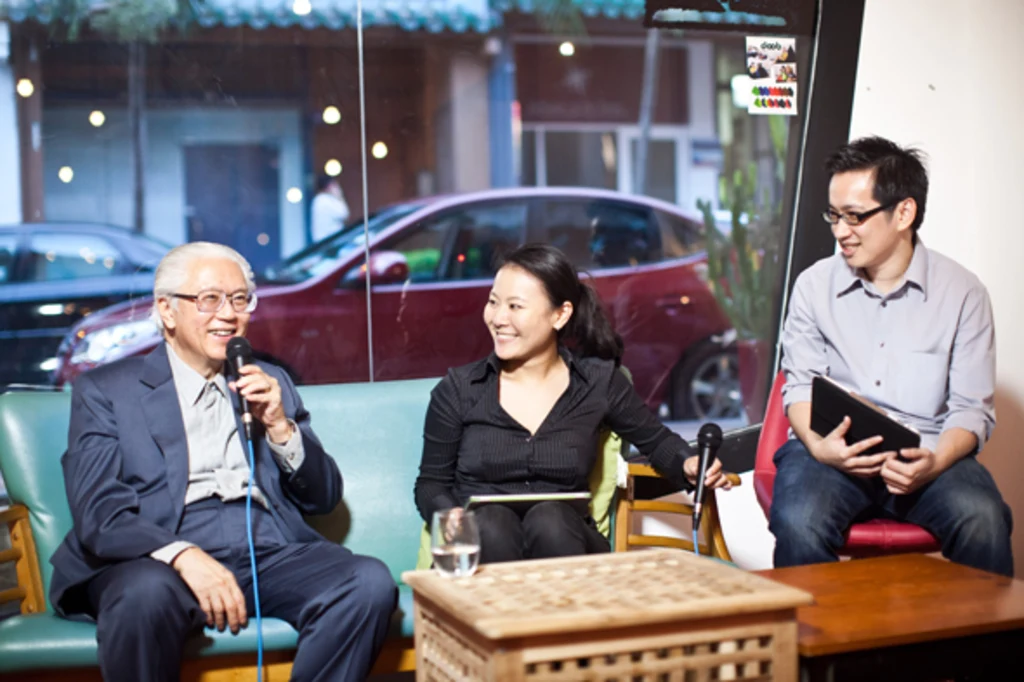
This is not the first time Dr Tony Tan (left) has engaged entrepreneurs like Gwendolyn (center) and Isaac, co-founder and lead developer of SGE respectively.
For half-an-hour, Singapore presidential aspirant Dr Tony Tan sat under the spotlight, his glistening white mane emphasizing his 71 years of age and extensive experience in both the private and public sector.
Displaying the calm and measured demeanor of an elder statesman, he took in a barrage of questions from 30 odd entrepreneurs and investors regarding the state of innovation in Singapore. Held at The Pigeonhole Cafe on August 3, the question and answer session is part of a regular SGE event called Chillin’ With — which gathers innovators in a casual setting to connect with one another. The moderators were SGE chief editor Gwendolyn Regina Tan and lead developer Isaac Timothy Tay.
Feedback from the floor was congenial at first, and then became more candid, sincere, and hard-hitting as the evening wore on. It was, after all, a rare opportunity to meet with a former deputy prime minister and potential president. In Singapore, the president serves a mostly ceremonial and symbolic role with little executive authority, although they wield soft power. The elections are scheduled for August 27.
While many issues were raised, two resonated most with the crowd. One major bugbear was what they perceive as the poor implementation of government funding for startups. Aileen Sim, co-founder and CEO of First Meta, cited her example. While her company has benefited from some government grants, it has also “suffered damages” from others.
“And speaking with at least ten other entrepreneurs I know that have taken government grants, the general consensus is that…they sound very generous and they’re great, and they’re well meaning, well-intentioned. However, a lot of times the execution of it ends up having unforeseen side effects,” she said.
For example, while startups want to spend as little money as possible in their operations and product development, they will receive more reimbursement from the government agency only if they spend more.
Dr Tan acknowledged this as one of the weaknesses of government funding in startups, which sees a clash between the need for civil servants to account for public money and the need for entrepreneurs to have free rein.
“That is where we have to try to move towards an ecosystem where there is eventually more money from private sector, from various funds, so that different people can exercise judgment,” he said.
He did highlight that the Singapore National Research Foundation’s model does mitigate the bureaucratic problem. Through its NRF TIS scheme, the foundation funds a startup on a 50-50 basis together with a venture capitalist. This allows the NRF to piggyback on the VC’s expertise as well as vested interest in seeing his funds generate returns.
“I think this type of arrangement is much more effective than having a group of civil servants sitting around in a committee trying to decide whether startup A or startup B will succeed,” he added.

However, Dr Wong Poh Kam, an angel investor and professor at the National University of Singapore Business School, pointed out that the government still micromanages in their involvement with investors.





Stay updated on the go with our mobile app.
Get latest insights with smoother, more personalized experience through TIA mobile app.