Paul Bischoff · · 5 min read
With DDoS attackers in its crosshairs, this startup defends you from downtime
Juniman Kasman started out his career as a systems engineer. In 2005, the website he was working for at the time came under a heavy distributed denial of service, or DDoS, attack.
"At that point in time, an attack was not very common," he recalls. "We did mitigate the DDoS successfully, but it was a really painful process."

In those days, it was common for hackers to blackmail companies into giving them cash at the threat of taking down their websites. Kasman says it could take three to six months to gather and implement the scattered technologies needed to solve the problem, so many companies gave in and paid up.
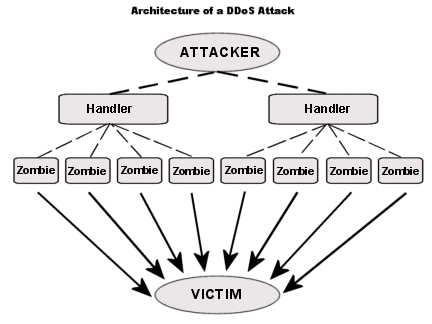
"Law enforcement agencies had low awareness at that time," he says, but today DDoS is one of the most common forms of attack on the internet. A single computer can activate thousands of "botnets" – unknowing computers with a virus that allows the attacker’s computer to take control – to send millions of requests to a single website in an attempt to overload its servers.
Kasman, an Indonesian, is now the CTO of Nexusguard, a DDoS mitigation service founded in Hong Kong. He says any "script kiddie" can coordinate such an attack these days for any number of reasons: personal, political, or the same outright extortion that was happening a decade ago.
DDoS attacks are hard to pinpoint, so law enforcement isn’t typically a first resort. Some websites feel they can’t go to the authorities for help, anyway. Porn and torrent sites, for instance, probably won’t find much sympathy from the police.
These days, most major websites have some form of protection. Tech in Asia, for example, is protected by CloudFlare. When the site gets hit by a DDoS attack (and it does, from time to time), users are redirected to a cached version of Tech in Asia on CloudFlare’s servers until the attack ends.
"Uptime is our highest priority"
Kasman argues Nexusguard is a much more feature-rich and robust solution than CloudFlare and other competitors. It still reroutes traffic when the main website is under attack, but the URL and IP address remain the same, whereas CloudFlare backup sites use a CloudFlare IP address. Additionally, Nexusguard has the ability to reroute traffic instantly, rather than waiting two hours for a change in the DNS – where all IP addresses and their associated URLs are stored – to take place.





Stay updated on the go with our mobile app.
Get latest insights with smoother, more personalized experience through TIA mobile app.