- Premium Content It takes our newsroom weeks - if not months - to investigate and produce stories for our premium content. You can’t find them anywhere else.
 Apoorva Dutt · · 7 min read
How a failing fridge company became Haier, China’s first super company
Zhang’s achievement in taking an ailing collectively owned factory and building it into a leading global firm is one of the stunning business success stories of China’s reform era.
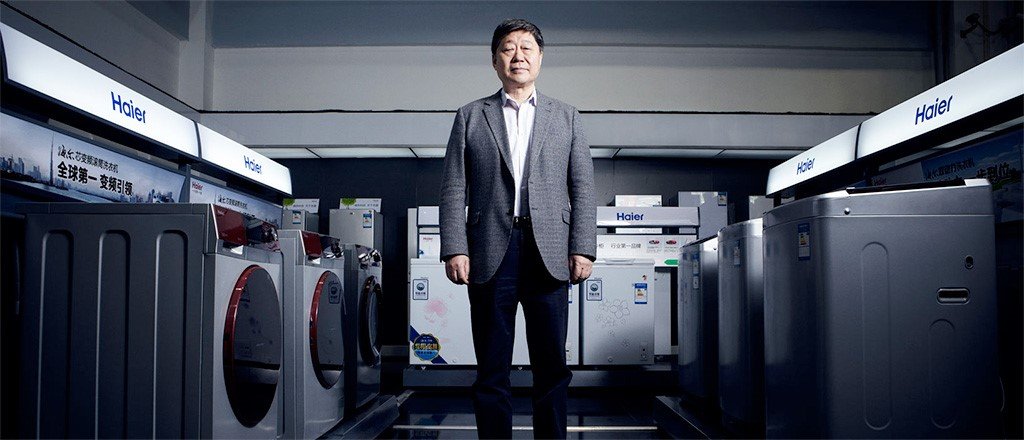
Zhang Ruimin, chairman of Haier / Image courtesy of Wharton Press
The following is an edited excerpt from China’s Disrupters: How Alibaba, Xiaomi, Tencent, and Other Companies Are Changing the Rules of Business by Edward Tse. The excerpt was provided by Portfolio Publishing. You can buy a copy here.
Zhang Ruimin is a household name in China. Thirty years ago, officials sent him to run a failing maker of poor-quality refrigerators in the coastal city of Qingdao. Today, that company – which he still heads – is better known as Haier, the world’s biggest seller of washing machines, air conditioners, and other major appliances. The company’s revenues – $29.5 billion – and profits – $1.8 billion – easily exceed those of its two largest global rivals, America’s Whirlpool and Europe’s Electrolux.
Zhang’s achievement in taking an ailing collectively owned factory and building it into a leading global firm is one of the stunning business success stories of China’s reform era.
Zhang was born in early 1949 -just months before the founding of the People’s Republic of China – to parents who worked in a garment factory in north China’s Shandong province. After the disastrous Great Leap Forward economic campaign of 1958 to 1961 and the subsequent famine of the early 1960s, Mao Zedong sought to reclaim his power and prestige by instigating the Cultural Revolution, a nationwide political campaign aimed at purging the Communist Party of his rivals and reestablishing the revolutionary spirit that had brought him to power.
Across China, countless young people joined this political movement, launching a long period of chaos and upheaval that left a deep scar on the country. After the initial fervor of the Cultural Revolution died down, Zhang took his first job in a construction-materials factory. Through the 1970s and early 1980s, he rose through the ranks to become to a member of the factory’s management committee. Along the way, he established a reputation as an autodidact who, despite having ended his formal education at the age of 17, read every business and management book he could lay his hands on.
In 1984, Zhang experienced the most pivotal moment of opportunity in his career, though it probably didn’t look like one at the time. He was dispatched to run the Qingdao Refrigerator Factory, the fourth director to walk through its doors within the space of a year. When he arrived, he found he was to lead an insolvent, debt-laden plant. “The workshop didn’t even have any windows then,” he later recalled. “The winter was very cold and the workers had no coal to keep themselves warm, so they removed the window frames and burned them as fuel.”
The one thing in the factory’s favor was that people wanted what it made. Its refrigerators may have been poorly designed and frequently defective, but China’s shortage of consumer goods was so acute that the few people who could afford home appliances would take anything they could get their hands on, regardless of its shortcomings. Of course, this didn’t mean customers were happy if their new refrigerators didn’t work properly. But for many companies, such matters were of secondary importance.
With demand rising fast, especially in the countryside where farmers were taking advantage of reforms that allowed them to sell surplus produce at whatever price they could find, manufacturers of home appliances and other household goods rushed to add capacity, certain they could sell everything they produced. Zhang, however, was convinced that such circumstances would not continue for long, and that inevitably, as supply rose to meet demand, consumers would become more picky.
For a business to thrive in the longer term, he believed, it would need a reputation for reliability and quality. The following year, in an act that is now legendary in Chinese business history, Zhang addressed this issue head-on. In one of the company’s warehouses, he lined up 76 refrigerators that had come off its production line with one problem or another. He asked his staff what they thought they should do with these faulty refrigerators. Sell them at a discount, suggested one person. Offer them to employees, said another. No, said Zhang, we shouldn’t be making such refrigerators in the first place.
Taking up a sledgehammer – now carefully preserved in a Beijing museum – he destroyed the first of those 76 refrigerators, then forced his staff to follow suit with the other 75. His statement could not have been more emphatic. From that point on, the Qingdao Refrigerator Factory (shortly afterward renamed Haier) set about establishing a reputation for quality. Zhang instituted rigorous production standards at his factories. To gain access to better technology, he set up a joint venture with Liebherr, a German maker of high-end refrigeration equipment. Inspired by his reading of Japanese management books, he focused on instilling discipline into his workforce.
Work processes were improved, and every employee’s performance was evaluated on a daily basis. At a time when most companies in China were more interested in simply selling whatever came off their production lines, Haier’s focus on establishing itself as the country’s first major appliance brand by producing quality products soon started producing results. In the late 1980s, confident that he could instill similar standards at other factories, Zhang launched Haier on its second stage of development: to acquire the scale that could make it a major player across China.
The company expanded its product range to include water heaters, air conditioners, washing machines, and other home appliances. Despite annual profits of less than $10 million, it listed its refrigerator arm on the Shanghai Stock Exchange, raising $400 million. Zhang used this money to build new factories in Qingdao and acquire what he called “stunned fish” – appliance companies that had added capacity to meet China’s rising demand but failed to invest in quality control and then found themselves stranded when faced with competition like Haier.
Stay ahead in Asia’s tech landscape
This is premium content. Subscribe to read the full story.
In 2017, they had a revenue of US$37.86 billion.
We know this is not ideal. ⌛ Sign up in 20 seconds. Cancel anytime.
Our subscriber community includes professionals from these companies:





Stay updated on the go with our mobile app.
Get latest insights with smoother, more personalized experience through TIA mobile app.