- Insights This article was written by a TIA community member. Insights pieces undergo the same rigorous editorial process that newsroom-produced articles have.
 Michelle Greenwald · · 12 min read
How Taiwan is reinventing itself from manufacturing hub to innovation center
I recently visited Taiwan with an eye toward learning how the country was fostering innovation and was impressed by its vision and methodical approach. Much like a top company’s strategic plan, it took stock of:
- Core competencies and competitive advantages
- Global high-tech industry trends and population needs
- Historical countrywide bottlenecks and cultural issues that could hinder innovation
Because Taiwan is small compared to the US (with a population of 23 million people) and its range of industries more narrow, it seemed manageable to plan an economic road map in a corporate, strategic planning kind of way.
My image of the country formed decades ago—as a kid growing up seeing toys and other inexpensive goods bearing the label “made in Taiwan.” This was also true of goods I remember at the time made in Hong Kong. Both countries left low-cost manufacturing behind, as labor rates in other Asian countries undercut their abilities to compete in those sectors, and both went in different directions. Hong Kong became a world-class financial, real estate, luxury fashion, and shipping center, while Taiwan used its engineering expertise to enter hardware technology.
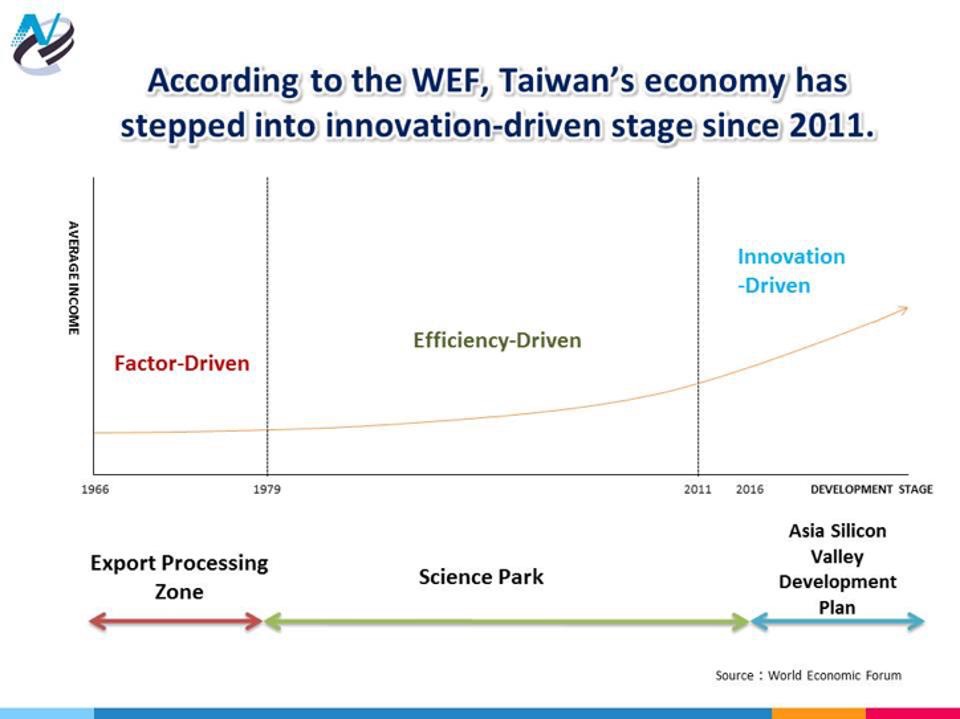
Recognizing that low-cost hardware manufacturing is not a way to sustain an economy when other countries can undercut them in price and that it has tremendous, broad-spectrum engineering talent as a country, Taiwan is once again reinventing itself, focusing on intellectual property and innovation that are less capital-intensive. The chart below from the World Economic Forum illustrates the evolution.
Taiwan has a 98.5 percent literacy rate, the fourth highest standardized math test scores in the world (according to the Organization for Economic Development), and over 25 percent of all its university degrees are in engineering. Sevent percent of the world’s integrated circuits are manufactured in Taiwan, and Taiwanese companies have for years excelled at mobile phone, computer hardware, and electronics engineering.
In a 2014 Bloomberg article, a Global Tech report cited that Taiwan had the highest number of patents per population and per R&D expenditure in the world. More recently, the country decided to use its formidable technology and engineering talent to focus on—in the words of Wayne Gretsky—“where the puck is going,” including areas such as virtual reality, robotics, artificial intelligence, internet of things, smart healthcare, smart logistics, smart machinery, green energy, and smart cities.
Four aspects about Taiwan impressed me unexpectedly, which global companies and even other countries can learn from:
- A clear, long-term vision and methodical/multi-pronged approach to achieve it
- A tremendous sense of humor infused in so many areas
- A sophisticated sense of design, love of color, and graphics
- A motivated workforce with the technical skillsets to both invent and execute
A vision and a methodical approach to achieve it
One of Taiwan’s goals is to become the Silicon Valley of Asia, a liaison and facilitator between the US and other Asian markets. Taiwan feels it can succeed because of its historical capabilities, geographic position in Southeast Asia (it’s relatively equidistant from Hong Kong, Korea, Japan, India, Indonesia, Thailand, and Vietnam), and because of the global business partnerships it has forged and continues to explore.
Government policy and long-term planning
The key government initiatives led by the Taiwan National Development Council (the body coordinating the country’s move toward an innovation economy) include creating:
- A startup and entrepreneurship ecosystem and support system
- Relationships with other global R&D innovation clusters around the world
- Software applications that build on its historical tech hardware expertise
- Assistance for innovations coming out of universities and research institutions in getting funded and commercialized
- Assistance to help innovations move along more quickly into prototypes and testing
- A culture of innovation and inspiration among children at the youngest levels in fun and interesting ways
A tremendous sense of humor
Sophisticated sense of design
Key takeaways for companies and even countries





Stay updated on the go with our mobile app.
Get latest insights with smoother, more personalized experience through TIA mobile app.