 Colin Moreshead · · 6 min read
This Korean startup is making wearables for the blind, but its ambition is much bigger
I need to begin with a disclaimer: if you’re staring at a screen right now, you don’t need the product featured in this article. But trust me, it’s worth a look all the same.
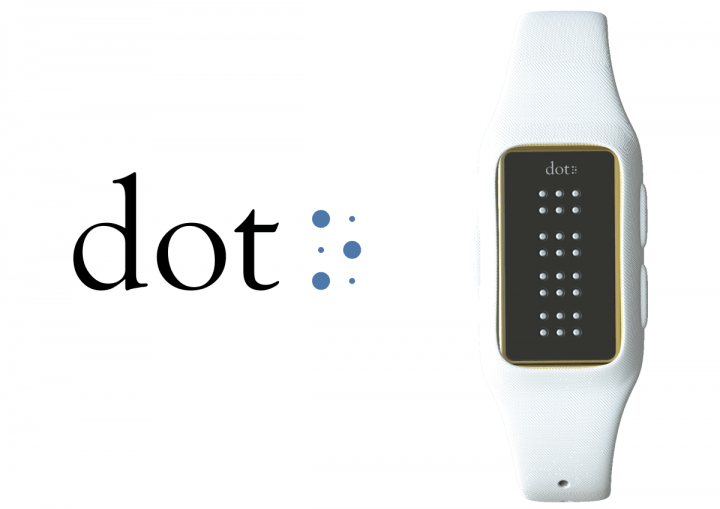
The smartwatch market has exploded over the past few years. In fact, reports show that smartwatch sales have increased an astronomical 457 percent in the last year alone, a figure that can be attributed to the Apple Watch. Since its release in April, Apple’s flagship wearable has captured a full three-quarters of the market, reaching about 4 million units sold to date. One thing you could safely assume about almost every one of those customers, though – nearly all of them can see.
The World Health Organization estimates that there are 285 million people with severe visual impairment around the world, of whom 39 million are completely blind. Among them, literacy is a serious issue because access to Braille education and materials is limited. Even for the literate blind, reading is laborious – one Braille Bible comes in 40 volumes, for example – and remains largely limited to the printed word. Active Braille technology, which displays changing Braille text in real time, typically cost upward of US$3,000 and haven’t changed much over the past decade.
Dot is a South Korean startup that believes the active Braille market is ripe for disruption. It has produced an active Braille smartwatch that’s a low-cost education and communication tool for the blind. With it, Dot hopes to return equal information access to a demographic that has been left behind in the age of real-time digital text.
A tactile experience
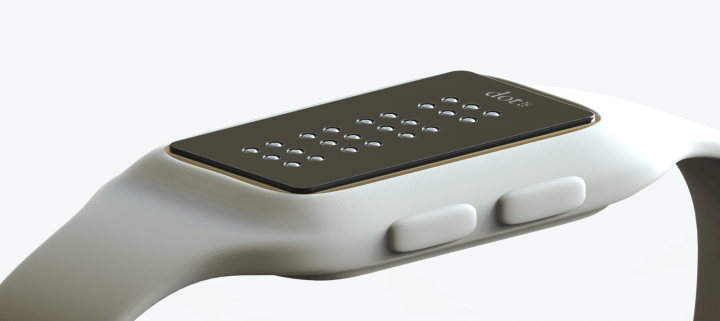
The Dot smartwatch appears, at first glance, like one of the many screenless wearables on the market already. You might mistake it for a white Fitbit from its telltale bulge where the hardware module rests atop the wearer’s wrist. That module houses four “cells” of six active dots each – enough for four Braille characters to be displayed at once. The device can be calibrated to display new characters at speeds ranging from a glacial 1 hertz to a breakneck 100 hertz; development has yielded a battery life of 10 hours, which will give average users five days between charges, Dot says.
The device is based on haptic technology, which provides feedback or information in real time through touch. By linking to any Bluetooth device, the Dot smartwatch can pull text from applications like iMessage using voice commands. Co-founder and CEO Eric Ju Yoon Kim says that Dot gives users the chance to read text their own way.
“Until now, if you got a message on iOS from your girlfriend, for example, you had to listen to Siri read it to you in that voice, which is impersonal,” Kim explains. “Wouldn’t you rather read it yourself and hear your girlfriend’s voice saying it in your head?”
As a wearable, Dot is still without competition. Current industry leaders produce hardware in the form of keyboards with active Braille cells that connect to computers via USB, with price tags in the thousands of dollars. Kim tells Tech in Asia that when the Dot smartwatch goes on sale in the United States this December, it will retail for less than US$300.
Going global
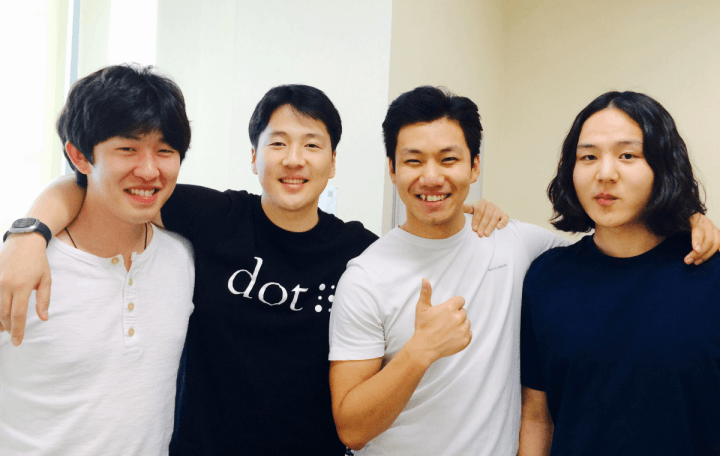
(L-R): Lead designer Mason Joo, CEO Eric Kim, CTO Ki Sung, and software engineer Juhwan Lim.
Kim founded Dot with Titus Cheng, a classmate from the University of Washington. The team they built in Seoul includes specialists in hardware, software, and design. In its first round of seed funding, Dot raised US$100,000 from the ActnerLab accelerator and an additional $500,000 from the South Korean government’s Tech Incubator Program for Startup (TIPS). The company will begin its second round of seed funding in August with a goal of raising US$1 million, and it’s hoping for international investors to help promote the company’s products overseas.
Educating a clientele
Making waves





Stay updated on the go with our mobile app.
Get latest insights with smoother, more personalized experience through TIA mobile app.









