Stefanie Yeo · · 6 min read
Cradle’s mission to fuel startup growth in Malaysia and beyond

Summary:
- Cradle is a government agency that drives Malaysia’s startup ecosystem forward by providing support to early-stage startups.
- By partnering with events such as Tech in Asia Conference 2025, Cradle is amplifying Malaysia’s position as a regional and global startup hub.
- Cradle’s strategy involves extensive collaboration, spearheading initiatives within Southeast Asia and seeing opportunities in building synergies with the Middle East.
- Dive deeper to learn more about Cradle’s mission, initiatives, and community.
It is often said that it takes a village to raise a child, and the same applies to startups. Building a startup is hard, and having access to the right resources – in terms of funding, partnerships, mentorship, and more – can be the differentiator between success and failure.
In Malaysia, Cradle is aiming to create that village. An agency under the Ministry of Science, Technology and Innovation, it focuses on supporting the development of early-stage startups.
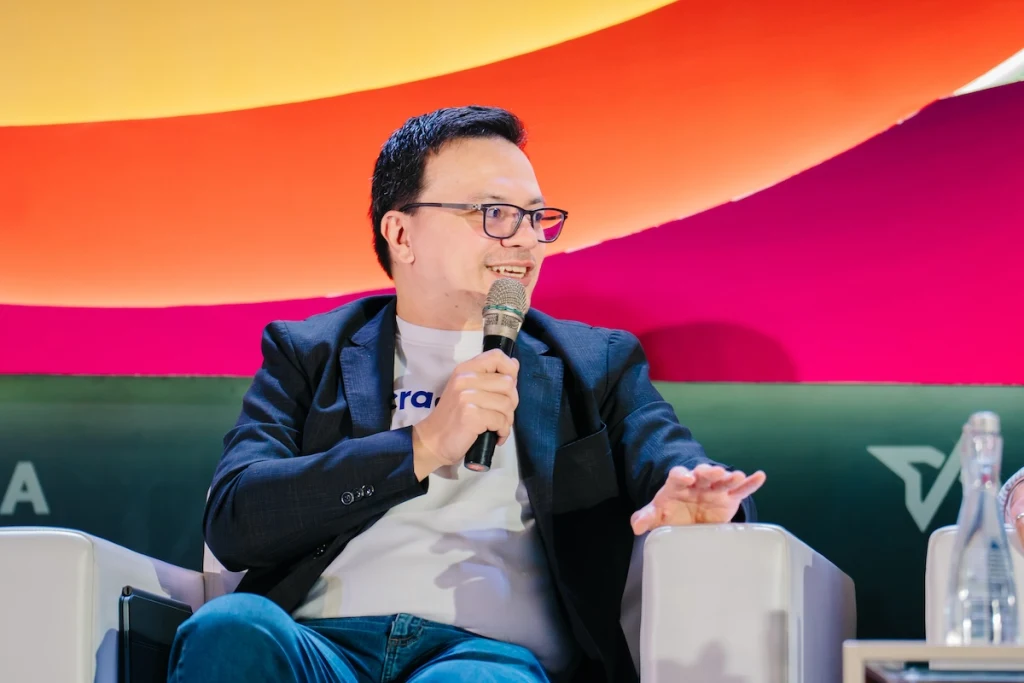
Norman Matthieu Vanhaecke, group CEO of Cradle / Photo credit: Tech in Asia
“We aim to drive the nation’s innovation and entrepreneurship agenda through funding, capacity building, and ecosystem development,” said Norman Matthieu Vanhaecke, group CEO of Cradle.
As part of its efforts to foster startup growth, Cradle came on board as a partner at Tech in Asia Conference 2025. It participated in a host of events and activations to connect with partners, builders, and enablers around the region, as well as cement Malaysia’s status as a startup ecosystem.
We sat down with Vanhaecke to learn more about the work Cradle does and the opportunities it sees for startup growth in Southeast Asia.
What is Cradle’s mission?
Cradle aims to create an ecosystem that supports a strong and innovative business-building environment for tech entrepreneurs and innovators by providing access to investment, commercialization support, and various other services to enable growth.
Why did Cradle decide to become a partner at Tech in Asia Conference 2025?
We joined Tech in Asia Conference 2025 to amplify the KL20 Action Plan to a global audience, showcasing Malaysia’s commitment to positioning Kuala Lumpur as a leading regional startup hub to investors, corporates, and startups across Southeast Asia and beyond.
The conference also serves as a platform to build momentum toward the Cradle LIVE! Startup ASEAN Summit 2025, strengthening networks and spotlighting Malaysia’s leadership in driving regional collaboration.
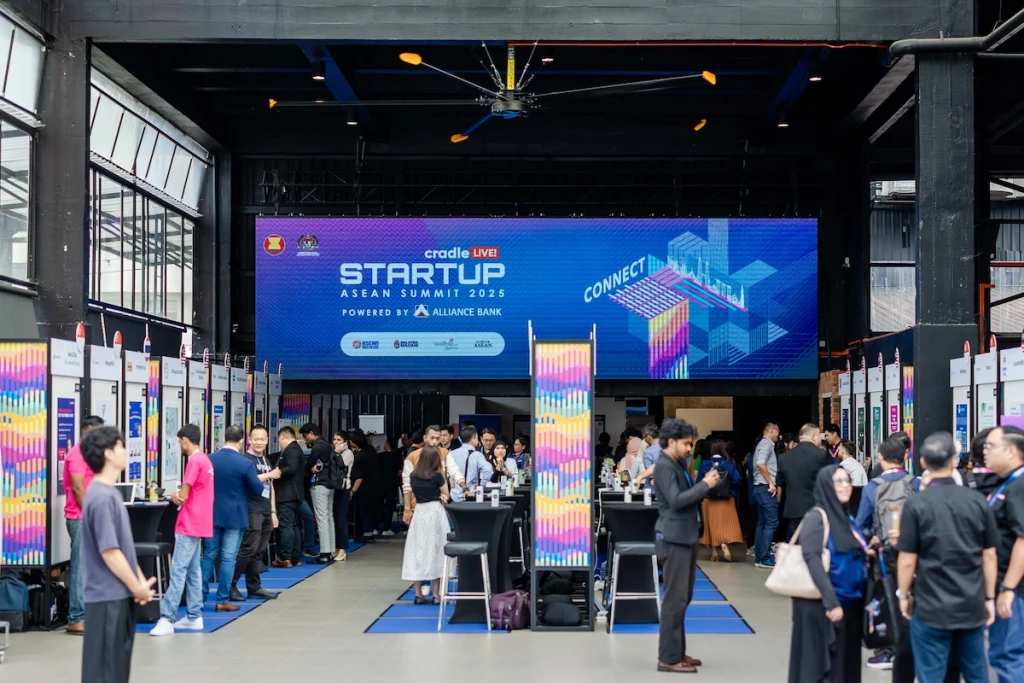
Cradle LIVE! Startup ASEAN Summit 2025 / Photo credit: Cradle
Participating at Tech in Asia Conference also enabled us to connect with global mentors and investors, unlocking new insights, partnerships, and bilateral market access opportunities for Malaysian startups.
What about Malaysia, and Southeast Asia more broadly, is exciting to Cradle?
Southeast Asia stands out as one of the most vibrant and fast-growing startup ecosystems in the world. For Cradle, the region’s diverse talent, entrepreneurial energy, and rapidly expanding digital economy offer immense opportunity for innovation and growth.
Strategically located at the heart of Southeast Asia, Malaysia serves as a natural gateway for startups to scale regionally and globally. This is reflected in the Global Startup Ecosystem Report 2025 by Startup Genome, which ranked Kuala Lumpur among the top 20 emerging startup ecosystems globally – a recognition driven by strong government support, rising early-stage funding, and deepening market access.
Building on this momentum, Cradle is committed to advancing national strategies such as the KL20 Action Plan and the Malaysia Startup Ecosystem Roadmap 2021-2030 to position the country among the world’s top 20 startup ecosystems by 2030.
What are the key initiatives Cradle has in place to support startups?
We have a number of different initiatives.
The Cradle Investment Programme (CIP) offers early-stage startups capital, mentorship, and business support. CIP Spark focuses on idea and prototype development, and CIP Sprint on market validation and early commercialization. So far, we have funded over 1,200 tech startups, created over 80,000 jobs, and achieved the highest commercialization rate among local government grants at 76.2%.
We also operate the MYStartup Single Window platform, which streamlines access to funding, programs, resources, and ecosystem partners. To date, it has registered more than 5,000 startups, making it the largest national database and gateway for Malaysia’s startup ecosystem.
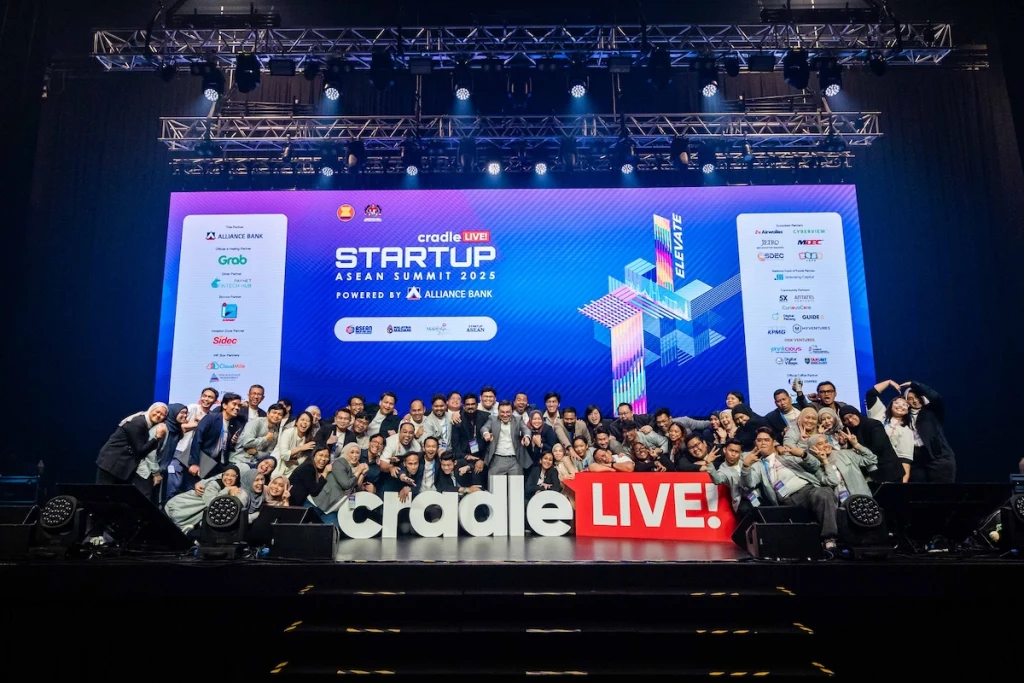
The Cradle team / Photo credit: Cradle
Bengkel Inovasi GLC is a collaborative program aimed at accelerating national development by connecting solution providers with implementation capacity, creating pathways between emerging tech developers and established market players. Some government-linked companies that have participated in the program include Bank Islam Malaysia, CelcomDigi, and the Malaysia Aviation Group.
Through the Cradle Innovation Advisory, we aim to address structural limitations within the national innovation ecosystem to help accelerate digital transformation among corporates and SMEs in Malaysia.
Dive deeper into Cradle’s support for the startup ecosystem
There is also the Startup ASEAN platform. Led by Malaysia, this regional initiative aims to connect startups, investors, and ecosystem players across ASEAN, fostering cross-border collaboration, talent mobility, and market expansion.
In the conference, you spoke on a panel about fostering greater collaborations between Southeast Asia and the Middle East. What are the synergies you see there?
The potential synergies between the Middle Eastern and Southeast Asian startup ecosystems are highly complementary, centered on a capital-for-market-access model and shared strategic sectors. Simply put, the Middle East has deep capital and is looking for solutions, while Southeast Asia has a massive, diverse market and high startup agility.
Sovereign wealth funds from nations in the Gulf Cooperation Council (GCC), especially the United Arab Emirates and Saudi Arabia, are diversifying their assets and pivoting toward Asia’s high-growth economies. This provides Southeast Asian startups with access to long-term capital.
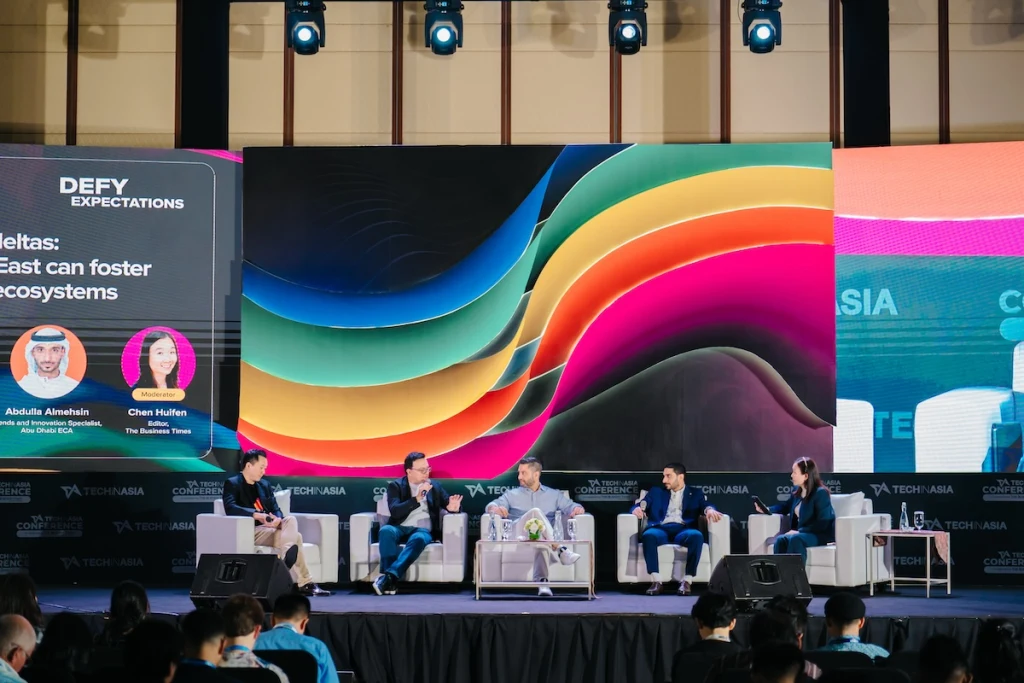
Vanhaecke speaking on a panel at Tech in Asia Conference 2025 / Photo credit: Tech in Asia
Markets like Indonesia, Vietnam, and the Philippines need large capital injections for their startups to scale from regional unicorns to global players. Middle Eastern funds are filling this gap, particularly in late-stage funding rounds.
Both regions have similar market characteristics with large and young populations, high mobile penetration, and a need for innovative solutions in sectors like fintech and healthtech, making business models easily adaptable across borders.
The halal economy also presents a significant synergy. Malaysia and Indonesia bring established expertise in halal certification, supply chain, and governance, while the GCC nations offer a high-demand market for halal-compliant goods and services.
What do you envision for the future of Malaysia’s – and Southeast Asia’s – tech and startup scene?
We envision Malaysia working with our Southeast Asian neighbors through Startup ASEAN to build an open, dynamic and scalable regional startup ecosystem – one where ideas move seamlessly across borders, investment and talent flow without friction, and Malaysian founders stand shoulder to shoulder with the world’s best.
By harnessing deeptech innovation, championing inclusivity across ASEAN, and aligning bold policy with ecosystem infrastructure, Cradle aims to enable not just thousands of startups but regional success stories that place Malaysia and ASEAN among the world’s leading innovation hubs.
Cradle is Malaysia’s focal agency for early-stage startups, driving the nation’s innovation and entrepreneurship agenda through funding, capacity building, and ecosystem development.
Learn more about Cradle and what it does on its website.
This content was produced by Tech in Asia Studios, which connects brands with Asia’s tech community. Learn more about partnering with Tech in Asia Studios.
Stay updated on the go with our mobile app.
Get latest insights with smoother, more personalized experience through TIA mobile app.
Recommended reads
 Indonesian AI startup goes global
 Forrest Li on scaling Sea, building smarter bots, and founder grit
 An AI assistant that joins sales calls and scores team skills
 SGX’s CEO says it doesn’t need a unicorn to win
 SMEs want AI too, but not the kind Big Tech is selling
 Oatside’s alt-milk rise hits a profitable gear
 Alibaba’s financial health in 12 charts
 Asia’s telcos bundle AI into mobile plans. Will it pay off?
 M-Daq chases bigger clients as revenue falls, losses grow
 VC tracker: Accel raises US$3.5b, including US$550m for India





Editing by Winston Zhang and Lorenzo Kyle Subido
(And yes, we’re serious about ethics and transparency. More information here.)