 Stefanie Yeo · · 5 min read
What does it take to make customer experience frictionless?

Great user experience is essential to the success of a company. After all, happy customers come back to buy more, which keeps the business going.
However, in an increasingly digital world, the meaning of good customer experience is changing rapidly. It’s trickier than ever to address customer needs effectively, and any friction could negatively impact a user’s opinion of a business, or worse, cause churn that impacts revenue and growth. It can be especially challenging to create a frictionless user experience for digital-first customers.
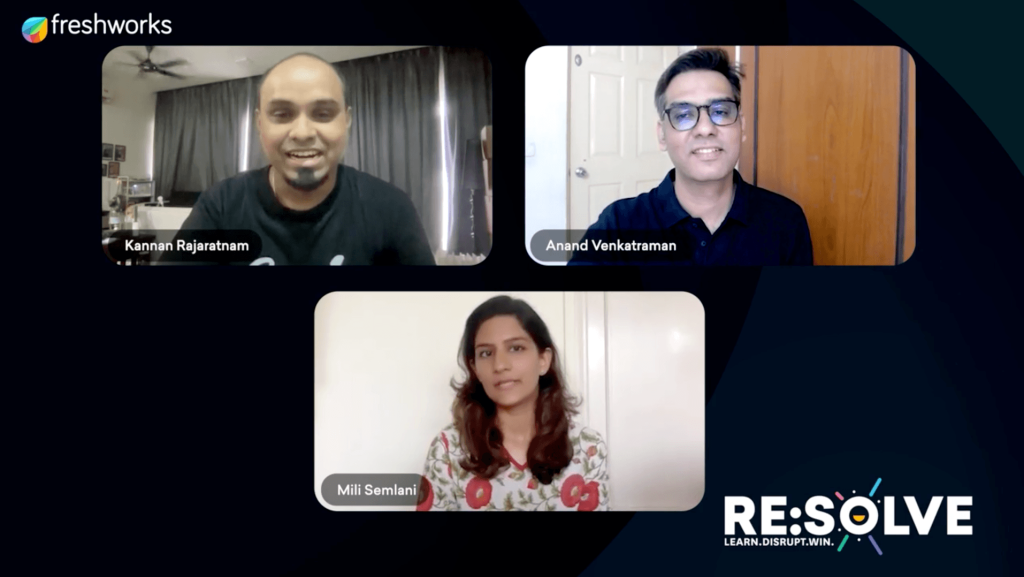
Photo credit: Freshworks
At Re:Solve, a virtual summit for digital-first customer experience organized by customer engagement firm Freshworks on August 26, business leaders from Freshworks and brands like online retailer Zalora shared their perspectives on what it takes to make customer experience as frictionless as possible.
It’s about trust
One of the key reasons friction comes up as an issue is because users want to be able to access anything – products, services, information – almost immediately, according to Anand Venkatraman, vice president and general manager for Asia Pacific, India, the Middle East, and Africa at Freshworks.
“There is this expectation of ‘instant-ness,’ of instant gratification, and it is percolating down all the way to the physical stores and to offline businesses as well,” he says, adding that these expectations, when unmet, create a sense of friction between customers and brands.

Anand Venkatraman, vice president and general manager for Asia Pacific, India, the Middle East, and Africa at Freshworks / Photo credit: Freshworks
“It’s like being in a relationship: There are certain expectations involved, such as answering calls promptly or responding to messages within a certain time frame,” says Kannan Rajaratnam, director of customer operations at Zalora. “Every second or every minute that is wasted, that sees a delay in getting a reply to a customer, becomes a trust deficit.”
This notion of friction holds true even beyond customer service queries. Every roadblock in a customer’s journey is a friction point, whether it’s a complicated payment process or the inability to find an answer to questions about a product, and reduces the likelihood of a purchase.
Meeting customers where they are
Making the customer experience smoother is crucial and there are several ways businesses can do it. Fundamentally, brands need to work to meet their customers where they are.
As one of the first ecommerce players in Southeast Asia, Zalora had to work hard to gain the trust of customers, many of whom were used to shopping offline. The firm rolled out pop-up stores across the region, which offered potential customers a physical connection with the brand even as it encouraged them to try its online services.

Kannan Rajaratnam, director of customer operations at Zalora / Photo credit: Zalora
Zalora also ensured that customers were empowered to help themselves through a straightforward returns and exchange process: Customers need not interact with a single customer service officer for returns or exchanges.
“Customers want to be able to control what happens with their order – if they need to change their delivery address, track parcels, or make a return, they can do it themselves very easily,” Rajaratnam explains.
When Covid-19 swept through Southeast Asia, Zalora equipped its mobile app with payment methods like cash on delivery, digital wallets, and “buy now, pay later” services.
All of this plays a role in the bigger story of streamlining a customer’s journey and ensuring the road to making a purchase – and returning to make more – is as effortless as possible.
Leveraging tech
However, no matter how much businesses work to ensure customers can navigate the purchase journey seamlessly, having strong customer service remains essential. After all, there will always be users who require more support for specific problems, and customer service plays a key role in addressing that.
Rajaratnam says ecommerce firms find it especially challenging during seasonal peaks in shopping trends.

Photo credit: dedivan1923 / 123RF
“No amount of customer service and operational personnel will suffice to handle the volumes that you get on these days,” he adds.
As such, he recommends that firms turn to technology to help address these challenges – a sentiment Venkatraman agrees with.
“We’ve found that 68% of customers like to engage with brands through messaging,” he shared. “To that end, tools like live chat can help support customer service significantly.”
Communicating over chat, for example, allows customer service personnel to attend to several users at a time. Live chats can also be augmented with artificial intelligence and chatbots, which can address frequently asked questions automatically and free up employees to focus on more complicated customer queries.
Businesses can also use relationship management platforms to help streamline workflows and provide a single source of truth for customer service personnel.
“The expectation of the customer is for the brand to recognize who that person is, and what they need,” said Venkatraman. After all, if a customer sends in an email enquiry and then has to explain their issue all over again to a customer service representative on the phone, that creates obstacles in the user journey.
“[Tech] really streamlines the experience and helps ensure greater service quality,” he adds.
A hassle-free customer experience
The truth is, keeping up with changing customer demands can be hard, especially in the face of new challenges brought about by larger socioeconomic forces. However, brands can build trust with their users and make the customer journey as smooth as possible by addressing customer needs effectively and leveraging new technology.
And reducing friction is just one aspect of the larger customer experience: In a digital world, brands have to understand how customer experience affects the growth of a business on a larger scale.
Businesses can learn from those who have successfully delivered digital-first customer experiences, and that’s what Re:Solve aims to help them do.
The event brought together insights from many leading businesses. Aside from Zalora, attendees heard from speakers from companies such as edtech unicorn Byju’s, online eyewear retailer Lenskart, and digital payments provider PhonePe, who shared how their companies are meeting the challenges of customer experience in a digital world.
It also featured perspectives from cricket icon Adam Gilchrist and activist Shiza Shahid on the value of empathy, disruption, and transformation, as well as masterclasses on how firms can utilize tools such as bots and messaging apps to enhance their customer service.
As the world marches on, customer expectations and demands continue to change and evolve – and it’s more important than ever for brands to keep up.
Re:Solve is the biggest summit for digital-first customer experience. Organized by Freshworks, the event aims to bring together leaders who have disrupted customer experience with a digital-first strategy and achieved exponential growth to share their secrets to success.
Register to watch the sessions on-demand here.
This content was produced by Tech in Asia Studios, which connects brands with Asia’s tech community. Learn more about partnering with Tech in Asia Studios.
Stay updated on the go with our mobile app.
Get latest insights with smoother, more personalized experience through TIA mobile app.
Recommended reads
 Making sense of Grab’s cloud kitchen shutdown in Indonesia
 Cold chain may be the next opportunity for Indonesia’s logistics startups
 How real-world validation helped this digibank launch its unique services with confidence
 How AI is making the future clearer for business forecasting
 Oddle built a profitable food delivery business. Here’s how
 As inflation bites, Indonesia’s warungs and low-income workers may have most to lose
 How the newest generation of hospitality businesses is revolutionizing the industry
 Can Sociolla become the AWS for smart retail?
 Ex-Google execs’ firm partners with delivery riders for commission-free online ordering in SG
 How ecommerce firms can get the most bang for their buck with digital advertising





Editing by Nathaniel Fetalvero and Arpit Nayak
(And yes, we’re serious about ethics and transparency. More information here.)




📅 Upcoming Events
22 October 2026
Payoneer x CSPN Summit 2026