Grace Priscilla Teo · · 4 min read
How a custom AI ordering bot turned SaladStop into a tech vendor
This article summarizes an episode of Amplify’s video series featuring Adrien Desbaillets, CEO of SaladStop.
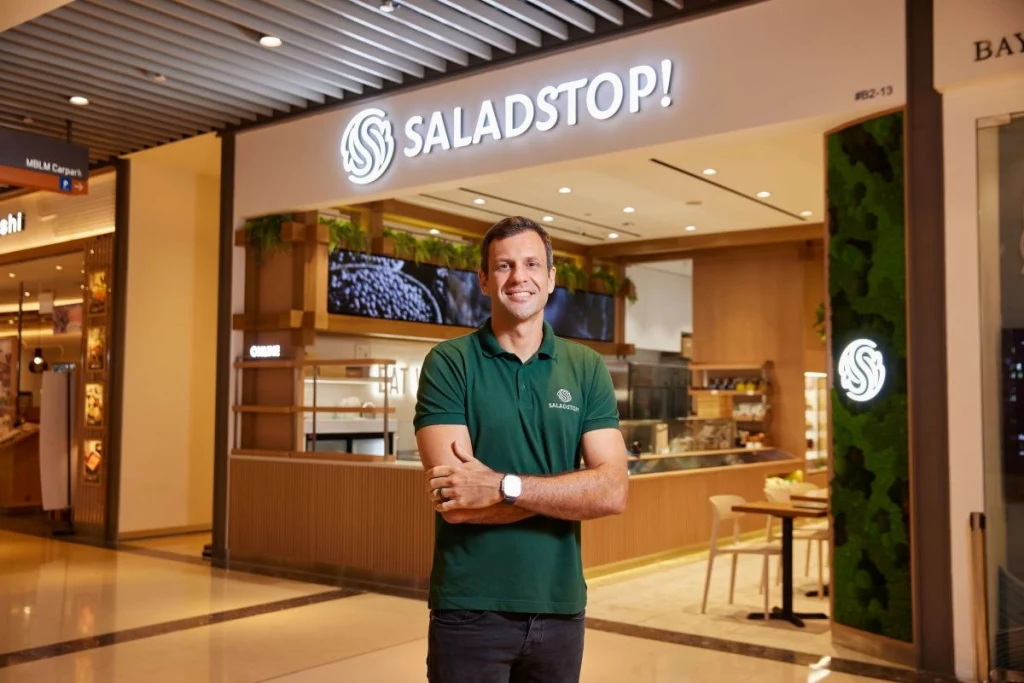
Adrien Desbaillets, CEO of SaladStop / Photo credit: SaladStop
Adrien Desbaillets, CEO of SaladStop, warns that the technology industry overestimates the power of general AI to disrupt established businesses. At a time when many believe basic AI models can easily replace existing companies, Desbaillets counters that a long history of smooth operations and proprietary data protects legacy businesses in ways startups cannot match.
In his view, surviving the AI transition requires relying on deep domain expertise rather than general computer programs. Companies that utilize years of their own customer data can protect their market share while successfully transitioning into technology providers.
Rethinking the benefit of AI
Because of this reliance on proprietary data, trying to change an industry using only a general AI model is rarely enough. While some founders assume an off-the-shelf tool can replace established food operations, these broad models lack the historical context needed to actually run a kitchen.
Desbaillets notes, “With 10 years of orders, the knowledge base that we’re building now, the depth of [our] expertise in the nutritional space, is going to be hard to compete against.”
He argues that broad AI systems will never replicate years of fine-tuned operations. “If you have a specific domain expertise, LLMs are not built for that,” he adds.
Customers still value human interaction
Beyond the kitchen logistics, that historical context also shapes how the food is served. Desbaillets points out that even as backend automation increases, diners still expect genuine interaction at the counter.
“I think that at some point the imperfection… that human touch, I think that’s what people will still be looking for,” he explains.
Handling difficult customer requests
To balance this need for personal service with the efficiency of automation, SaladStop looked at where dining friction actually happens: the menu.
Managing specific dietary restrictions through a standard list often frustrates both the customer and the staff, prompting the company to build an AI ordering system named Lulu that turns spoken requests into standard kitchen tickets.
Instead of navigating a restrictive menu, users simply speak their preferences to get exactly what they need.
Desbaillets explains how a user might say, “Build me a bowl below 500 calories with 35 grams of protein. I love corn. I want something spicy. I hate olives,” and the system instantly generates custom options.
Past data ensures high quality results
Processing those requests without serving unappetizing combinations required the company to ground Lulu in historical reality. To do this, they rebuilt their data systems to rely on proven past orders rather than AI guesswork.
Becoming a tech provider
Setting business limits





Stay updated on the go with our mobile app.
Get latest insights with smoother, more personalized experience through TIA mobile app.