During my years as an angel investor, I came across different equity crowdfunding platforms and have met founders who were apprehensive of using such a platform to raise funds. They thought it would send a signal of “negative select.”
I have also come across investors who believe that stronger companies do not use a crowdfunding platform to raise funds.
In this article, I try to dismantle some of those myths and make comparisons of some of the top platforms. The rating is based on the pros and cons of each from available information.
A caveat: This article is not a comprehensive list of the equity platforms. Those rated here are evolving fast and so the rating may not be a true reflection of the space. The goal is to help investors and founders make an informed decision.
But before we dig into the individual platforms, let us talk about equity crowdfunding, its history and the myths surrounding it.
What is equity crowdfunding?
Crowdfunding is a way of getting support from the “crowd.” That means you, me, and all our friends and families could contribute money to help a certain founder, innovator, or startup who is asking for help to continue their idea and work on their new company.
As more people connect to the internet, it has become easier to reach thousands who believe in similar causes. The support may be in the form of a donation or financial support to build your favorite cooler, for example.
Equity crowdfunding is where you can invest in a startup in exchange for equity or shares in the company. Since this falls into the securities area, the restrictions are tighter. The companies raising funds are at different stages of the business life cycle and may be at the early idea stage with very little traction or they may be at a stage where the startup is generating millions in revenue.
Why equity crowdfunding?
Equity crowdfunding is a win-win situation. Well, sort of.
For the early-stage founders, raising capital has always been a difficult task; banks generally do not lend to businesses at this stage. The world of angel investment/VCs is often shrouded in mystery and is difficult to navigate.
Before this current trend began, a founder would have to rely on her contacts to get through to an investor.
For investors, it has been difficult to get access to high-growth companies and this access has so far been limited to only a lucky few, those who have the necessary network and are in the right place at the right time.
Unlike traded companies, where you can ask your broker to buy a share, buying shares at private companies has been limited to a few individuals who are part of the circle. It is important to get into these companies because data indicates that a lot of wealth will be generated from them. If you are the suspicious type, look at the following chart. It highlights how the returns are shifting from public to private markets.
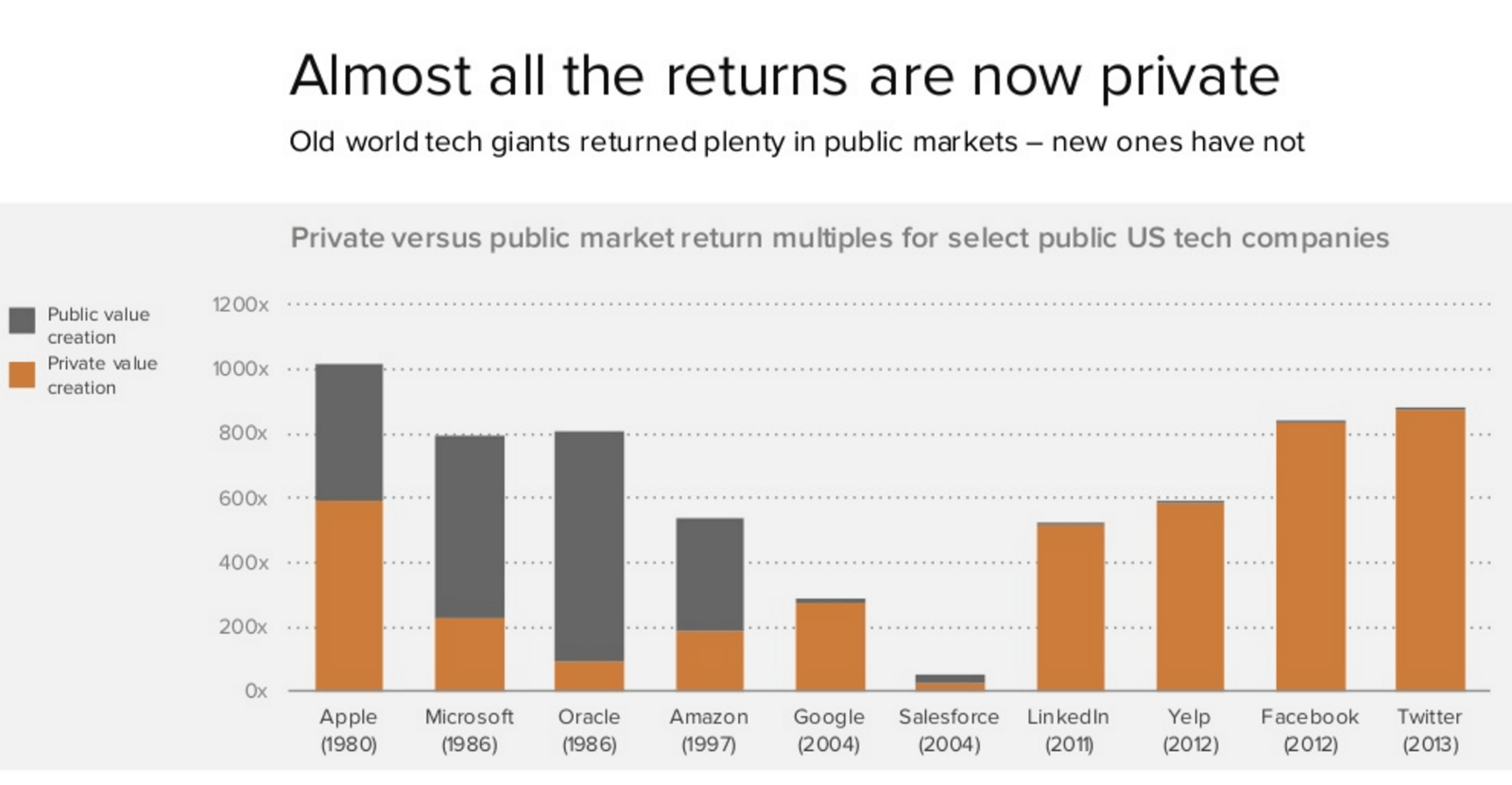
Photo credit: Andreessen Horowitz.
The history
The regulation
How big is equity crowdfunding?
Direct vs indirect investment
Products
The myths
So, how do the platforms stack up?
Conclusion





Stay updated on the go with our mobile app.
Get latest insights with smoother, more personalized experience through TIA mobile app.










📅 Upcoming Events
22 October 2026
Payoneer x CSPN Summit 2026