 Nathaniel Fetalvero · · 4 min read
Are corporate accelerator programs becoming redundant?


Photo credit: Pexels
For almost as long as startups have been around, accelerators have been there to guide them. The rise of these programs started in 2005 with the founding of US seed accelerator Y Combinator, which launched billion-dollar companies like Dropbox, Airbnb, and Stripe.
With the increasingly lucrative potential of the model, corporations have followed suit. In 2009, for example, Microsoft created BizSpark, its own startup support program, which the tech giant has updated several times.
While seed accelerators focus on driving a company’s growth by providing resources and mentorship, their corporate counterparts have an added goal: to keep themselves up to date with emerging technology.
While working with corporations means that participating startups can expedite the adoption of their tech solutions and become part of a larger product ecosystem, the rapid growth of the startup space may be affecting the viability of these types of programs.
Growing ecosystem, changing needs
As internet access becomes more widespread, information on starting a business is now easier for entrepreneurs to find. According to Sean Tan, managing partner of Korea Innovation Launchpad in Singapore (KILSA), this means that accelerators can’t just bank on offering mentorship and capital as their only selling points.
“After the accelerator program ends, there has to be follow-through. Especially for foreign companies leveraging Singapore as a launchpad, it’s vital to ensure there’s a local presence and local resources beyond just a simple four- to six-week program,” he shares.
For instance, while KILSA’s approach seeks to assist startups via mentorship, funding, and business matching opportunities, it also offers other services like helping set up a local team, following through with deals that were made, and even raising funds to scale the business. This ensures that the networks created during the accelerator program don’t go to waste when participating founders return to their home countries.
Some platforms like venture builder Budding Innovations also give startups assistance that’s tailored to their growth stage and needs.
“If [the participant] is still a lab-based team – for example, a scientist in ASTAR – we can help with all the steps to set up an operational company,” shares Budding Innovations CEO Bert Grobben. “If a startup is already at the later stages and they come to us with an MVP, then we can bring on board a whole different skill set to help them scale.”
However, Kong Wan Sing, founder and CEO of workspace provider JustCo, points out that corporations need to consider the slow rate of return on accelerator investments, due to the cost of crafting such tailored initiatives.
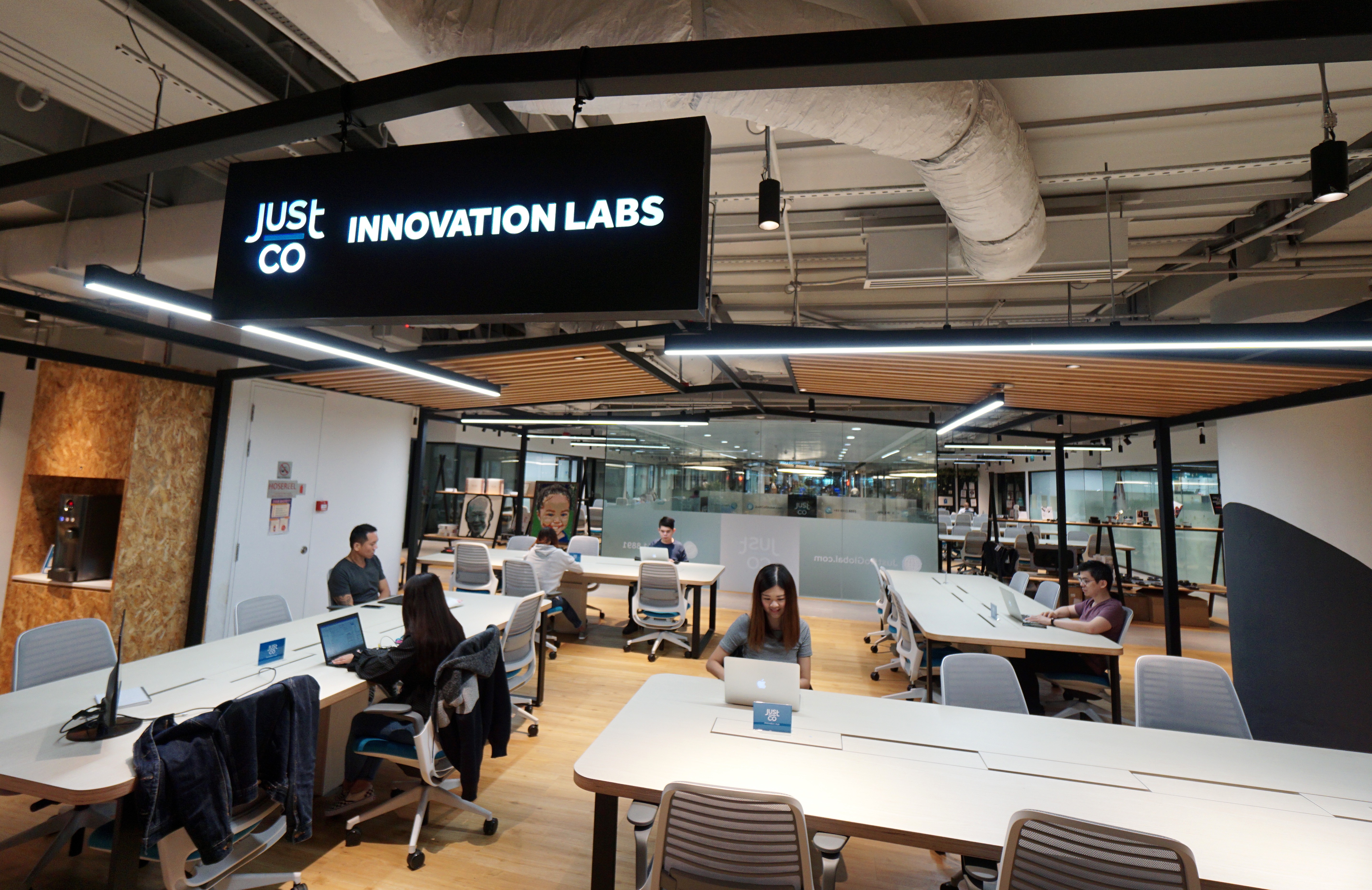
Photo credit: JustCo
“In most cases, corporate initiatives and their stakeholders are put against goals [that are] reviewed on an annual basis as compared to accelerators, which can only expect to see returns on their startups on a four- to five-year horizon,” he explains.
This time gap makes it difficult for corporations to justify such initiatives to stakeholders. Instead of giving customized support for startups, corporations may then opt to only provide general services to optimize their operational costs. But doing so would lessen the overall impact of their accelerators and diminish their appeal to participants.
According to Grobben, however, corporate accelerators aren’t down for the count yet. Rather, he thinks they will go through an evolutionary process.
“I expect corporate accelerators to start further experimenting with not just connecting corporates with startups, but actually bringing more capability partners on board,” he shares. For Budding Innovations, Grobben says it teamed up with Bangkok-based Rise Accelerator so it could offer a wider pool of connections for participants.
It also began working with JustCo Labs, a regional platform run by the workspace provider to house accelerators, incubators, and corporate innovation labs. These entities can run their programs in areas within JustCo spaces, attend events, and network for possible business opportunities. Working with JustCo Labs can also reduce the upfront investment required to run a program, as entities will only be charged when program cycles go live.
In the same vein, corporations can partner with other organizations to scale their accelerators at lower costs.
The future of acceleration
As the startup ecosystem continues to grow, the needs of entrepreneurs will inevitably change as well. As such, JustCo’s Kong believes this will lead corporate accelerators to become “asset-light and nimble enough to pivot when required” by relying on their existing network and resources to be able to react swiftly to evolving demands.
On the other hand, Lawrence Lim, who heads international development at blockchain platform IOST, says this will cause a surge in the use of predictive models to determine the potential returns that corporations can get from working with startups. In IOST’s case, using data can help it calculate a firm’s viability.
“We’ll be able to identify early from all the data that the solution will have good traction, and we’ll feel comfortable investing more. If it’s going to be bad, we’ll either suggest for [the startup] to pivot or – if it’s going to be a bad investment – we can exit earlier and manage our losses,” explains Lim.
Regardless of how corporate accelerators will evolve in the coming years, Grobben says it’s important for such initiatives to be purposeful.
“It’s important to accelerate startups such that they can really drive impact to the industry. I think acceleration programs that do that will be more successful,” he asserts.
JustCo Labs is an initiative that serves as a nurturing ground for the next generation of technology innovators and disruptors by providing accelerators and startups access to JustCo resources.
Learn more on the JustCo Labs website.
Stay updated on the go with our mobile app.
Get latest insights with smoother, more personalized experience through TIA mobile app.
Recommended reads
 Edtech accelerator EduSpaze names 9 startups in 5th cohort
 Recession Run: 500 Global’s investment plan in SEA
 To take VC money or not: Indonesia’s profitable bootstrapped startups at a crossroads
 Y Combinator cuts cohort size by 40% amid market downturn
 Singtel pours additional $100m in VC arm Innov8
 1337 Ventures opens applications for 43rd cohort of digital accelerator
 US investor Franklin Templeton opens inaugural Asian fintech incubator in SG
- Balance of power tilts in favor of self-sustaining startups
 Thai startup media firm launches early-stage accelerator program
 500 Startups partners with government unit to support tech startups in Cambodia





Editing by Jaclyn Teng and Eileen C. Ang
(And yes, we’re serious about ethics and transparency. More information here.)






📅 Upcoming Events
22 October 2026
Payoneer x CSPN Summit 2026