The Asia Pacific Gateway (APG) is an NTT (Nippon Telephone and Telegraph)-led initiative to lay submarine cables across 12 Asian Telcos and not 11 as initially reported.
These countries include: China (China Mobile, China Telecom, China Unicom), Taiwan (Chunghwa Telecom), Korea (KT and LG Uplus), Japan (NTT Communications), Singapore (StarHub), Malaysia (Time dotcom), Vietnam (Viettel and Vietnam Posts and Telecommunications) and the Philippines (PLDT).
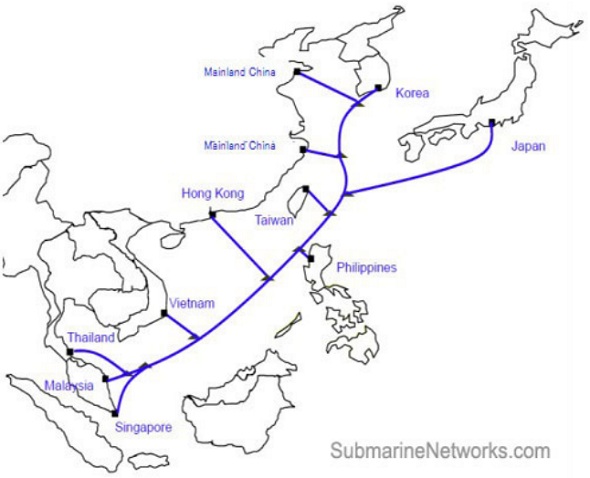
Credit: SubmarineNetworks.com
The net effect of this project is to increase the available capacity in Asia from 10 Terrabytes to over 40 terrabytes (see graph).
According to published reports in the BBC, this project is envisioned to provide “a better user experience for a greater number of Facebook users in countries like India, Indonesia, Malaysia, the Philippines, Hong Kong, and Singapore“. This reflects “Facebook’s journey into the East” where growth rates are still climbing while its US growth had “slowed sharply”.
Potential Benefits:
For startups in Asia, among the benefits includes lower latency (time it takes traffic to reach a destination) and a possible drop in bandwidth costs (at least for intra-asia). New revenue sources could open up. Companies like Starhub, in theory, could extend its cable services to other countries by routing the video over to this 40gbps (soon to be 100gpbs) link.
Another potential benefit might be improved mobile Internet access for users via wifi hotspots instead of LTE or 3G technology. Companies such as Devicescape offers a Wifi Offload technology for mobile operators that automatically detects nearby Wifi hotsposts and connects mobile subscribers over WiFi rather than take up scare capacity on cellular networks.
Yet the project raises some questions.
Mystery #1 No direct link to the US.
Unlike Google’s UNITY project that includes a ‘back haul’ to the US (Network diagram reproduced below), the APG project (based on recent published diagrams) show that it has no known links back to the US where Facebook servers are.
Without this link back to the US and to Facebook servers, it is unclear how Facebook users using APG could connect to Facebook. Nor for that matter, how “the fibre-optic cable will help the countries send and receive data to North America faster,” according to consortium leader Time Dotcom.
Mystery #2 Facebook is Censored in China.
Even if Facebook were able to connect its servers to the APG, Facebook is currently blocked in China and until censorship is lifted, users in China won’t be able to access the social network.





Stay updated on the go with our mobile app.
Get latest insights with smoother, more personalized experience through TIA mobile app.