 Jonathan Chew · · 5 min read
Context matters: International business communication takes more than just translation

In 1987, Braniff Airlines made a critically embarrassing error.
The US-based carrier wanted to show off its luxurious leather seats but made a mistake when translating its marketing materials into Spanish. Because the Spanish terms for “in leather” and “naked” sound extremely similar, Braniff ended up telling the Hispanic market to “fly naked.”
Such gaffes are a clear reminder of why effective and accurate communication is vital, especially in a globalized world.
However, language barriers remain a perennial issue in international business communications. Despite English being considered the world’s top business language, less than 400 million people use it as a first language.
“This language barrier can lead to frictions in collaboration, productivity, customer service, and global expansion,” says Fardad Zabetian, CEO and co-founder of Kudo, a multilingual web conferencing platform. Miscommunication could lead companies to miss out on crucial business opportunities or damage their reputation.
Indeed, 64% of respondents in a 2012 survey conducted by the Economist Intelligence Unit said that differences in language and culture made it difficult to gain market share in new territories.
More harm than good
While companies have several options to overcome the language barrier, not all are effective. In fact, some could even create new problems.
For instance, companies might rely on bilingual employees to act as interpreters. But because they aren’t professionally trained, technical material and linguistic subtleties that could change the meaning of a word or sentence might escape their notice, Zabetian explains.

Fardad Zabetian, CEO and co-founder of Kudo / Photo credit: Kudo
Adding interpretation to an employee’s job responsibilities also hurts their productivity and wastes key resources. At the big-picture level, this distracts a company from its core growth efforts.
To help with written translations, some businesses use automated online translation tools like DeepL. However, these tools tend to fall short when unfamiliar cultural nuances need to be taken into account, particularly when there’s no proper oversight from professional interpreters.
Being aware of these nuances is especially important in countries with high-context cultures such as Japan, China, and France, where people rely on underlying context, meaning, and tone during communication. Any of these elements could alter the way customers perceive messages.
The inability of automated tools to consider cultural contexts could potentially cause misunderstandings and communication errors that are damaging to the company’s brand.
“Simultaneous interpretation requires emotional intelligence and the ability to produce ‘neutral’ language to match the audience’s cultural context,” observes Zabetian.
Get a professional
Ultimately, the best way for businesses to overcome the language barrier is by using professional interpreters, according to Zabetian. In this regard, companies can look to service providers like Kudo.
“Using professional interpreters with experience in the subject matter will ensure the message is communicated accurately and matches the audience’s cultural sensitivities,” he explains.
Online platforms also allow for interpretation to be conducted remotely – a great boon for companies that need to quickly reach a global audience. Kudo, for its part, hosts a marketplace that allows companies to book interpreters for multilingual meetings up to two hours prior to an event.
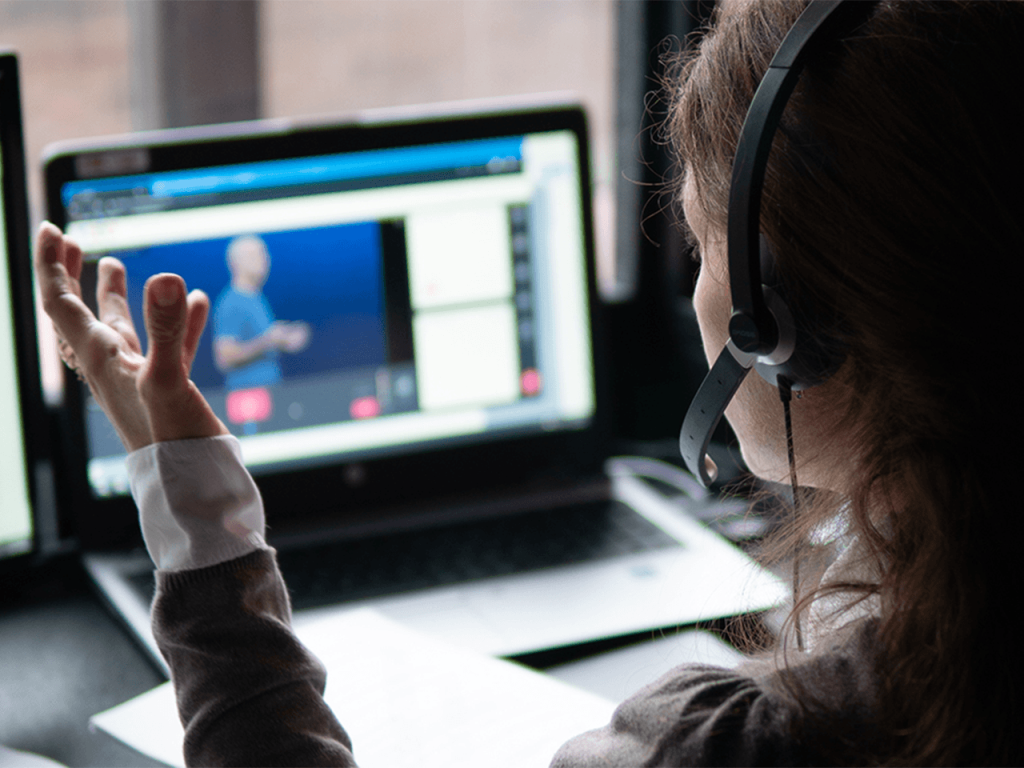
A Kudo interpreter conducts remote simultaneous interpretation / Photo credit: Kudo
This feature came in handy in 2018, when the Inter-American Telecommunication Commission (CITEL) took part in a two-week-long conference in Dubai. The organization wanted to hold daily briefing sessions for its members during the conference, but that required interpretating information into English and Spanish.
CITEL members were able to attend briefings dubbed in the language of their choice through remote interpretation services provided by Kudo. This allowed CITEL to help its members make the most out of their time at the conference. CITEL also got onboarding assistance prior to the event to ensure that it could learn to use Kudo’s platform effectively.
Using professional interpretation services also shows that companies genuinely want to understand their audience’s point of view. In situations that involve sensitive information, such as health concerns or legal matters, this sincerity is instrumental in winning the other party’s trust.
For example, a study published in the Health, Risk & Society journal found that patient trust in doctors was linked with their willingness to engage in medical procedures or alternative therapies in which the long-term risks were unclear. This shows the importance of sincerity in communication – something that may be lost in ineffective translation.
During meetings, companies can overcome the language barrier and smooth out communication if they can provide a good interpretation experience.
In this regard, AI-powered tools like live captioning could be useful in meetings when simultaneous interpretation is necessary, as they allow participants to quickly identify who is talking. It can also help promote inclusivity for variety of users, including those who are hard of hearing.
Apart from live-captioning capabilities, Kudo’s platform offers other AI solutions such as an interpreter assistance tool. Thanks to this feature, interpreters can generate a glossary of translated terms from documents, web pages, and keywords before meetings take place. By planning ahead, they can ensure that the interpretation – even when it includes technically difficult subjects – can flow smoothly and accurately.
Overcoming the final obstacle
The demand for bilingual capabilities in international business communications grew by more than 2x in five years. As such, platforms that provide interpretation and translation services will have a sizable impact on business capabilities.
“For businesses looking to globalize, interpretation is essential,” says Zabetian. “It gives clients and partners a better overall experience, and it facilitates communication and collaboration without anything being lost in translation.”
He believes that remote simultaneous interpretation platforms like Kudo will eventually become seamlessly integrated into all business communications, making multilingual interactions the norm. When that happens, the world can move towards a more “promising” and interconnected future.
“The language barrier is the last obstacle that must be overcome for people and businesses to truly connect on a global scale,” he contends.
Kudo is a live interpretation platform that gives users the power to be understood by allowing them to engage in their preferred language, removing language barriers and easing communication.
To find out more about Kudo, schedule a demo on its website.
This content was produced by Tech in Asia Studios, which connects brands with Asia’s tech community. Learn more about partnering with Tech in Asia Studios.
Stay updated on the go with our mobile app.
Get latest insights with smoother, more personalized experience through TIA mobile app.
Recommended reads
 Indonesian AI startup goes global
 Forrest Li on scaling Sea, building smarter bots, and founder grit
 An AI assistant that joins sales calls and scores team skills
 SGX’s CEO says it doesn’t need a unicorn to win
 SMEs want AI too, but not the kind Big Tech is selling
 Oatside’s alt-milk rise hits a profitable gear
 Alibaba’s financial health in 12 charts
 Asia’s telcos bundle AI into mobile plans. Will it pay off?
 M-Daq chases bigger clients as revenue falls, losses grow
 VC tracker: Accel raises US$3.5b, including US$550m for India





Editing by Winston Zhang and Eileen C. Ang
(And yes, we’re serious about ethics and transparency. More information here.)




