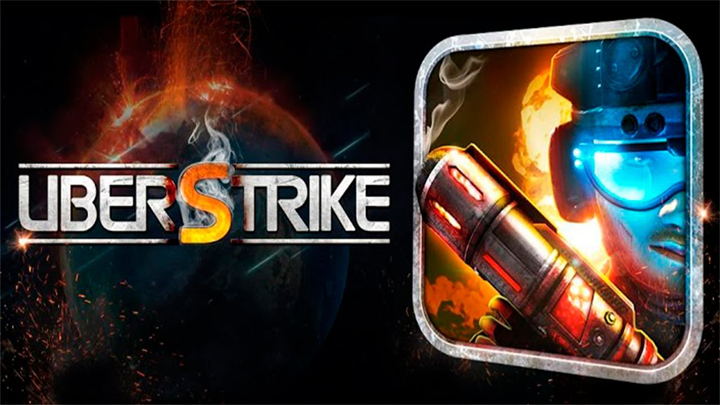
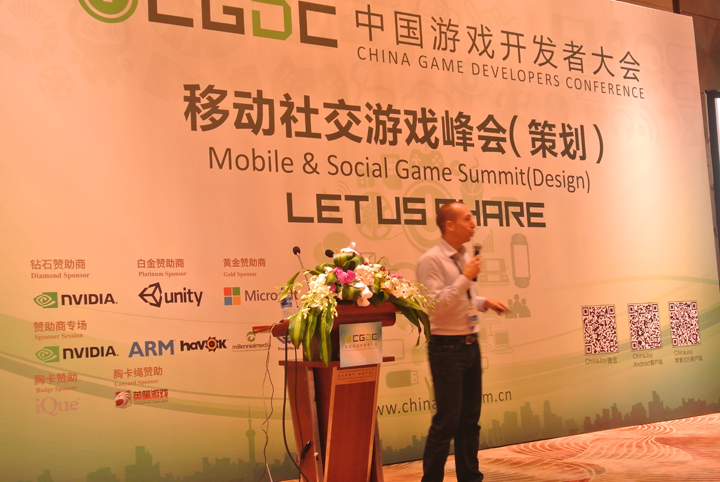
Cmune has been the leading company at the forefront of the free-to-play 3D shooter scene since the revamp of its previous title Paradise Paintball into Uberstrike in 2010. The game presently has around 1.3 million monthly users across all its platforms which include web browsers and the iPad. Cmune CEO and co-founder Ludovic Bodin spoke recently at the China Game Developers Conference during Chinajoy about the company’s practices which have led to Uberstrike’s success – and he also outlined the potential challenges companies will face when looking to make a foray into this space.
Keyboard and mouse adaptation: Arguably the most important point in the list, the company created a control scheme for its iPad game that’s similar to the keyboard and mouse mechanic that has been the bread and butter of PC shooters. To address the issue of players across different platforms sharing the same battle sphere, Cmune had to ensure the non-PC players in Uberstrike would not be at a disadvantage when matched up against their PC counterparts so as to ensure a unified and fair user experience. Through user feedback, the system has also been continually refined and improved upon.
Competitive “play to win”: Although the game is free-to-play and adopts a freemium approach of microtransactions as its revenue model, Ludovic stressed that Uberstrike places an emphasis on balancing the game between paying and free users. He highlights the fact that there are no weapons exclusive only to paying users and the entire game’s arsenal can be accessed by all users. The difference between player classes determines only the speed at which the weapons can be acquired.
Community management: Unlike more casual games, the core nature of Uberstrike pits players against each other frequently in a relentless online competitive setting. Games within such a category have to deal with the constant problem of cheaters who can ruin the experience of others using exploits in the game’s framework to create hacks that give them an advantage over others. Ludovic stresses how his team focuses a lot of their effort and time on patching the game and stomping out hackers to keep gameplay fun and fair for all players.
Content crowdsourcing: In addition to content pushed out from its employees, Cmune provides its own set of tools and tutorials to encourage the game’s community to create its own custom content like maps which are pushed out to the player base. This gives the opportunity for talented community members vested in the game to create unique content that builds on the user experience.
Player conversion: Nothing speaks more to your audience than positive opinions from fellow community members. The company has an ongoing practice of reaching out to high-level and prominent players in the community, converting them into advocates for the game. They provide the platform for them to create tutorials and forum posts for fellow users, establishing greater engagement with the user-base.
Industry Challenges
Having fully experienced creating a successful free-to-play 3D shooter from scratch, Ludovic highlighted some of the challenges game studios looking to grab a slice of the pie in this arena will face.
The staggering profits seen in mainstream shooters like the Call of Duty and Battlefield franchises always come on the back of huge budget allocations from large studios like Electronic Arts and Activision. Such financial outlays are not common for smaller indie studios looking to create something in the genre.
Unlike PC and console-based shooters, which often have gigantic file sizes, indie studios looking to create shooters that target mobile platforms have to contend with memory limits. This fact is even more prevalent in developing countries with dated phone models.
Although the benefits of pushing out games on multiple platforms are apparent, the extended expertise required is still an additional obstacle companies have to contend with. Some have chosen instead to focus on a sole platform rather than deploy their games over a wide array of platforms like Android, iOS and web browsers.
Last but not least, to even venture building a shooter on multiple platforms in addition to the PC, a competent control scheme has to be established across non-PC platforms to provide a smooth user experience when all players congregate.





Stay updated on the go with our mobile app.
Get latest insights with smoother, more personalized experience through TIA mobile app.