 Edith C. · · 5 min read
How cloud computing services impact markets like Indonesia

In Southeast Asia, people are likely to use a digital service like Grab or Gojek to get a ride. In seconds, they can be matched with a driver. And millions more are on similar mobile apps as customers or partners for convenient services. Cloud computing helps these companies store, manage, and process data through remote servers.
With the amount of data startups process in each country, cloud computing is a critical 24/7 business function. Data needs to be securely stored, retrieved, and analyzed whenever users need the service, and startups need to make multiple critical data-based business decisions at all hours of the day. This is why cloud services are important to businesses and up-and-coming Southeast Asian markets.
Why cloud computing is important to Indonesia
In Indonesia, it’s not only the four unicorns – Gojek, Traveloka, Bukalapak, and Tokopedia – that deal with a large amount of data on a daily basis while remaining compliant with regulations and protecting user privacy. Small hypergrowth local startups, reminiscent of China’s gladiatorial entrepreneurial ecosystem illustrated by venture capitalist Kai-Fu Lee, have also been sprouting throughout Indonesia and Southeast Asia.
The next unicorns from Indonesia are predicted to be from the education and healthcare sectors. Both industries straddle traditional and future mindsets, and deal heavily with personal data and content.
Indonesia’s digital dreams are for it to stand as the region’s digital tech hub by 2020 by leveraging on its tech industry. It’s estimated that the country’s digital trade sector could create US$172 billion worth of economic opportunities by 2030 for the domestic economy alone.
This goal isn’t a pipe dream. According to PricewaterhouseCoopers, Indonesia is set to be the world’s fourth-largest economy in 2050, behind China, India, and the US.
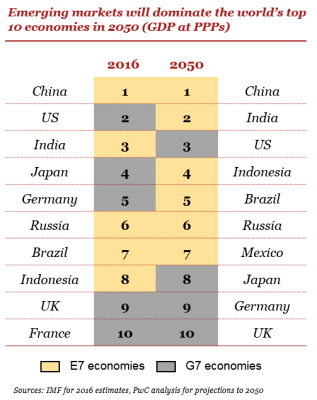
And digital services that power Indonesia’s future can’t exist without the cloud. Without the cloud, many digital services and traditional industries like financial services might go dark. Famous businesses using cloud computing services come from a range of legacy and new businesses, from Xerox (through a cloud print solution) to Netflix.
What Indonesia can learn from China’s cloud and ecommerce ecosystem
Cloud service providers like Alibaba have pounced on this opportunity by growing and committing data center capacity to streamlining business processes. But what makes a difference in the local ecosystem is the cloud service’s physical presence, which brings about a robust win-win ecosystem, according to Leon Chen, country manager of Alibaba Cloud Indonesia.
“Since we’ve set up a data center, I can see the difference [in response] from customers and founders. It’s about human attachment. They feel we’re serious to the market,” he says.
There’s transferable expertise for Indonesia from China. Both are large developing markets with resources, landmass, and population. And Indonesia is practically unrivaled in size in Southeast Asia.
Chen shares two observations of how a service like Alibaba Cloud could drive Indonesia’s digital dreams.
1. The cloud can help scale up operations
The first observation is that of scale. Few countries in Southeast Asia can rival Indonesia’s large economy. But it’s not just about replicating China’s success in Indonesia, since the former’s “super-app” model isn’t a one-size-fits-all solution.
But Chen believes Alibaba’s China experience in supporting different industries with digital transformation and handling data intelligence, security, media, and ecommerce would certainly be excellent references for the Indonesian market.
For perspective, Alibaba’s revenue is US$56.1 billion and is second only to Amazon in the world’s internet retail category, according to Forbes. No one else in Southeast Asia rivals this.
Robust technology and a public cloud platform underpin the entire Alibaba ecosystem for ecommerce and payment. For example, the success of the gigantic 11.11 Global Shopping Festival each year in China speaks to the scalability, reliability, and security of Alibaba Cloud’s computing service.

Alibaba Group CEO Daniel Zhang at a Singles Day preview event in October 2018. / Photo credit: Alibaba
Now that Alibaba Cloud is housed in Indonesia, data compliance is an added bonus.
“Cloud services can help reduce initial investment cost. Ecommerce or media platforms tend to see traffic spikes from promotions,” says Chen. With over 100 million smartphone users in action in Indonesia, this would be a headache for businesses without an elastic or dynamic cloud service.
2. Young people help drive new solutions
Chen notes that Indonesia and China are quite similar. Both markets are embracing new technologies such as cloud and AI, and their young people play a significant role for businesses.
“Both countries are on the track of digitizing traditional industries, including retail, agriculture, and manufacturing, with a large youth population that’s training to grasp the latest digital skill sets,” he explains.
Benefits to the local economy
The knowledge transfer has a trickle-down effect on the local economy.
For one, the majority of Alibaba Cloud Indonesia’s staff are local. “We help to identify and recruit talented people. We believe this territory belongs to locals,” says Chen. He adds that Alibaba Cloud is building a local partnership ecosystem. It offers partner training, bringing expertise that helps local businesses transform for the digital era.

Photo Credit: Rizky Maharani
With partners like Indonet and Blue Power Technology, Alibaba Cloud provides tailored solutions for Indonesian customers to expedite the digital transformation journey in various sectors including retail, media, and fintech. The company has also been working on digital talent development and startup support programs to assist in Indonesia’s goal of becoming the largest digital economy in Southeast Asia by 2020.
Chen also emphasizes the benefit of cloud services for businesses, many of which usually only pay for services they use. “The beauty of cloud computing is that it’s a subscription model. You use it only when you need it and you pay per usage,” he says. “Before you jump and adopt a cloud solution, have a good solution architect and a domain expert to decide and revisit your IT architecture.”
Alibaba Cloud is the cloud computing arm of Alibaba Group. It provides a comprehensive suite of global computing services to startups, corporations, and government organizations worldwide, as well as to merchants doing business on Alibaba Group’s marketplaces.
Find out more about Alibaba Cloud’s range of cloud services here.
Stay updated on the go with our mobile app.
Get latest insights with smoother, more personalized experience through TIA mobile app.
Recommended reads
 Why AI isn’t crushing SaaS in SEA
 Temasek-backed PsiQuantum to build first commercial quantum computer
 DailySocial.id pivots to AI-powered research, consultancy with DiscoveryShift
 Ex-AWS exec launches startup to power enterprise systems with AI
 Singaporean celebs test out new startup’s AI avatars
 IFC to invest $30m in Malaysian healthcare startup MiCare
 Thailand ecommerce startup N-Squared secures series A funding
 Recognized by Malaysia’s prime minister, this fintech firm is looking to go beyond SMEs
 Wavemaker-backed WasteX raises $450k to expand biochar solution across Indonesia
 Tepbac, Vietnam’s answer to eFishery, seeks to raise $20m





Editing by Nathaniel Fetalvero, Dante Gagelonia, and Charmaine de Lazo
(And yes, we’re serious about ethics and transparency. More information here.)







📅 Upcoming Events
22 October 2026
Payoneer x CSPN Summit 2026