- Premium Content It takes our newsroom weeks - if not months - to investigate and produce stories for our premium content. You can’t find them anywhere else.
 Melissa Goh · · 5 min read
How ClassPass has succeeded in Asia where its competitors failed
Newly minted unicorn ClassPass is flexing its muscles in Asia, having outmanoeuvred competitors in the region. Last year, the New York-headquartered fitness app expanded its global reach from four to 28 markets globally. The Asia-Pacific region where it operates in 11 markets is the fastest growing and the growth looks sustainable.
“With the volume of subscribers and number of studio partners we have, as well as the positive sentiment around ClassPass – it would be incredibly difficult for another aggregator to enter the [Asian] market,” Samuel Canavan, the company’s general manager for Asia Pacific and the Middle East, tells Tech in Asia.

Photo credit: ClassPass
The startup, which launched in 2013, partners with gyms and fitness studios, allowing its users to book classes on demand. Customers gain access to a variety of workouts like yoga, boxing, and indoor cycling, while gyms benefit from increased traffic and revenue.
Lifting its weight in Asia
Classpass’ early success spurred several regional players to adopt its model of offering flexibility and a variety of workouts. Among them was Guavapass, which ClassPass acquired in 2019. The Singapore-based startup’s presence in 11 cities across Asia and the Middle East was vital for ClassPass in cementing its standing in the region.
There was also KFit – founded by Malaysian entrepreneur Joel Neoh – that offered an unlimited fitness subscription service similar to ClassPass, but it struggled to perfect its business model.
KFit ceased operations in August 2019 and is now integrated into merchant app Fave – also helmed by Neoh – which offers Groupon-like deals for fitness classes alongside F&B and wellness options. Neoh did not immediately respond to Tech in Asia’s request for a comment.
With ClassPass’ footprint in Europe “basically complete,” the unicorn’s focus is tilting toward Asia and Latin America, where it will be launching in new markets this year, Canavan says. This expansion will be fuelled by the US$285 million series E round it raised from investors – including Singapore sovereign fund Temasek – earlier this month.
The company declined to share the app’s monthly active users in the region, though Canavan says it’s “extremely happy” with its performance across the Asian markets it operates in.
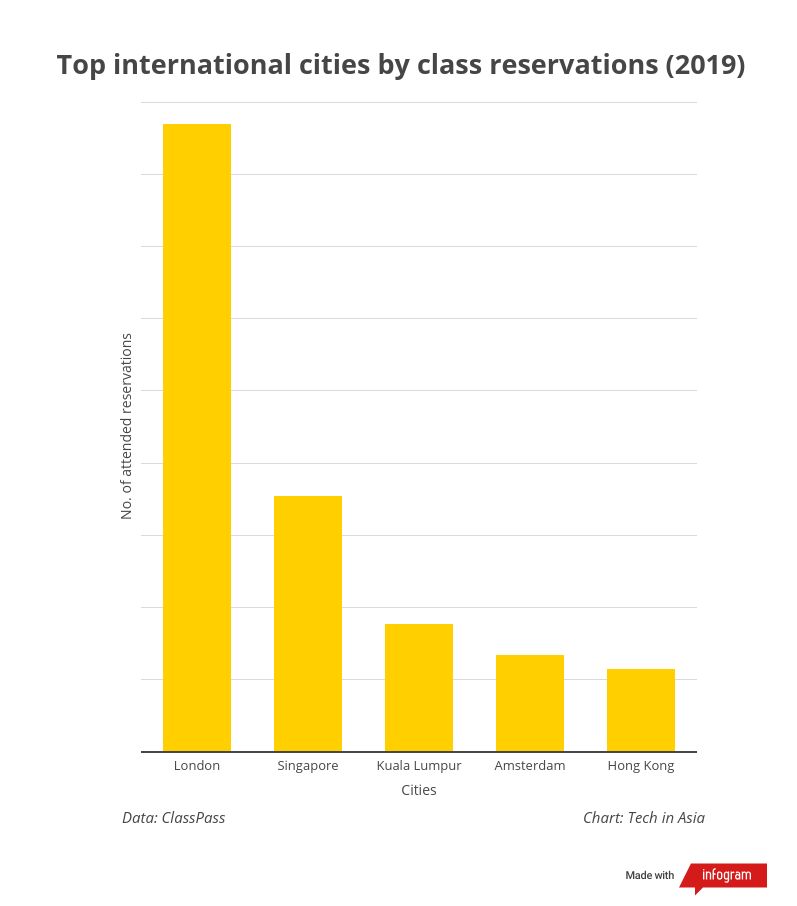
Singapore, where ClassPass has been live for slightly over 12 months, is one of its top 10 cities globally. Almost 800,000 bookings were made at 500 studio partners in the city-state within the past year.
“One thing in Asia that’s certainly different is the propensity of people to invite friends to class – it’s markedly higher,” Canavan adds. “In Asia, people are more likely to book a class, invite a friend, and create a community through ClassPass organically.”
Hiring aggressively
Another strategic focus for the company this year is building its corporate program, for which it is “hiring aggressively,” Canavan says.
Not sitting idle
Stay ahead in Asia’s tech landscape
This is premium content. Subscribe to read the full story.
The Temasek-backed startup is pulling no punches following its latest fundraise, which took it into the unicorn club.
We know this is not ideal. ⌛ Sign up in 20 seconds. Cancel anytime.
Our subscriber community includes professionals from these companies:





Stay updated on the go with our mobile app.
Get latest insights with smoother, more personalized experience through TIA mobile app.