
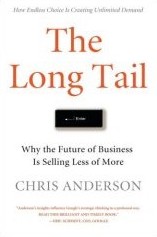
To coincide with the preparation for the coming panel “Future of the Web” in Nexus 2007, I have managed to get Chris Anderson, author of the book “The Long Tail” and editor of Wired magazine for a short 30 minutes interview. Throughout the interview, Chris Anderson will share with us his thoughts and insights about the impact of the long tail economy and its implication to the Singapore economy. As an added bonus for our readers and those who are attending my panel in the Nexus 2007 conference, he has provided me one burning question to quiz our four panellists from Yahoo!, Google, SalesForce.com and Amazon.
BL: Hi Chris, thank you for accepting this interview. To start off, how did you come about exploring the concept of the long tail in the famous article you wrote in Wired Magazine?
Chris Anderson: As Wired editor, one of my jobs is to give speeches and speculate new economic trends which will be important to emerging industries.
In order for me to provide insights on trends, I started collecting and analyzing data that I was able to get from different companies. At that point, I was looking at a dataset from the online music retailer Rhapsody, which is a subscription-based streaming service owned by RealNetworks, and this company offered more than 1.5 million tracks (now more than 3 million).
When I started plotting the number of downloads (vertical axis) versus the rank of the music track (horizontal axis), I found that the shape of the curve looks an “L” which is indistinguishable from the axes themselves. However, that’s because the sales of the #1 track has stretched the vertical axes and the huge number of titles has stretched the horizontal axis. But if you delete the top 100, you can see that there the structure of the remaining titles. Virtually every single track will have downloads. By examining the curve, you would find that it corresponds to the Pareto distribution, often used to study network effects in complexity theories. That curve is the long tail.
BL: What are the crucial features in the long tail that sets it apart from traditional internet business models?
Chris Anderson: First, the underlying principle of the long tail is that our culture and economy are increasingly shifting away from just a small number of its at the head of the demand curve and move toward a huge number of niches in the tail of the curve. The next dimension of the long tail effect is that the costs of reaching those niches is falling dramatically. As a result, the forces such as digital distribution and power search technologies, can drive demand down to serve millions of niche markets.
For example, we used to have niche physical fashion boutiques that only reach out to a limited audience, given the geographical constraints and lack of access. Hence the system to reach these niche markets is inefficient. However, the creation of the internet helps to increase the efficiency by allowing consumers to have easier access that breaks the geographical barrier and lowering distribution costs.
With the latent diversity of different tastes and products exposed through the internet, customers are now able to access and explore new vertical markets. It is now easier for the consumers to act as guides when they start to post their reviews via blogs and pictures. The marketing of a niche product is now made easy from a bottom up approach via the grassroots movement. For example, we used to rely on Hollywood to produce the blockbusters films. With digital video cameras and video editing software, we can now produce our own grassroots blockbuster movies. Others can easily access our grassroots movies through searches using the aggregators (Amazon, iTunes, eBay) and filters (Google, TechCrunch and Engadget reviews) in the internet.
BL: Who will be the winners in a long tail economy-based model? Is it going to be the big MNCs or the small medium enterprises?
Chris Anderson: Actually, it does not matter whether it is the big MNCs or the small medium enterprises. In my opinion, there are three groups which will benefit from the long tail economy:
- 1. The aggregators and filters: The companies which create long tail market places by democratizing distribution and connecting the supply and demand (e.g. Google, Rhapsody).
- 2. The consumers: They win because they have broader and rich choice of products and services to choose from.
- 3. Niche producers: They provide the access to a larger audience or what I call the Ebay effect.
BL: If a young entrepreneur seeks your advice in riding on the long tail, what are the three important lessons in the long tail economy you will share with him or her?
Chris Anderson: The three lessons which I have emphasized with the book are: (i) make everything available, (ii) help me find it and (iii) get it out there with a low price. The biggest opportunity I see at the moment for entrepreneurs is to create new aggregators out that can create new vertical marketplaces. These vertical aggregators differ from the one size fit all type aggregator (for e.g. Google) by being optimized for niche or specialized communities.





Stay updated on the go with our mobile app.
Get latest insights with smoother, more personalized experience through TIA mobile app.