Celia Chen · · 4 min read
Chinese flying taxi still faces issues before commercial take-off
Commuters in China may soon be riding in autonomous flying taxis, soaring over busy streets and skyscrapers at the push of a button, thanks to Guangzhou-based Ehang, which describes itself as the world’s first maker of passenger-grade electric, autonomous aerial vehicles.
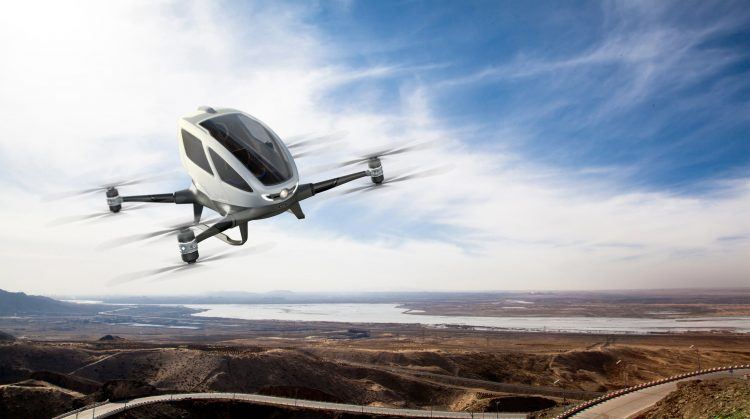
Ehang 184 / Photo credit: Ehang
Flying taxis have been talked about for years in China, and now the buzz over Ehang’s passenger drones is rising after the startup said “commercial flights are on the horizon.”
“We expect to operate a line of commercial flying cars in Guangzhou soon,” said Derrick Xiong Yifang, co-founder of Ehang in an interview last week.
Xiong, however, did not provide details on when commercial operations will start, how many Ehang flying cars will initially be made available, and the costs involved in this major new enterprise.
The company announced earlier last month that its headquarters in Guangzhou will serve as the first “urban air mobility pilot city” for its flying cars in the country.
China is pushing the adoption of new transport technologies, such as autonomous driving, to help deal with congested roads in its major cities. If Ehang successfully launches its commercial transport business, China will become the first country in the world to have a fleet of electric autonomous flying taxis serving daily commuters.
Ehang still faces a number of issues, from new regulations and public safety concerns to establishing rigid personnel training and equipment maintenance, before its commercial flying taxi operation takes off.
“Urban air mobility is a potentially huge market, but regulation remains a big obstacle,” said Chinese aviation expert Zhang Baoxin. “There is a long way to go from test flights to daily transport operations […]. The development of autonomous cars has set the example on the challenges that lie ahead.”
Ehang’s Xiong said the company believes it can overcome “fundamental challenges to launching its commercial flying taxi operations, whether in terms of technology or regulation.”
“We are working with Chinese regulators to help set up rules.”
In February last year, Ehang became the first company in China to initiate tests of its electric-powered, autonomous flying drone with passengers on board.
More than 200 people, including the deputy mayor of the southern coastal city of Guangzhou, were among the passengers who flew on roundtrips of up to 15 kilometers, with some flights reaching the vehicle’s top speed of 130 kilometer per hour.
Ehang, controlled by state-owned aerospace and defense conglomerate Aviation Industry Corp of China, was established in 2014 by Chinese engineer Hu Huazhi, with backing from GGV Capital. Ehang unveiled its first flying taxi model, the 184, at the Consumer Electronics Show in last Vegas in 2016. Its latest model, the two-seater Ehang 216, was unveiled in April this year in Vienna, Austria.





Stay updated on the go with our mobile app.
Get latest insights with smoother, more personalized experience through TIA mobile app.