Josh Horwitz · · 3 min read
China’s taxi-hailing startups roll out low-cost ridesharing service in 61 cities

Didi Dache and Kuaidi Dache, China’s recently-merged taxi-hailing startups, have entered the next phase of their business. Yesterday the companies announced they will roll out a low-cost service called Yihao Kuaiche in 61 cities.
Curiously, Yihao Kuaiche isn’t accessible as a standalone app, nor is it tucked inside Kuaidi or Didi’s existing apps. Instead, users who download Yihao Zhuanche, an app that was once Kuaidi’s answer to UberBlack, will spot the new service at the very top of its vehicle listings. As domestic media has reported, Yihao Kuaiche claims to operate on “not-for-profit” model, wherein the passenger only pays for the cost of the ride, and the startup takes no cut from the transaction. Pricing starts at base fare of zero, followed by RMB 0.3 (about US$0.05) per minute and RMB 1.9 (about US$0.30) per kilometer, with a minimum total charge of RMB 10 (US$1.61). Factor in the inevitable discounts, and you’re looking at one cheap ride.
Users can pay for trips using Alipay, the Alibaba-affiliated payment service, or through bank transfer.
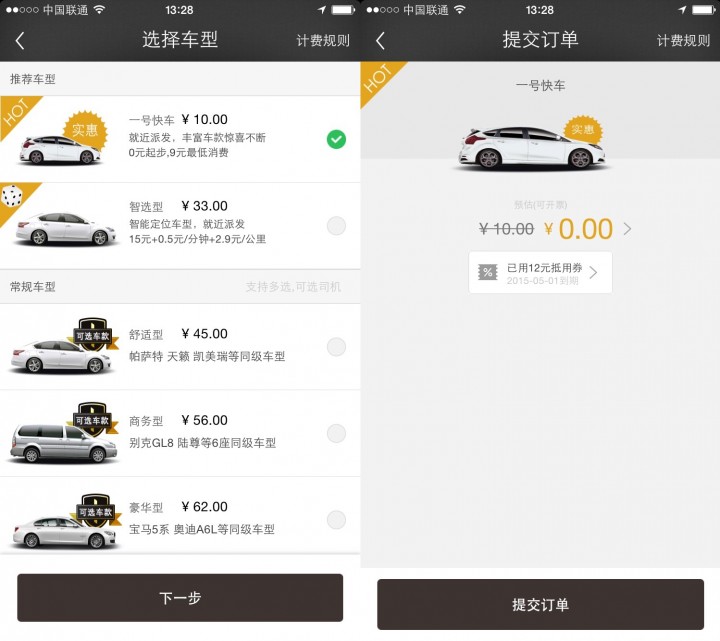
The service was originally launched in seven pilot cities two weeks ago, but yesterday marked its official rollout – welcomed by none other than Martin Luther King Jr.

Yihao Kuaiche bears a strong resemblance to The People’s Uber – Uber’s “not-for-profit” ridesharing service, which is currently in seven cities across China. At the moment, the People’s Uber is actually priced slightly lower than Yihao Kuaiche. But don’t think for a second that Kuaidi and Didi won’t find all sorts of ways to make their service even cheaper.
We’ve reached out to Kuaidi to ask for more information about what types of drivers are eligible to join Yihao Kuaiche.
Ridesharing remains in a legal grey-area in China, but compared to other countries, government agencies haven’t acted as swiftly. In February, China’s minister of transport said publicly that private cars will never be available for commercial use. That would seem to not bode well for ridesharing startups, were it not for the fact that transport ministers get paid to say such things. Regardless, Uber, Kuaidi, and Didi’s embrace of a “not-for-profit” model shows they’re nevertheless treading carefully.
While peer-to-peer ridesharing services like UberX and Lyft have dominated US cities like San Fracisco and Washington DC, in China, the densest ride-hailing networks center around taxis. Didi and Kuaidi claim that they together book six million rides a day. But recently, ridesharing startups have made headlines in Chinese media. Baidu invested in two ridesharing firms, Tiantian Yongche and 51yongche. The search giant also disclosed an investment in Uber last December. Meanwhile, Reuters reported that Uber is “in talks” to acquire Dida Pinche, a small ridesharing startup currently in eight Chinese cities. The company declined to comment on the rumor when asked by Tech in Asia.
(Source: Qianjiang Evening News, 36kr)





Stay updated on the go with our mobile app.
Get latest insights with smoother, more personalized experience through TIA mobile app.