 Harsimran Julka · · 5 min read
This dorm room startup CEO went from $200 to $125 million in seven years
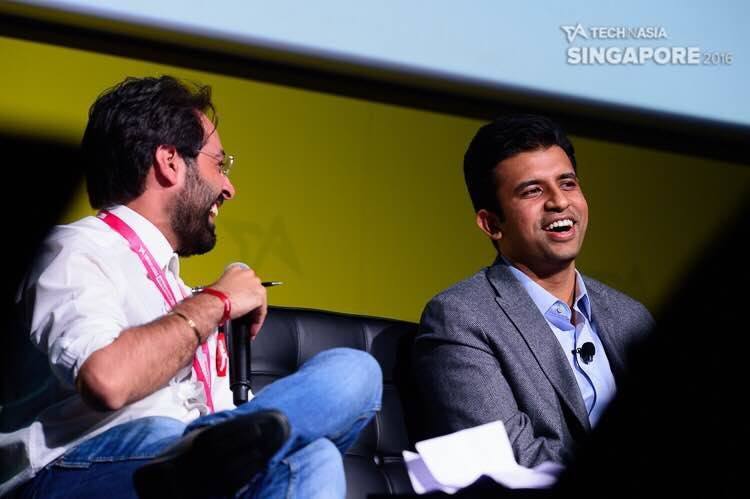
(From the right) Practo CEO Shashank ND in a fireside chat with Harsimran Julka at Tech in Asia Singapore conference 2016.
In 2009, Shashank ND, CEO of Practo had just under US$200 left in his bank account to run the company’s operations.
“It was just days worth of cash left,” Shashank tells me in front of a 4,000 strong audience at Tech in Asia’s Singapore conference this week.
To come out of that situation, Shashank started keeping a daily scorecard on a whiteboard in his office with the number of sales he had completed that day and the number of lines he had coded.
“I used to go on my scooter to pitch to doctors and sell them our product. There were only two important things that mattered – it was coding and selling. Everything else was a distraction,” he says. Abhinav Lal, his cofounder and classmate would stay at the college dorm and code.
The company came out of its lowest point and went on to raise US$124 million. It is now valued at about US$500 million, as per last funding round.
It has spread its wings to Singapore, Indonesia, Malaysia, Philippines, and Brazil besides India.
Startup tips from Doctor Who
1. Domain expertise doesn’t always make you win
When Shashank was first getting started, a doctor advised him to close his business and move to the United States.
It was his final year of college and the economic crisis of 2008 had just ended. Nothing was working out.
But in this case, the doctor did not know best. Domain expertise can sometimes limit your thinking and you may not be able to see the bigger picture.
“When a customer says that your business won’t work – it can be demoralizing. However, often they don’t see what you can imagine,” he adds.
2. Take push-backs and paranoia as motivation
“Startups are insanely hard, everything that can go wrong will go wrong,” he says. Starting from his initial employees leaving, to money running out, to important customers quitting, there was a lot of trauma on his journey.
Shashank says that it’s critical that you use your failures to motivate yourself and to try and ensure that all these lows push you higher.
“I kept on saying that this is the lowest point, this is the lowest – and that yes, I can handle it,”
“Being part of a startup will change you. You will realize your true personality,” he adds.
The company started in 2008 when Shashank’s father had to undergo a knee surgery.
He wanted a second opinion from a doctor in the US. He was unable to get enough information online about the doctor.
That’s when he got the idea to start a service from his college dorm that would connect doctors to patients in India.
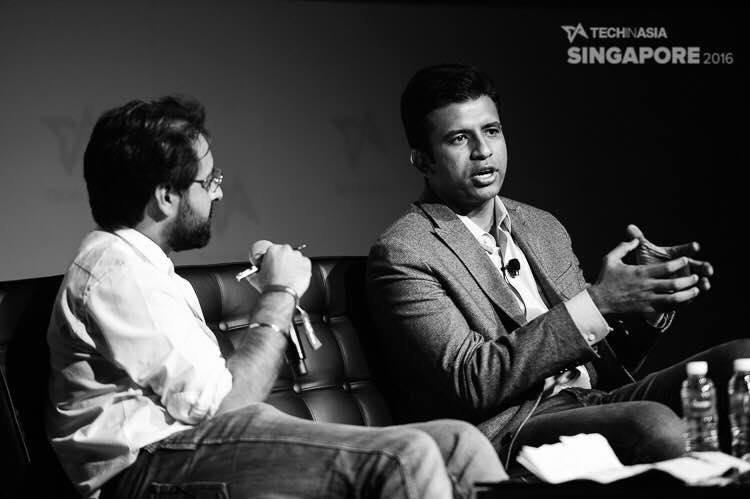
(From the right) Practo CEO Shashank ND in a fireside chat at Tech in Asia Singapore conference 2016.
3. Keep the vision aligned; love the problem, not the idea
Often entrepreneurs start at one end but end up at another in a business lifecycle.
The idea that a business started with on day one may not remain the same for even a few months.
Shashank says that his vision was clear from day one. He wanted to build a great product and have an impact on the global healthcare industry.
“I love building products. Even if I was to do it for free, I would do the same. I love building things that can change the world,” he adds.
“We had a lot of products that don’t scale so we cut them,” he says.
4. Making vision supreme will prevent team conflict
Shashank says the way to avoid politics in a startup when it becomes big is to emphasize loyalty to the vision and not to its people. “This is one way to avoid conflicts is to make the vision the most important thing for the people,” he adds.
“If you optimize processes aligned to the vision, the arguments are never what’s good for you or for me it will always be what’s good for the vision,” says Shashank.
5. Always have a 30-second pitch ready
The first thousand customers are the hardest to crack. Once you have a brand or reputation in the market, it becomes easier.
Shashank says the most important concept in order to sell successfully to a B2B or B2C user is instant gratification.
“It’s critical to learn how to make sure that in 30 seconds you can get the customer interested in your product. Within 30 seconds, his mind is likely to be distracted so I would never spend time talking about history of the company,” he says.
“I made a demo that would blow his mind. I showed them in 30 seconds how I can give them their value back, increase usage, and provide instant gratification.”
6. Crack the template – only then scale up
The company spent its first few years cracking just the Indian, and even more specifically, the Bangalore market.
“Even in bootstrapped days we knew we wanted a global product, we only expanded after Series A, we raised US$4 million,” he adds.
Practo also made sure it always had a runway of 24 months. “We did not even put an iota of energy in a new market unless we had a good existing runway,” he says.
The company started expanding overseas only after five years of its launch in India.
Top five one-liners:
-
Don’t ever focus on more than two critical activities at one time.
-
The first thousand customers are the hardest to crack.
-
Never let your ego get in the way of your product.
-
It’s always a humbling experience being an entrepreneur.
-
Don’t ever give up.
Things you never knew about Practo’s CEO
-
His father, mother, and even uncles use Practo and give him product suggestions over the dinner table.
-
With Practo’s expansion into listings of gyms, spas and salons, the CEO now books his haircut appointments through his app.
-
He danced to a Pitbull song at a bonfire with the team after the company got its first check of US$4 million from Sequoia Capital in 2012.
-
He still lives and operates out of the same house in Bangalore where Practo was first started.
Stay updated on the go with our mobile app.
Get latest insights with smoother, more personalized experience through TIA mobile app.
Recommended reads
 What it takes to stand out as a product manager in the AI era
 When streaming turns into shopping
 AI is shrinking SaaS moats, redefining sales
 The AI reckoning threatening India’s software assembly line
 Sequoia partner reveals 4 types of ‘poor quality’ revenue
 Sam Altman’s lesson from Google: Trust over ads
 Hypefast sheds brands, finds profit
 Why buying, not building, is winning fintech’s scale race
 Take a peek at how the managing director of a global firm works from both office and home
 A $650M AI founder: Your ‘demo-level’ AI is a ‘real danger’





Editing by Meghna Rao & Charlie Custer
(And yes, we’re serious about ethics and transparency. More information here.)




