
Photo credit: Sam Valadi
This year is off to a rousing start for Chinese tech companies listing overseas, with multiple companies already planning to go public in Hong Kong, and US$110 million raised and nearly US$2 billion filed for the US.
“The supply of capital for new listings is growing,” says Kai Fang, managing director and head of China equity capital markets at China Renaissance. The investment bank has helped with some of China’s top tech deals, such as the public listing of JD, Alibaba’s domestic archrival.
“Institutional investors are increasing their allocations to Chinese ‘new economy’ companies,” he says, referring to a broad term for high-growth industries, including tech. “And even if there is an IPO from one of the unicorns, there should still be plenty of capital remaining for other companies.”
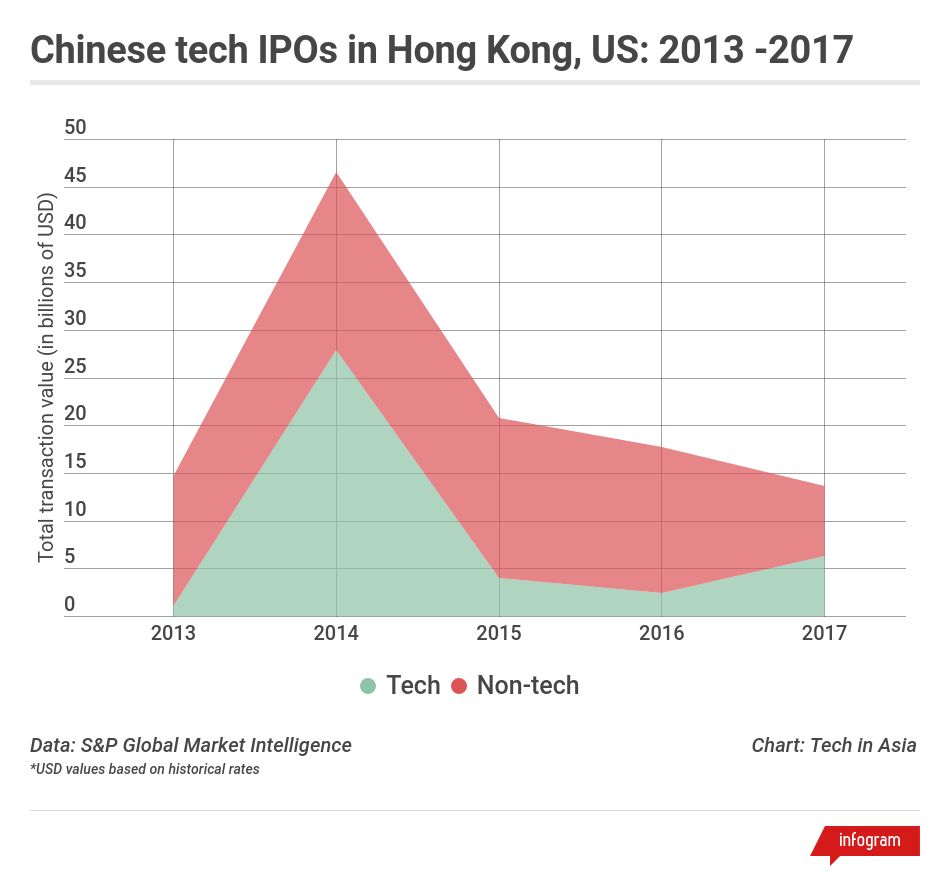
2014 was a golden year for US exchanges, which saw three public listings whose proceeds surpassed US$1 billion. Alibaba, which ended up raising US$25 billion, is still the largest IPO in history.
China’s appetite for public listings isn’t new. The country has led the world in IPO market share since 2014, according to a 2017 report by Thomson Reuters. Last year, Greater China, which includes mainland China, Hong Kong, Macau, and Taiwan, issued a total of US$49 billion in IPO proceeds – or a quarter of the global total – from both domestic and cross-border listings.
But tech will be a particularly important sector to watch this year, as Chinese companies eye the global market and tech-savvy investors. Last month, Huami, Xiaomi’s wearable device partner, broke the seal on cross-border tech listings with a US$110 million IPO in the US – a taste of what’s to come with Xiaomi’s own public listing, which could push its value to a rumored US$100 billion.
Last year, Greater China issued a total of US$49 billion in IPO proceeds – or a quarter of the global total.
Indeed, IPO activity from the Chinese tech scene is part of a growing trend. It’s already one of the top three industries for IPOs from Greater China, according to consulting firm EY.
“Tech companies in China have developed rapidly in recent years, benefiting from various [government] initiatives, such as ‘13th Five Year Plan,’ ‘Internet Plus,’ and ‘Made in China 2025,” says Paul Lau, partner and head of capital markets at consulting firm KPMG China.
“Recently, we’re witnessing high levels of oversubscriptions for IPOs from the ‘new economy’ sector. This reflects the market’s confidence in China’s increasing efforts towards innovation and technology,” he tells Tech in Asia.
Corporate spinoffs
For Chinese tech companies, going public overseas offers two main benefits: blockbuster valuations and international exposure.
Last year, fintech companies were particularly well-represented, with seven companies going public in the US. Many were online consumer lending platforms, such as PPDai and Lexin, which use big data to assess creditworthiness and offer microloans.
Government action





Stay updated on the go with our mobile app.
Get latest insights with smoother, more personalized experience through TIA mobile app.












📅 Upcoming Events
22 October 2026
Payoneer x CSPN Summit 2026