Michael Tegos · · 6 min read
Data scientists caught Singapore’s ‘rogue train’. Here’s what else they can do.
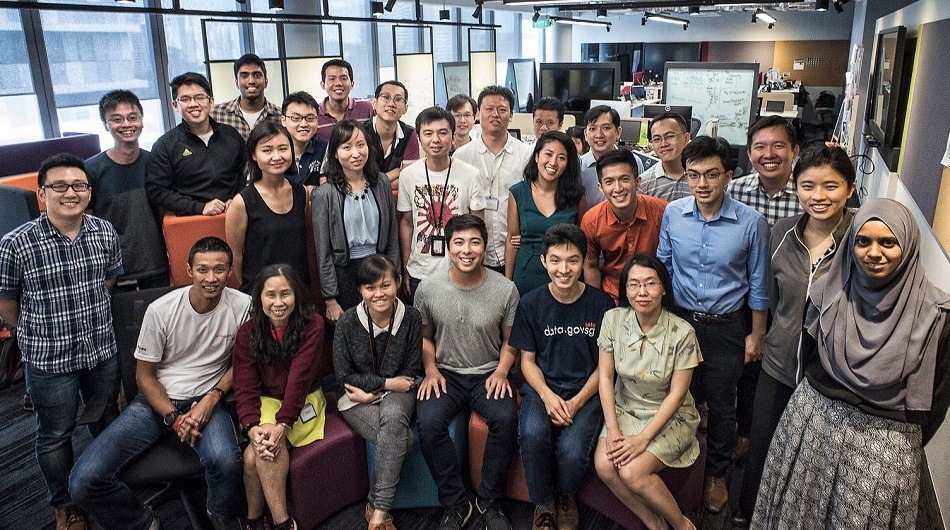
The team comprising the Data Science Division. Photo credit: GovTech.
In the early hours of Saturday, November 5, Feng-Yuan Liu received a call from Singapore’s Ministry of Communications. A particularly nasty and persistent problem in the city’s Massive Rapid Transit (MRT) system had resurfaced once more. Stumped authorities were out of ideas.
Feng-Yuan, director of the Data Science Division of the Government Technology Agency (or GovTech), fired up his team’s WhatsApp group chat. Someone was going to have to come to work that Saturday.
“I was actually in Japan at the time,” he tells Tech in Asia. “So I pinged the team and asked if there were any volunteers who could help. These three guys stepped up.” The three guys are data scientists Daniel Sim, Shangqian Lee, and Clarence Ng.
The trio have documented how they managed to solve the mystery in a blog post that has gone viral, shared on Facebook even by Singapore’s Prime Minister.
In the blog, they explain the movie plot-worthy “trail of destruction” left by the rogue train designated as PV046 and how they helped stop it. It’s basically the computer geek version of 2010’s Denzel Washington-starring Unstoppable, thankfully with much lower stakes.
The post is a must-read, not only because of the complex problem-solving involved, but also as a look into how much data is generated around us daily and can be put to use.
See: Inside the Singapore government’s lab of the future
Runaway train
The crisis the team was called to tackle has been well documented in Singapore, but here’s the gist if you haven’t heard: the MRT, Singapore’s subway system, is largely automated, with trains riding the tracks by bouncing signals off each other and the stations.
At some point at the end of August, several trains on the system’s Circle Line started braking suddenly for no obvious reason. The culprit was a faulty train sending errant signals, which confused its fellow vehicles, creating disruption in the clockwork system.

Singapore’s automated MRT trains. Photo credit: tang90246 / 123RF.
The problem showed up intermittently over the course of several months, resulting in delays and angry commuters on social media. The Land Transport Authority, transportation company SMRT, and the Defense Science and Technology Agency all tried to look into the problem before calling in the Data Science Division.
Making sense of Singapore through text
Feeling the pulse





Stay updated on the go with our mobile app.
Get latest insights with smoother, more personalized experience through TIA mobile app.