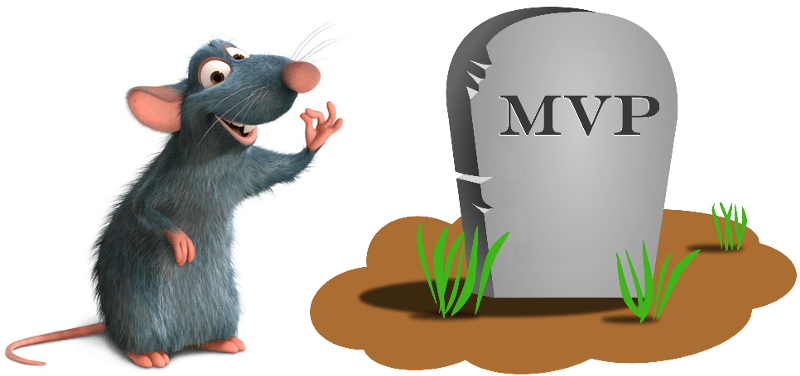
There is a flaw at the heart of the term minimum viable product: it’s not a product. It’s a way of testing whether you’ve found a problem worth solving and a way to reduce risk and quickly test your biggest assumption. Instead of building an MVP, identify your riskiest assumption and test it. (Riskiest assumption test or RAT.) Replacing your MVP with a RAT will save you a lot of pain.
MVP is used so much it’s lost its original meaning. It’s often mistakenly applied to refer to the first release of a rudimentary product. As a result, the term MVP has ended up becoming much more complex than the quick test it was supposed to be and far too shoddy for a released product.
MVP is used so much it’s lost its original meaning.
Worried about a second-rate product, people call for minimum valuable products or minimum lovable products. This is going in completely the wrong direction, leading them to make larger bets on riskier assumptions and learning from real customers even later.
A minimum viable test is sometimes used as an attempt to make smaller iterations before release. This fails to capture two crucial points: Why and what are you testing? Furthermore, the word “minimum” is ambiguous. When asked how minimal your MVP should be, Eric Ries, author of The Lean Startup, replied, “Probably much more minimum than you think.”
A RAT is explicit. There is no need to build more than what is required to test your largest unknown, no expectation of perfect code or design, and no danger it will prematurely become a product.
An MVP seduces with false reassurances of a clear, linear path to an optimized solution. A RAT puts the focus on learning. It is a candle in the darkness that allows us to move forward one step at a time. Once you’ve validated the riskiest assumption you can move on to the next one, gradually building confidence in the viability of your idea.
The key to this is small, rapid tests. What’s the smallest experiment you can do to test your biggest assumption? As Tom Chi, co-founder of Google X, puts it, “Maximizing the rate of learning by minimizing the time to try things.” And not just minimizing the time spent, but dramatically minimizing it. Even prototypes for complex ideas like Google Glass were built in 1 day!
Identifying the underlying assumptions takes a lot of mental energy and discipline. Express the opportunity as a customer problem and work backward. What has to be true for the opportunity to exist? Now, take each of those assumptions and ask, “What are the main assumptions behind them?” Repeat until you’ve reached the root assumptions. This is similar to the five whys—working your way back up from the bottom to identify evidence that supports each assumption.
You should now have a clear idea of where the critical gaps in your knowledge are and a clear idea of what your RAT needs to be.
Every new idea starts with a RAT
This doesn’t just apply to startups; it is equally important for established companies, maybe even more so. When you’ve been operating successfully for a number of years, you can be lulled into a false sense of security. This leaves you at risk of disruption and at risk from piling money and time into building something that nobody wants to use.
Meanwhile, your competitors are discovering the jobs that need to be done, building products aligned to what people actually need. They are gradually stealing your customers.
Doing RATs in established companies comes with different challenges, though. The constraints of a startup drive the frugal thinking that lends itself so well to RATs. With plentiful resources, there appear to be fewer consequences when committing to large projects before validating them.
Maximize discovery





Stay updated on the go with our mobile app.
Get latest insights with smoother, more personalized experience through TIA mobile app.