This has been an eventful year for internet freedom (or lack thereof) in China. The latest Freedom on the Net study from American NGO Freedom House was published today, showing that China – which ranked third from last in 2014 – has now sunk so far it can’t sink any lower.
In last year’s report, China was bested by Iran and Syria. For 2015, however, those two nations are now tied for second-to-last, and China has pushed its way to the back of the bus.
It’s worth mentioning that North Korea is not included in Freedom House’s survey, as there was not enough access to the country. But it would, presumably, be the only country to rank below China.
How did we get here?
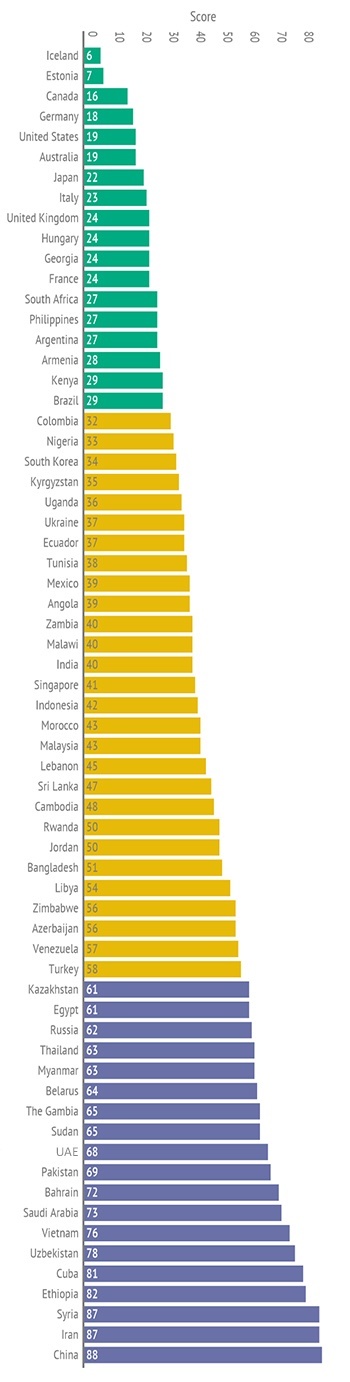
Graph by Freedom House
- A serious government-led push for real-name registration online, in an effort to make it impossible to run an anonymous blog or leave comments on an online forum without revealing your identity.
-
The dawn of the “Great Cannon,” the use of the government’s censorship apparatus to intercept internet traffic towards one site and send it to another, effectively crashing the victim site under an avalanche of accidental visitors. That’s what happened in April to GitHub.
-
An anti-terrorism law that would require all telecoms and internet service providers to give the government “backdoor” access and encryption keys.
-
That time a government agency was caught issuing forged digital security certificates for websites including Google, which could have been used to deliver malware to unsuspecting users.
These are all in addition to the kinds of typical Chinese censorship shenanigans that anyone who has spent time in the country has gotten used to – the inability to access Facebook and Twitter, messaging apps that won’t send messages about politically sensitive subjects, viral videos that suddenly disappear, and the fact that essentially nothing associated with Google, from Maps to Translate, works at all.
Uniquely terrible
China is home to innovative, exciting companies like Xiaomi, Baidu, and Alibaba. With all the hype around Chinese internet firms – from the web giants to the smallest startups – it’s easy to forget how uniquely bad the situation is for internet freedom in the country.
“It’s just China,” is the common refrain each time another website is blocked, blogger arrested, or faulty security certificate slipped into people’s web browsers. But that doesn’t really give the nation’s censors enough credit: through their hard work and determination, they’ve managed to out-rank Cuba, Vietnam, Russia, and Libya to become literally the worst place for internet freedom in the world.





Stay updated on the go with our mobile app.
Get latest insights with smoother, more personalized experience through TIA mobile app.