 Li Tao · · 4 min read
China ‘has decided not to fan the flames on supercomputing rivalry’ amid US tensions
China chose not to confront the US directly in the field of supercomputing before the Trump administration’s recent decision to add five Chinese high-performance computing companies to its trade blacklist, according to people familiar with the matter.
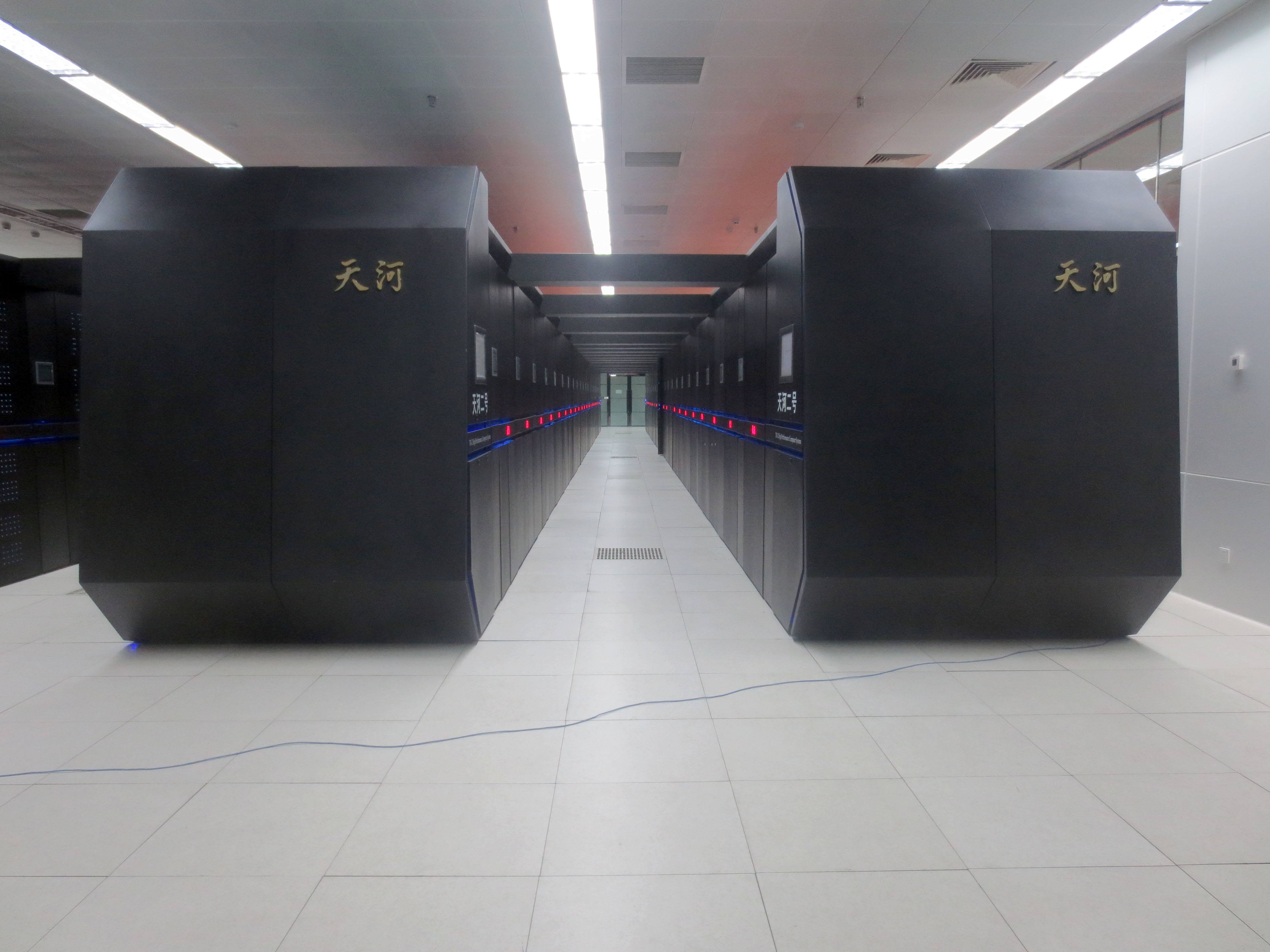
The Tianhe-2 supercomputer in the National Supercomputer Center in Guangzhou / Photo credit: O01326
Chinese decision-makers decided to withhold the country’s newest Shuguang supercomputers from the latest supercomputing contest, even though they operate more than 50% faster than the best current US machines. China does not want to fan the flames of existing trade tensions, said the sources, who declined to be named as the information is private.
According to the Top500 list published last week, the US has retained its top position as the producer of the fastest supercomputers in the world. China, which has not introduced any new machines in recent months, is in second place. The Top500 list is released twice a year: once in June and again in November.
The newest Shuguang supercomputers, currently located at the computer network information center of the Chinese Academy of Sciences in Beijing, are capable of performing more than 200 petaflops. A petaflop refers to one quadrillion (or a million billion) calculations per second.
The Shuguang supercomputers’ abilities far exceed the US leaders in the chart, Summit and Sierra: two IBM-built supercomputers that delivered a record 148.6 petaflops and 94.6 petaflops in the June contest respectively, said the people.
“China is finding itself with no choice but to create its own alternatives to US technology,” said Paul Haswell, a partner who advises technology companies at international law firm Pinsent Masons.
“This inevitably takes time, and will have a corresponding impact on China’s development in all fields requiring state-of-the-art supercomputing tech.”
However, China’s strategic concession to play a low-key game on supercomputing rivalry did not stop the US Commerce Department last Friday from adding five Chinese top supercomputing developers to its Entity List, which effectively bars them from purchasing American technology.
Supercomputers have become an emblem of technological might, and apart from bragging rights, they can be applied to sensitive areas such as nuclear weapons development, encryption, and missile defense, among others.
They are also used for weather prediction, ocean current modeling, energy technology, and nuclear explosion simulations. Demand for supercomputing in commercial applications is also on the rise, driven by developments in AI.
The US Commerce Department said it was adding Sugon, the Wuxi Jiangnan Institute of Computing Technology, Higon, Chengdu Haiguang Integrated Circuit, and Chengdu Haiguang Microelectronics Technology – along with numerous aliases of the five entities – to the Entity List over concerns about military applications of the supercomputers they are developing.
The move comes ahead of US President Donald Trump and Chinese President Xi Jinping’s meeting during the G20 summit in Japan this week, and as China and the US vie to produce the first exascale computer, a next-generation machine capable of one quintillion – or a billion billion – calculations a second.
In 2015, US President Barack Obama signed an executive order to authorize the creation of the National Strategic Computing Initiative (NSCI) to accelerate the development of technologies for exascale supercomputers and to fund research into post-semiconductor-based computing.





Stay updated on the go with our mobile app.
Get latest insights with smoother, more personalized experience through TIA mobile app.










📅 Upcoming Events
22 October 2026
Payoneer x CSPN Summit 2026