Peter Rothenberg · · 9 min read
Check out the winners from Osaka’s groovy global pitch competition
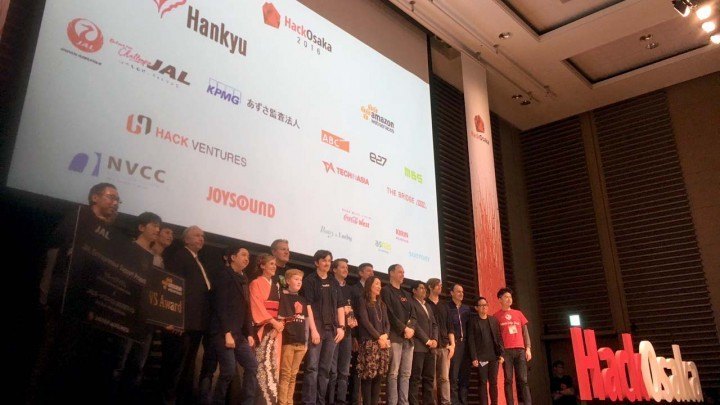
This year’s competition featured 10 startups from seven different countries.
Osaka – western Japan’s capital of industry, comedy, and delicious takoyaki octopus balls – hosted its third annual Hack Osaka international startup event yesterday. This year’s global pitch battle featured startups from seven different countries.
Things kicked off Osaka-style with the crowd participating in some laughter yoga before a speech by mayor Hirofumi Yoshimura. In his keynote, he expressed the desire to build an open and innovative city that can be a hub for entrepreneurs.
Ikuo Hiraishi, CEO of Sunbridge Global Ventures, believes that lack of capital is keeping Osaka behind its eastern rival Tokyo. In a panel discussion, Ikuo said both Tokyo and Osaka have students – whom he believes are the leaders of innovation – forming three percent of the population. But Osaka only saw US$72 million invested in startup companies compared to Tokyo’s US$912 million in 2014.
The highlight of the event was a global startup pitch competition with 10 entrepreneurs selected from 630 applications. Check out the winners below.
Gold Prize – Pawnhero
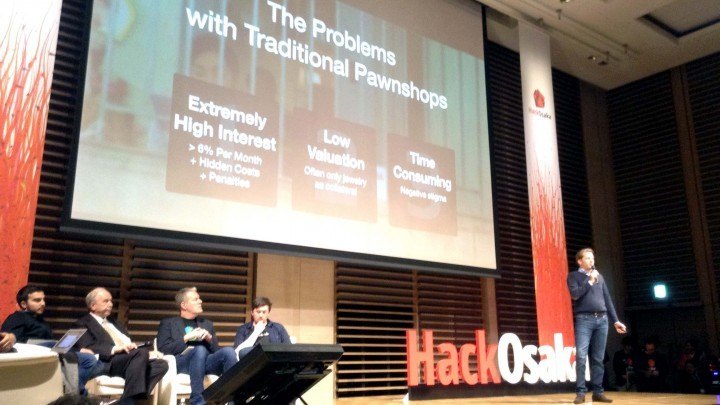
Pawnhero is Southeast Asia’s first online pawn shop – offering users a safe and secure way to pawn items online. Featured before on Tech in Asia, co-founder and chairman David Margendorff wants to put “a pawnshop in everyone’s pocket.” After finding that most Filipinos do not have access to affordable credit, David saw an opportunity to help people become more financially independent.
Pawnhero works in three steps: first customers take a picture of their item for a free appraisal. Then, after accepting an initial estimate, customers can schedule a pick-up date or drop their item off at select locations for the final appraisal in person. After that’s completed the loan is deposited into the customer’s bank account or on a special Pawnhero debit card. When repayment of the loan is complete, the item is shipped back to customers, insured and free of charge. David clarified after the pitch that currently 72 percent of loans are paid out on the same day.
Pawnhero also has started a marketplace for defaulted items and has actually been able to make a profit by recovering 114 percent of the loan on average.
Pawnhero received close to US$4,400 for the gold prize and 50,000 bonus miles for three people from Japan Airlines. (50,000 miles is good for approximately one flight from Osaka to North America.)
Silver Prize – Podaris
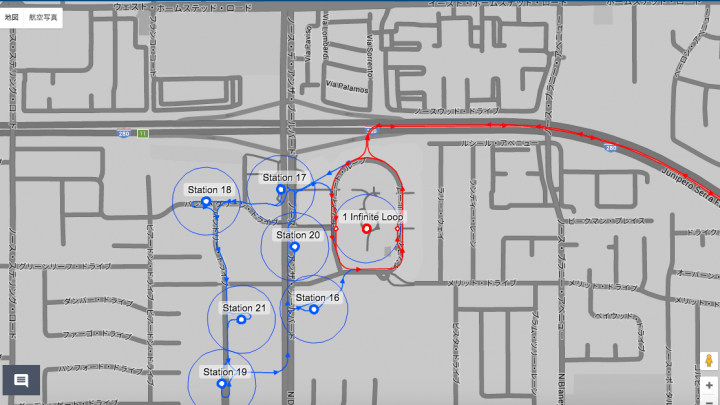
Sample project from Podaris’ homepage.
Podaris lets urban planners design and collaborate in real time with a browser-based application.
Founder and CEO Nathan Koren opened his pitch with urban infrastructure horror stories like Berlin’s Brandenburg Airport project that has been set back over seven years due to poor communication.
Podaris brings collaboration and design tools seen in web and app design services like Invision, Balsamiq, and Moqups to infrastructure planning. Podaris hopes to make the traditional long process of building new roads, rails, pipes, wiring, and so on, faster by keeping all parties involved in real time.
Recently accepted into Deutsche Bahn’s Mindbox accelerator in Berlin, Podaris also wants to develop an API that provides real-time infrastructure monitoring. You can see sample projects (including Apple’s 1 Infinite Loop!) on their homepage.
Podaris received approximately US$2,600 for the silver prize and 50,000 bonus miles for two people from Japan Airlines.
Bronze Prize – Shipwise

Shipwise wants to make international freight shipments more connected and more transparent.
Founder Alexander Malov pointed out that nearly 90 percent of all physical goods were at one point in a shipping container. One would think there is some high tech infrastructure keeping the world’s goods moving. Not so – Alex says it’s actually a slow and complicated process that hasn’t changed in decades. The most meaningful change in the last 30 years was from fax to email, he adds. Alex estimates that 30 percent of logistics budgets and countless man hours are lost in dealing with this outdated process.
Shipwise brings all supply chain participants onto the same platform with door-to-door tracking. They are currently working with small and medium enterprises and have already gained a few hundred paying customers since the end of November 2015. Shipwise currently charges US$500 per shipment.
Shipwise received approximately US$900 for the bronze prize and 50,000 bonus miles from Japan Airlines.
Amazon Web Service Award – Mago Channel

Grandparents want baby pictures.
Mago Channel (grandkids’ channel in Japanese) helps less tech savvy grandparents stay connected with a device that beams pictures and videos to their home television. The device works in combination with a smartphone application to create a new “channel” featuring videos and pictures taken from parents’ smartphones.
Each time the channel is watched the young parents also receive a notification on their phone, helping families who live separately to stay connected. The device has a built-in 3G connection so grandparents can enjoy pictures without needing an internet-enabled smartphone or other internet connection. Founder Kenji Kajiwara claims that Mago Channel is easy to set up and that no change in behavior is needed – grandparents just watch TV and parents just take pictures.
Mago Channel received a Fire tablet from Amazon.
Special Recognition Prize – Meleap (Hado)

Hado is developing augmented reality sports.
Tech in Asia mentioned Hado at KDDI’s demo day in January 2015 and CEO Hiroshi Fukuda’s passion and energy are still going strong. It is Hiroshi’s dream to bring his childhood hero fantasies to life and allow everyone to use special powers and magic in real life.
Currently Hado is focusing on augmented reality (AR) software, which uses a smartphone and a head-mounted display. With this setup, it is able to create an augmented reality sports experience where up to 10 players at the same time can battle each other or monsters.
Since last year, the startup has opened temporary and permanent exhibits at amusement parks, shopping malls, and events all over Japan. Hiroshi believes that audience involvement and encouragement is very important and hopes to bring their coined “techno sports” to the world with a huge Olympics-like event in 2020.
Fabelio
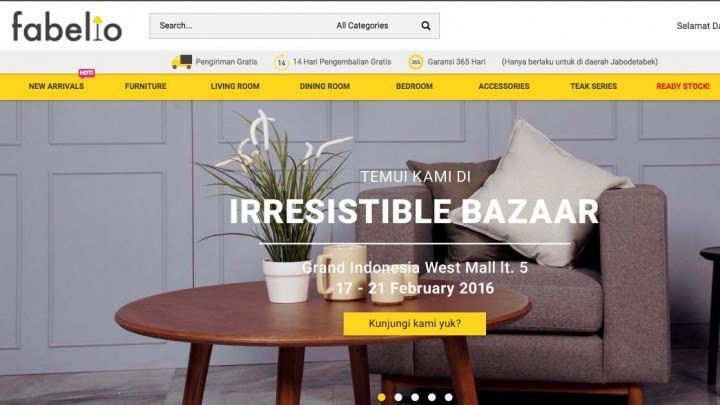
Fabelio is a design-centric online furniture marketplace based out of Indonesia. It is coming off of a US$2 million series A round in January and is looking to make every home beautiful. Co-founder and CEO Krishnan Menon wants to focus on bringing high quality furniture into the middle class market by connecting designers and consumers through the handling of production and distribution. Krishnan takes great pride in helping designers scale up their businesses and wants to bring their current order-to-arrival lead time down from around 30 days to 14. While it’s well known and the market leader in Indonesia, Fabelio is looking to expand to western markets with some partnerships already in place.
Budo Finder

Budo Finder is a community marketplace for martial arts that connects practitioners with clubs, events, and equipment suppliers.
Co-founder and CEO Djuro Stojanovic from Montenegro has been a lifelong martial artist with a lot of experience under his belt. He claims to have appeared in eight European and World championships.
Budo Finder hopes to bring the disarrayed martial arts information to a single location to help all parties connect faster. You can use the website to search for people, products, dojos, and events.
Djuro says the website currently sees 100,000 monthly visitors and the team is now looking for partners and investors. While still unsure of a business model, Budo Finder has started making money by charging equipment suppliers 15 percent from every sale to list their products on the website.
Acpad

Acpad Founder Robin Sukroso rocking out on stage.
Acpad is the first wireless MIDI controller for acoustic guitars.
Founder Robin Sukroso came out guitar blazing and serenaded the audience with his groovy riffs before starting his pitch. Acpad lets musicians play over 1,000 different sounds on the patent-pending, pressure-sensitive attachable pads. Robin saw fellow musicians struggling to play the guitar and synthesizers at the same time and started developing a wire-intensive prototype, which he took to Kickstarter. A video of the pad in action on YouTube has attracted over 1.8 million views.
Acpad is looking to expand to other string instruments with many requests for cello, violin, and double bass. However Robin stresses that it is important to not damage the sound of the acoustic instrument. The technology is the same on each instrument and the team hopes to make a smaller version to bring to acoustic drums and electric guitars and basses. It’s currently looking to raise US$3,340,000 for further development.
YesBoss

YesBoss is aiming to be a one-stop on-demand concierge shop. Co-founder and CEO Irzan Raditya described the service as aggregating on-demand and ecommerce services.
Featured on Tech in Asia in June of last year, the startup has been testing the market using only SMS.
Irzan stated during his pitch that the company will release a native app by the end of the month, which features a new human-assisted artificial intelligence system designed to help the company scale.
YesBoss is showing good numbers in January according to Irzan and looking to raise US$3 million using this initial traction.
Meet My Dog

Meet My Dog wants to help you and your dog make new friends. Founder Sifang Lu loves dogs and believes our furry friends can help us make new human friends too. He sees the app as a cure for loneliness, stating in his pitch that half of single people want to own a pet, and 80 percent of those that do own a pet consider it a cure for loneliness.
Meet My Dog makes it easy to set up a profile, discover similar dogs around you, and schedule playdates. While other apps like Sniffr in Canada have enjoyed some success, judges were concerned about the business model. Sifang seemed confident that his love, passion for pets, and experience as being part of the core team that coded and designed the huge social game FarmVille, will help the business get past tough times.
Converted from Japanese Yen and Euro. Rate: US$1 = JPY 114.00; US$1 = EUR 0.90
Update on March 1 2016, 1:45pm JST: We previously wrote that the data for investments in Tokyo and Osaka was from 2015. It is in fact from 2014.
Stay updated on the go with our mobile app.
Get latest insights with smoother, more personalized experience through TIA mobile app.
Recommended reads
 🇮🇳 Roundup: GlobalBees buys fitness brand Reach, more
 Nykaa’s financial health in 5 charts
 Indian healthtech startup gets $15m funding dose from Alpha Wave, Lightrock
 SG-based B2B marketplace seeks $2m seed raise
 Coupang’s video-streaming arm to hire in Singapore, Seoul
 SoftBank-backed Swiggy to shed 380 employees
 JioMart shuts down pilot quick commerce service
 Shopee closes shop in Poland
 Spotify set to slash jobs this week
 Deep Dive: PayMongo’s precarious predicament





Editing by Michael Tegos, Nadine Freischlad, and Terence Lee
(And yes, we’re serious about ethics and transparency. More information here.)