Mark John Buenconsejo is an elder statesman in the tech startup community in Cebu, Philippines. No, he’s not that old; at around 32 (he says he couldn’t remember exactly), he’s not far removed from the twenty somethings that predominate the scene.
But he is one of the most experienced. Formerly a freelance developer, his entrepreneurial journey started in 2002. He set up LearningToGo to create educational software for Palm PDAs, the now obsolete precursor to today’s touchscreen smartphones.
Thinking global from day one, it was one of the few software companies then that was developing in the Philippines and selling in the United States.
“Palm was big back then. They had an app store. They don’t require you to have a business address, so anyone can set up an account and submit their apps,” he says.
They developed their first app, a dictionary, for a competition. While they didn’t submit it in the end, they pushed it out to PalmGear, which was an app store. Within a month, they made 150,000 Pesos (US$3,000), enough to recoup development costs.
“No programmers developed dictionaries then. It was a very boring app,” he says.
The initial success motivated them to do more. At the height of the company, they had 12 software for Palm and Pocket PC, which were the Apple and Android of that era.
But in 2005, Mark moved on from his first business, starting Simpleteq in 2005, a company that builds web apps using tools like Linux, Ruby, and Javascript.
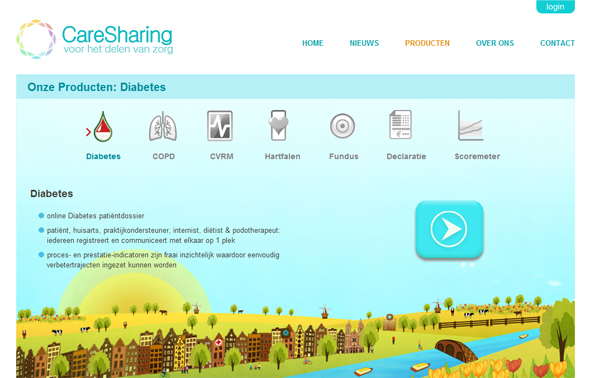
Caresharing began as a project by Simpleteq, a year after its founding. Collaborating with a partner from Netherlands, Mark created a web app for doctors to conduct chronic disease management for conditions like diabetes, cardiovascular diseases, and chronic obstructive pulmonary disease.
Doctors can input patient data into it and share it with their peers or specialists. Lab data can also be uploaded onto the cloud. This is especially useful in patient referrals, which saves the patient time and trouble to dig up obscure information that might have been displaced.
Health practitioners can also use the software to submit data like the number of patients and appointments a month, automating a tedious process that was previously done manually on Excel sheets.
Doctors in the Netherlands were required to submit such information in groups to the insurance companies every quarter, and during that span of time, a conglomerate of 75 doctors could easily see up to 100,000 patients.
Mark and his partner felt they were onto something, and soon developed Caresharing into a full-fledged business in 2009. Today, they are the dominant provider of this kind of software in the Netherlands, serving about a thousand doctors who pay a monthly subscription fee.





Stay updated on the go with our mobile app.
Get latest insights with smoother, more personalized experience through TIA mobile app.