- Premium Content It takes our newsroom weeks - if not months - to investigate and produce stories for our premium content. You can’t find them anywhere else.
 Glenn Kaonang · · 6 min read
Why eSIMs could be the next startup goldmine
During a recent vacation to Laos, Andrew Baisley noticed that booths at Wattay International Airport in Vientiane were exclusively selling eSIMs, not physical SIM cards.
This observation was particularly striking because Laos, a country not necessarily known for being tech-savvy, was already moving toward eSIM technology. Two months ago, Baisley launched his own eSIM company in Singapore called Rockee. (Disclosure: Baisley was a senior executive at Tech in Asia from 2019 to 2021.)
Image credit: Timmy Loen
In recent years, eSIMs have gained rapid popularity across the world, which industry experts have largely attributed to Apple’s release of the first eSIM-compatible iPhone model in 2018 and its decision to ditch physical SIMs in iPhone 14 models for US customers four years later.
But what innovation does eSIM technology offer, and could this translate into a billion-dollar opportunity for Southeast Asian startups?
ESIMs come, eSIMs go
An eSIM, short for embedded subscriber identity module, works exactly like traditional SIM cards, except it doesn’t involve any plastic components to be inserted into a phone.
For some people, the struggle to insert and remove physical SIM cards while traveling to different countries is real, especially if they use iPhones.
ESIM technology relies on a specialized chip called eUICC (embedded universal integrated circuit card) inside a device to store multiple SIM profiles, which are issued by cellular providers. These profiles identify and securely connect the device to their network.
For customers, getting an eSIM is pretty simple: Choose a plan, and then scan a QR code sent by the carrier to activate the eSIM profile.
This means no queuing at airport booths upon arrival or opting for expensive roaming packages – pain points for many frequent travelers. With eSIMs, customers can switch back to the main carrier upon returning to their home country.
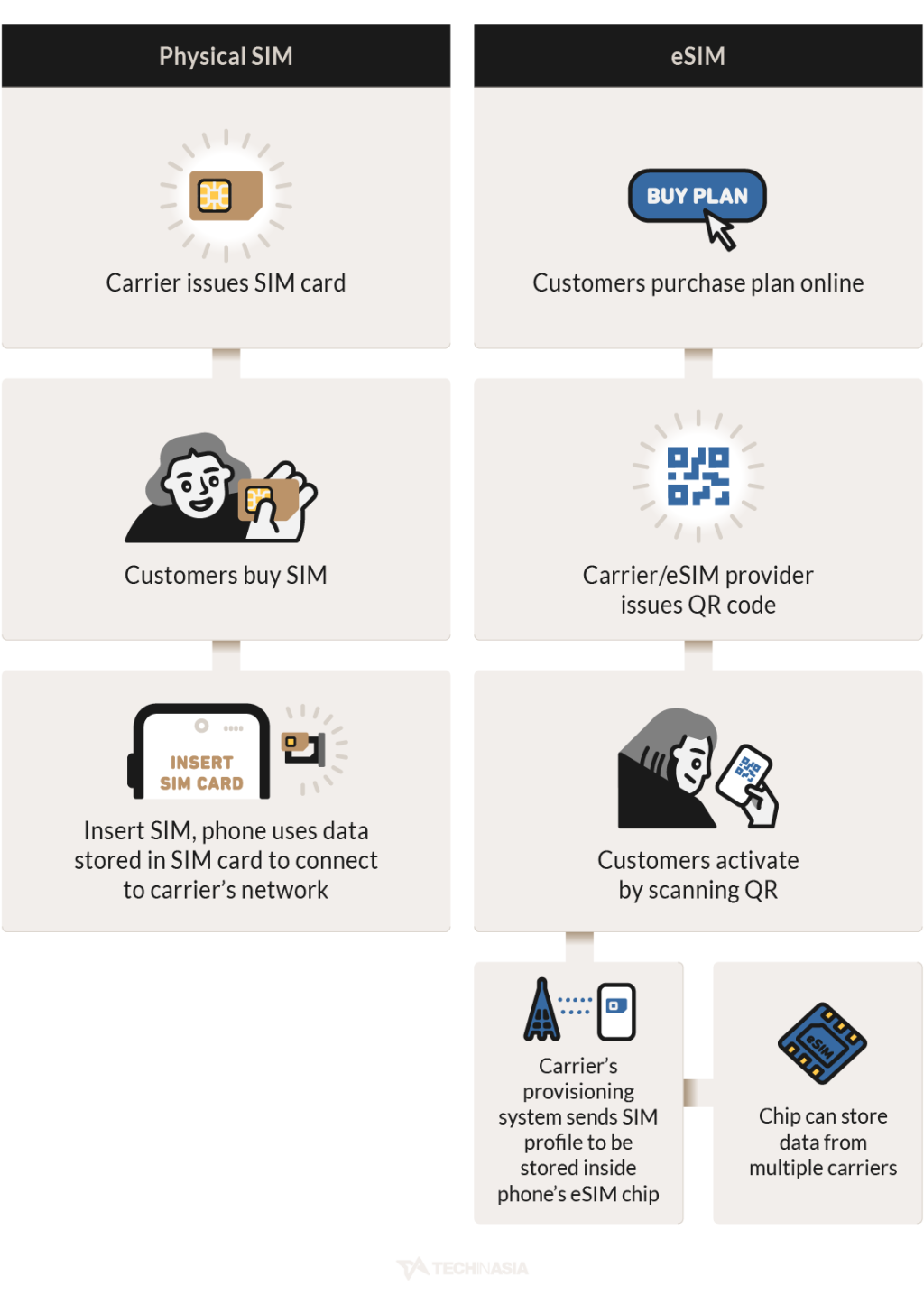
Image credit: Timmy Loen
In Southeast Asia, the travel eSIM sector has been attracting significant investor interest. In July 2023, Singapore-based eSIM company Airalo secured US$60 million in series B funding.
Earlier this month, Jetpac, a travel eSIM division of Circles Life, announced a strategic investment from Japanese telecom provider KDDI. Vietnamese eSIM startup Gohub recently landed US$500,000 in pre-seed funding from Iterative VC and is seeking another US$3 million.
Telcos and eSIM startups: friend or foe?
Are eSIMs the future of mobile connectivity?
Stay ahead in Asia’s tech landscape
This is premium content. Subscribe to read the full story.
To tap into the eSIM market’s billion-dollar potential, will Southeast Asian eSIM startups need to partner with or disrupt telcos?
We know this is not ideal. ⌛ Sign up in 20 seconds. Cancel anytime.
Our subscriber community includes professionals from these companies:





Stay updated on the go with our mobile app.
Get latest insights with smoother, more personalized experience through TIA mobile app.