- Premium Content It takes our newsroom weeks - if not months - to investigate and produce stories for our premium content. You can’t find them anywhere else.
 Qishin Tariq · · 6 min read
Indonesia has 1,500 rural banks. Komunal is bringing them online
At first glance, Indonesian fintech startup Komunal may seem like one of the many companies vying for the country’s millions of underbanked consumers.
But one thing stands out about the firm: its sheer focus on rural customers.
While Komunal is ostensibly a licensed peer-to-peer lender, it is also pioneering a concept called “neo-rural bank” where it helps rural community banks – known locally as Bank Perkreditan Rakyat (BPR) – go digital.
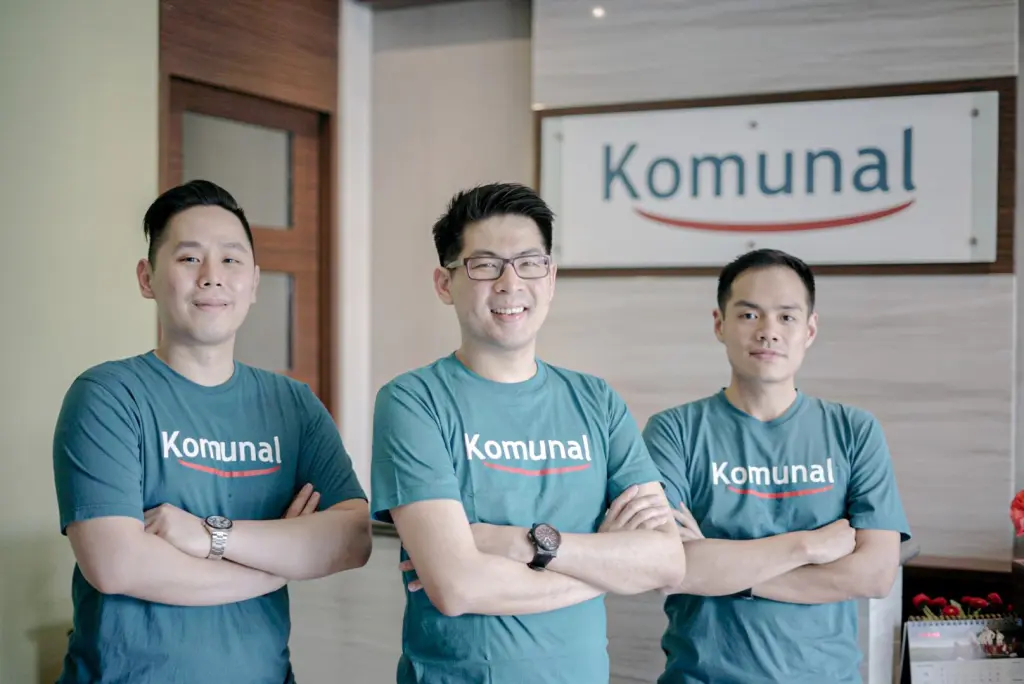
From left: Komunal co-founders Rico Tedyono, Hendry Lieviant, and Kendrick Winoto/ Photo credit: Komunal
It’s perhaps an overlooked but promising space. There are roughly 1,500 BPRs across Indonesia with US$8.3 billion in third-party funds combined.
“These 1,500 BPRs are a sleeping giant waiting to be awakened. With 97% located outside of Jakarta, the potential is enormous,” says Hendry Lieviant, Komunal co-founder and CEO. “Komunal wants to empower, facilitate, and awaken them, and create an ecosystem that all BPRs are willing to take part in.”
So far, the neo-rural bank is working with 140 out of the 1,500 BPRs. It is backed by East Ventures, who led the company’s US$2.1 million pre-series A round in September 2021, as well as its initial seed round.
The rural connection
The Komunal team is made up of co-founders Lieviant, Rico Tedyono (COO), and Kendrick Winoto (commissioner), along with CTO Devin Marco. Prior to establishing Komunal, Lieviant and Winoto were based in Singapore where they worked in lending, finance, and risk management at companies like Goldman Sachs and GE.
When Komunal was founded, Lieviant says, there was a huge gap in fintech development between what was being done in Jakarta and outside the capital city. This was exacerbated by the Covid-19 pandemic, which made it even more challenging for SMEs outside of first-tier cities to get funding to scale.
Though the team wanted to serve these SMEs, available data on them were patchy at best. This led to the realization that the Komunal team would need an “inside man” with ties to local communities.
This inside man would turn out to be the BPRs. Translating to “People’s Credit Bank,” BPRs mainly cater to their local community’s savings and loan needs – including those of SMEs – primarily in rural areas.
Though often viewed as small-time local banks, the Komunal team found that BPRs had a solid deposits product. Owing to its special status in the eyes of the government, these banks are able to offer higher ceiling rates – up to 2.5% higher than commercial banks.
But operationally, these banks remained largely offline, requiring much paperwork and in-person marketing to sign up new customers. This stopped them from aiding many customers and drove up the cost of capital. High operating expenses cut profitability to as low as 3%, even when these banks can earn as high as 14% in returns from loans.
“Imagine a BPR issuing 20 loans a month – you’d need 20 people to process that. Why do you need so much manpower? With digital tools, we can process applications faster and reassign that workforce to generate business instead,” he shares.
Digibanks: competitors or allies?
Stay ahead in Asia’s tech landscape
This is premium content. Subscribe to read the full story.
Operating in an overlooked but promising space, the “neo-rural bank” is reaching underbanked consumers with a local touch.
We know this is not ideal. ⌛ Sign up in 20 seconds. Cancel anytime.
Our subscriber community includes professionals from these companies:





Stay updated on the go with our mobile app.
Get latest insights with smoother, more personalized experience through TIA mobile app.













📅 Upcoming Events
22 October 2026
Payoneer x CSPN Summit 2026