Nathaniel Fetalvero · · 4 min read
How this team won the WeChat Developer Challenge

Kent Lau first heard about the WeChat Developer Challenge in June from his longtime friend Claire Chen, the project director of digital agency Imp Digital.
“A message from Claire popped up in my WeChat window, shouting about the WeChat Developer Challenge,” recalls Lau, who heads brand communication and design firm MadAboutDesign. “She was very excited about it.”
The objective for the competition was to develop WeChat Mini Programs to address the needs of Chinese travelers in Southeast Asia.
Contestants were asked to choose from six challenges, which were designed to tackle specific issues for WeChat partners like Singapore Airlines, Grab, L’Oreal, Singapore Association of Convention & Exhibition Organisers & Suppliers (SACEOS), Resorts World Genting, and Resorts World Sentosa.
Despite Imp Digital’s expertise in developing mini programs for luxury brands like Chanel, the team decided against selecting L’Oreal. Instead, it set its sights on the SACEOS challenge, which tasked the team with enhancing the attendee experience at business and lifestyle events.
Chen thought this issue was more exciting. “Nobody has done this kind of mini program before,” she claims.
Combining the digital and physical events experience
Under the MadAboutDesign brand, the team built a SACEOS mini program called SmartWDC, a platform that aims to enhance Chinese travelers’ exhibition experience from the pre-event to post-event stage.
By using SmartWDC, users will be able to find information on the event, register for it, and even pay for entrance. WeChat’s user authentication process, which requires accounts to be tied to verified identification documents, reduces the risk of spam and fake registrations for event organizers.
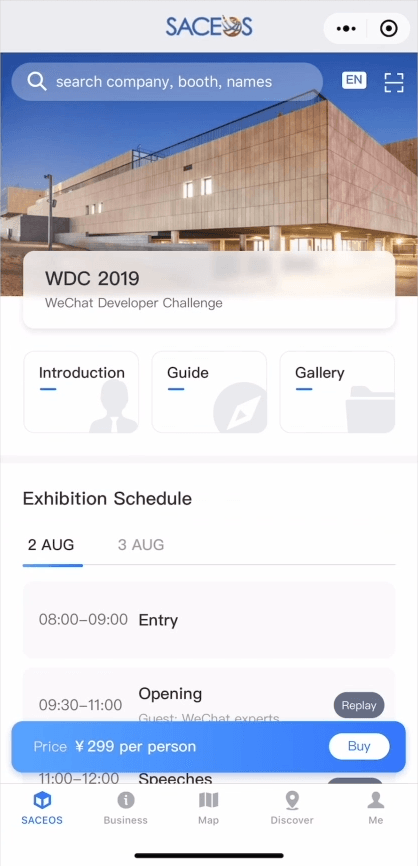
Photo credit: MadAboutDesign
Lau and Chen’s mini program also allows users to browse from a list of other participants and set up casual meetings through its “business matching” feature. They will be able to add contact details and a short biography on their personal profiles for other users to see as well.
Along with access to exhibition schedules and details on event speakers, attendees can also look up food and attraction recommendations within the vicinity of the venue.
Choosing what features to leave out
In the challenge’s development stage, MadAboutDesign consulted SACEOS to uncover the pain points that event participants usually face. However, the team ultimately decided against developing features for all the issues.
“[SACEOS] wanted to build a lot of features that we thought weren’t good to combine in one mini program,” shares Chen.
One of these was a community section.
“Once they’re connected, people just want to get out of the system and create their own private groups on platforms they’re more familiar and comfortable with,” says Lau, who has experience in building communities as the secretary general of the Singapore Chamber of Commerce and Industry in China.
Chen adds that business people typically don’t have the time to share or post in a mini program, anyway. “If we built a community, the people posting may not have good, high quality content.”
Another feature the team didn’t develop was instant messaging.
“If they want to meet each other, they can just send an invitation on the business matching function and meet offline,” Chen says.
Clinching the grand prize
Despite limiting what its mini program can do, MadAboutDesign beat out 29 teams, winning the competition’s US$10,000 grand prize.
“It made everyone’s hard work – for those days we stayed up all night to build our solution and improve on the presentation – worth it,” says Chen.
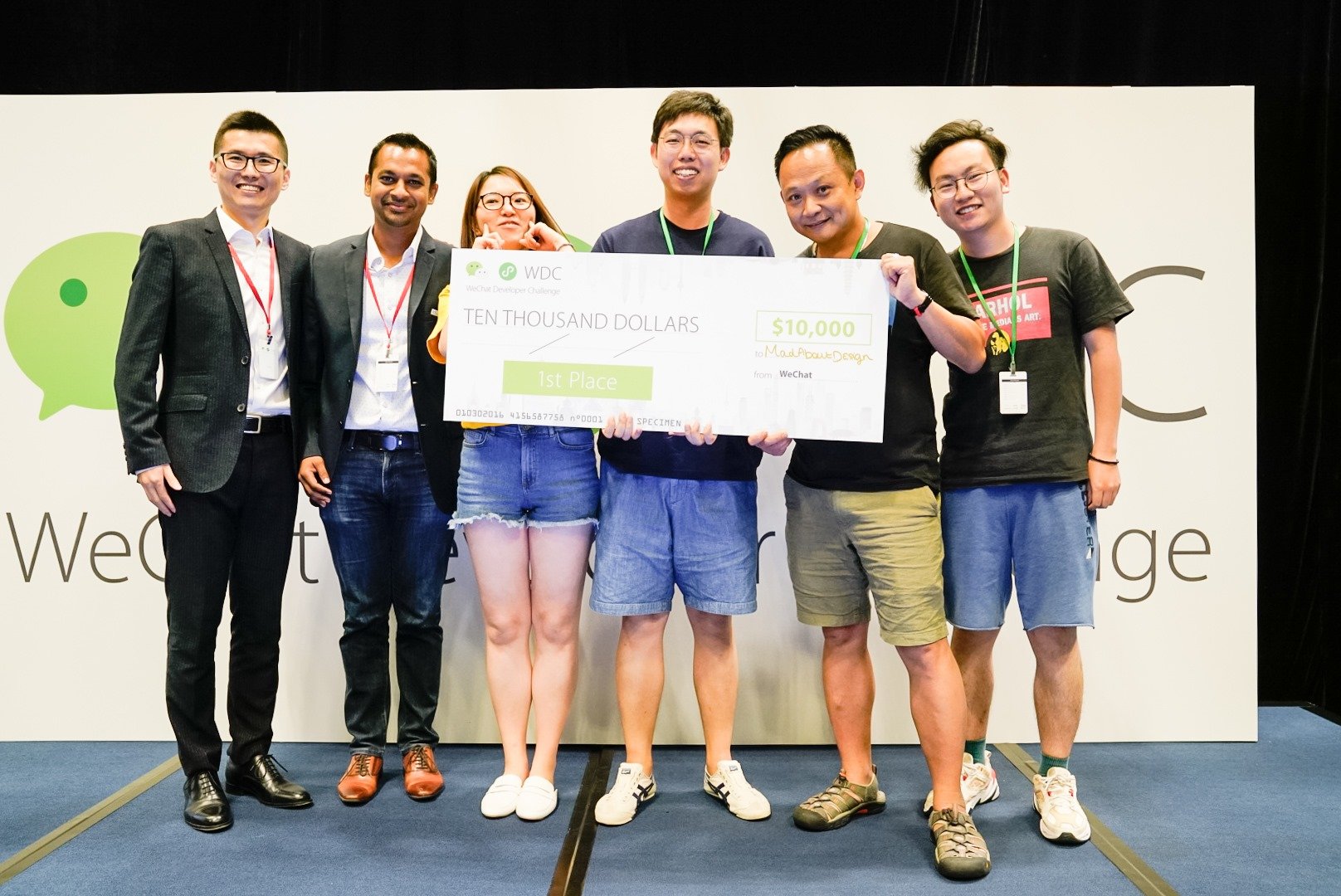
Photo credit: WeChat
She adds that in the team’s communication with the WeChat team, it’s been able to glean insight into the chat giant’s future direction, which will help her in her work at Imp Digital in developing mini programs for its clients.
Moving forward, both Lau and Chen hope that SmartWDC can have real-world applications with either SACEOS or other event organizers.
“We didn’t do this app just for the purpose of the competition,” says Lau. “SACEOS has the first right of refusal, but we certainly hope that this is a solution that, in one form or another, can benefit users across Asia or even the world.”
The WeChat Developer Challenge is a Tencent initiative that aims to develop mini programs based on current challenges faced by its partner businesses. The goal of the challenge is for these mini programs to address the needs of Chinese travelers in Southeast Asia.
Learn more on the WeChat Developer Challenge website.
Stay updated on the go with our mobile app.
Get latest insights with smoother, more personalized experience through TIA mobile app.
Recommended reads
 Indonesian AI startup goes global
 Forrest Li on scaling Sea, building smarter bots, and founder grit
 An AI assistant that joins sales calls and scores team skills
 Beyond the check: Why VCs need more than capital
 SGX’s CEO says it doesn’t need a unicorn to win
 SMEs want AI too, but not the kind Big Tech is selling
 Oatside’s alt-milk rise hits a profitable gear
 Alibaba’s financial health in 12 charts
 Asia’s telcos bundle AI into mobile plans. Will it pay off?
 M-Daq chases bigger clients as revenue falls, losses grow





Editing by Jaclyn Teng and Eileen C. Ang
(And yes, we’re serious about ethics and transparency. More information here.)