Paul A. Christensen · · 5 min read
He built robots as a teen. Now he’s rethinking how they’re tested
This article is part of our series, The Backstory, where we sit down with founders, operators, investors, and community builders who are doing something out of the box. The goal is to uncover how they’re thinking about and solving real-world problems, and how they got there.
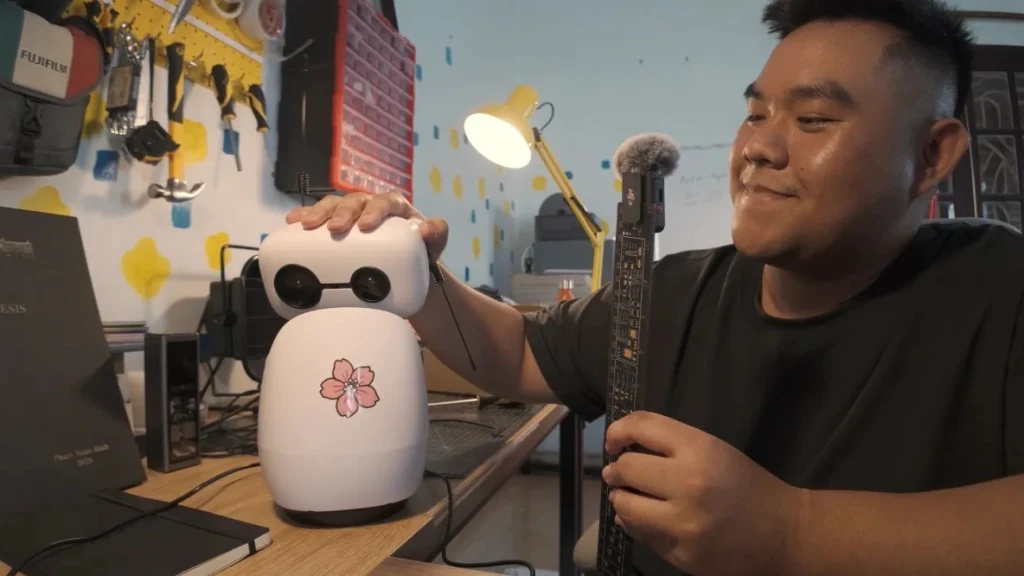
Photo credit: Binh Pham
Vietnamese robotics engineer Binh Pham was writing in the programming language C++ in 6th grade and running web infrastructure from a server in his bedroom in Hai Phong by 10th grade. When the then-teenager tried to get his smart aquarium lighting system made, manufacturers politely turned him away.
He kept building anyway: 3D printers designed from scratch, brain-computer interface devices and, in his first semester at university, work in Ericsson’s Innovation Department on its 5G data plane.
Now a software and robotics engineer at developer platform LiveKit, he works on getting robots deployed in the real world. We speak to him about what he traded to move fast, his gripe with performative tech culture, and why he believes robot testing has to leave the lab.
In brief
- Biggest moment: Raising US$500,000 from VC firm South Park Commons and incubator FR8, four months into building a robotics startup, before leaving the company
- Where you might have seen him: Hackaday and Hackster.io, which have both featured his builds, including a local AI language model running on a USB stick
- Key achievements: Built a Pixar-style desk lamp robot from scratch and trained its reinforcement learning policy in two weeks
This interview has been edited for clarity and brevity.
You’ve gone from building 3D printers in high school to working on robot deployment at LiveKit. What pushed you from tinkering to real-world embodied AI work?
I never moved away from tinkering. When I was in high school in 2019, I designed 3D printers from scratch. In my first semester of university, I worked on Ericsson’s 5G data plane, which handles hundreds of gigabits per second. I built brain-computer interface devices at Hungary’s national research center. That’s all tinkering.
To me, tinkering is just having fun with something, and that something can be very hardcore. I’d rather describe myself as someone passionate about problem-solving, which means I end up tinkering a lot. If you don’t have to tinker, you’re probably working on an easy problem.
AI infrastructure is hard and overlooked. Good research baselines are becoming commoditized, but deployment is still in its infancy. No one really knows how to deploy general robots in the wild. That’s what I’m working on with folks at LiveKit.
You build fast as a solo hacker, but LiveKit needs production-grade systems. How do you reconcile the two?
Moving fast no longer has to mean breaking things. Agents make the expensive, boring parts of engineering cheap enough to do while I focus on experiments. In under a week, I can explore multiple designs, check their behavior with formal methods, and build simulations before committing. None of those methods are new. They’re just cheaper now.





Stay updated on the go with our mobile app.
Get latest insights with smoother, more personalized experience through TIA mobile app.